Lesson #13 – This week’s recap!

Every Sunday, we will recap the lessons of the week. Before we do that, I would like to thank each of you for your desire to learn and to implement this financial information into your lives and into the lives of the people that you love. We are sowing seeds and expecting a great harvest to reap.

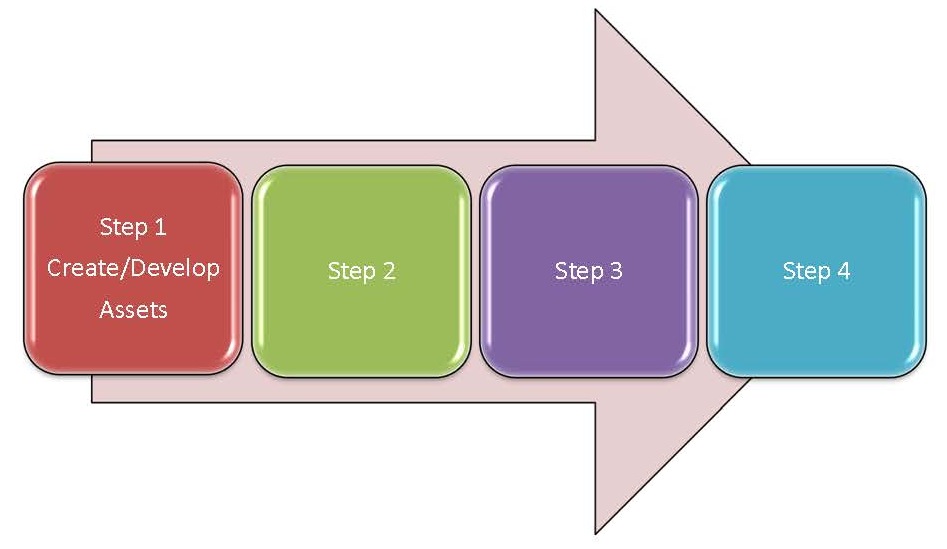
We are still in Step One or Phase One of the building wealth continuum – Creating/Developing Assets. We will continue discussing other aspects of this phase in the week to come, but for now, let’s recap what we learned this week.

Education:

Monday, January 27, 2014
Lesson #7 – Vision Setting

Tuesday, January 28, 2014
Lesson #8 – Exploring Savings Alternatives

Wednesday, January 29, 2014
Lesson #9 – The asset you sleep in!

Thursday, January 30, 2014
Lesson #10 – Is you HOUSE underwater?

Friday, January 31, 2014
Lesson #11 – Should I rent or buy?

Saturday, February 1, 2014
Lesson #12 – Let’s play Financial Football to test your financial knowledge.

Action Step: To cheer on Peyton Manning and the Denver Broncos. Go Broncos!

Lesson #12– Let’s play Financial Football to test your financial knowledge.

 photo 2

Word hard, play hard!

It’s Super Bowl time, so let’s test your Super financial knowledge!

Anyone who knows me, knows that I am an avid football fan (let’s say ‘glorified junkie’).  On the eve of Super Bowl XLVIII, I cannot think about anything other than football and team winning the game.  Although my beloved Tampa Bay Buccaneers neglected to make it to the big dance this year, my favorite QB of all time, Peyton Manning, will lead the Denver Broncos to a victory tomorrow.

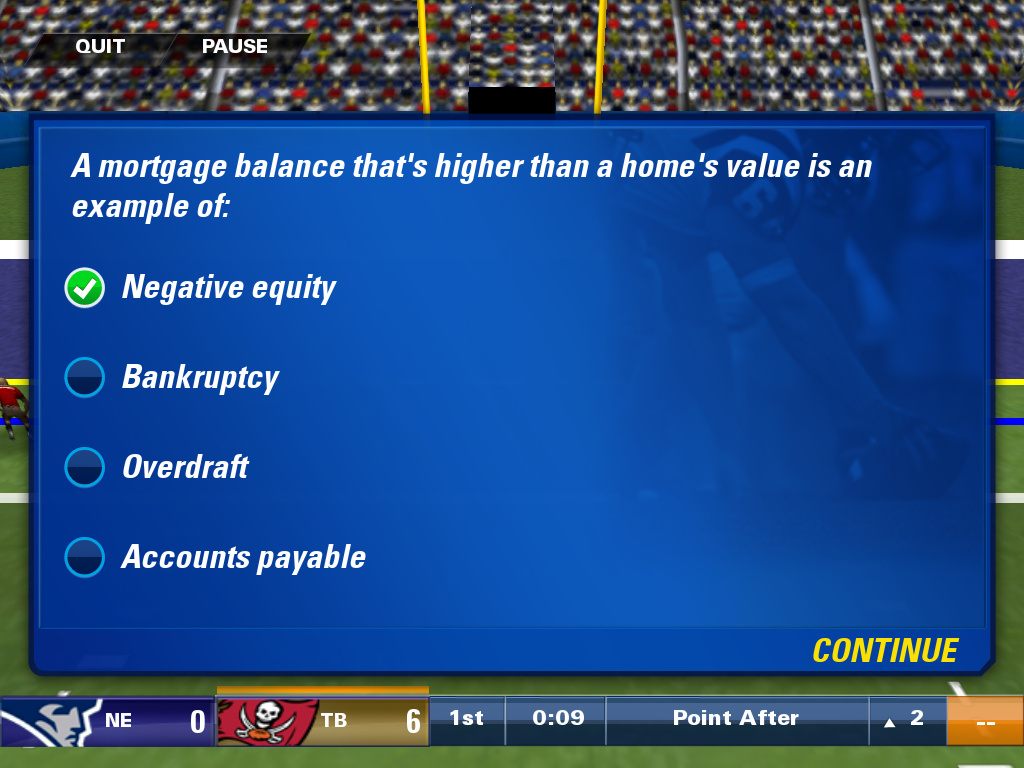
I have been playing this game nonstop since the release earlier this week.  Check out the question asked that we discussed in Lesson #10.

photo 1

Education:

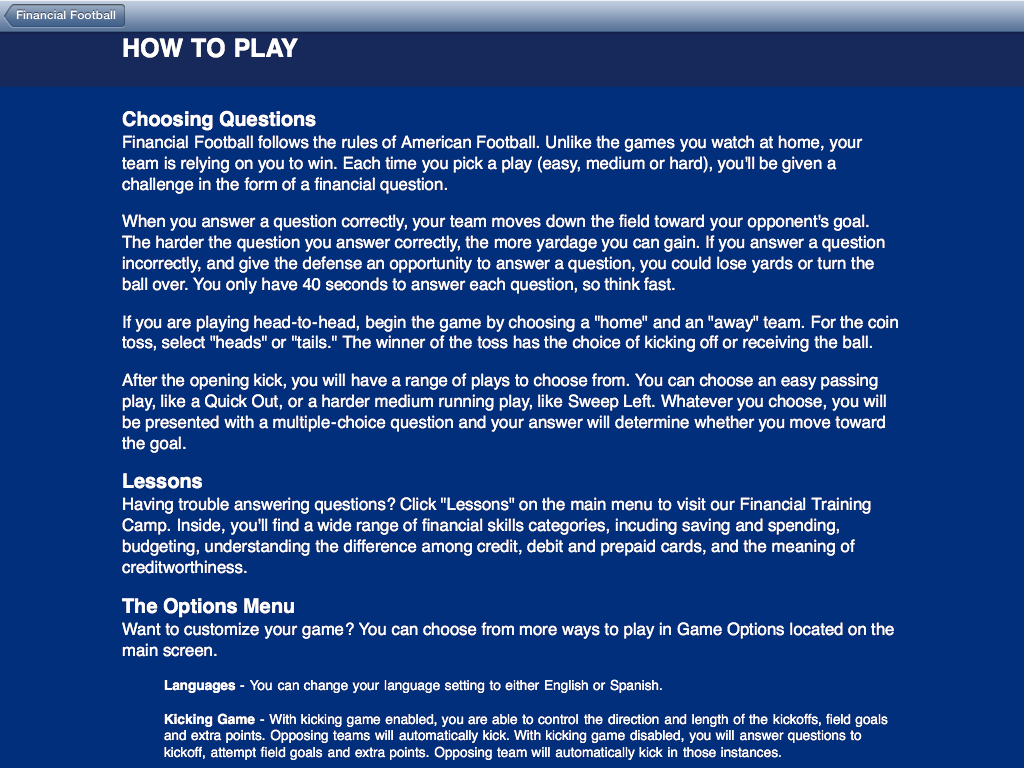
Today’s lesson will test your knowledge of financial information.   You have worked hard all week with demanding lessons, so let’s unwind today.  Financial Football is part of Practical Money Skills for Life (www.practicalmoneyskills.com) a free, award-winning financial education program that reaches millions of people around the world each year.

 photo 4

Resources: 

Practicemoneyskills.com – A website to help consumers and students of all ages learn the essentials of personal finance.

Important terms from this lesson:

Term

Definition

FUN No definition needed!

 Action Step:       Download and play the Financial Football game.

Today is about having fun, so grab the kids and play Financial Football. 

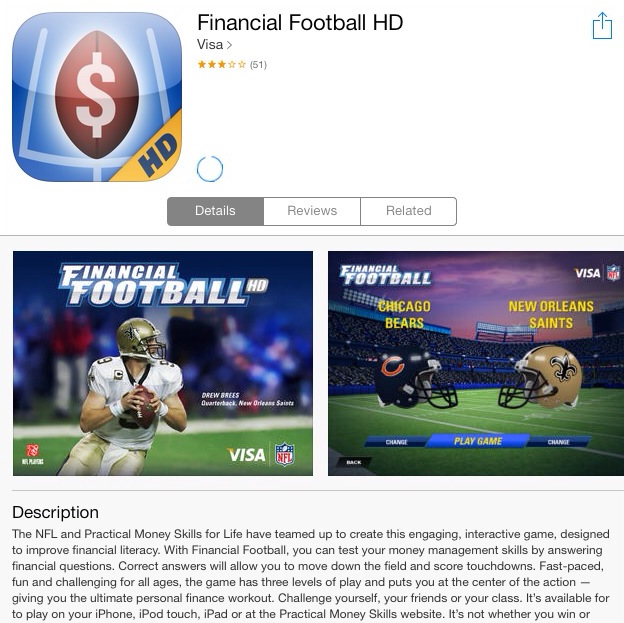
Available online at www.practicalmoneyskills.com/financialfootball, Financial Football puts students’ fiscal knowledge to the test in an online simulation game environment by combining the structure and rules of the NFL with financial education questions of varying difficulty. Visa has also released the game as a free iPhone app on iTunes, along with an optimized HD iPad version.

photo5

Lesson #11– Building wealth – Step 1: Create/Develop Assets – Should I rent or buy?

To RENT, or to OWN, that is the question—

In Lesson #10, we focused on the homeowner, but what about the people who are trying to decide if homeownership is for them?  Personally, I believe that a home provides more wealth that can be enumerated; however, it is NOT required to be wealthy.  There is no place where this is more truthful, than in New York City where many wealthy people still rent.  If this sounds like a setup, then let me assure you that it is not.  Buying a home may not be the best option for everyone and the truth is that it may ‘not’ save you money, it may ‘not’ be a factor for wealth creation, it may ‘not’ offer the best rate of return, and so on.  It is important that you understand the cons of homeownership as much as the pros.

Education:

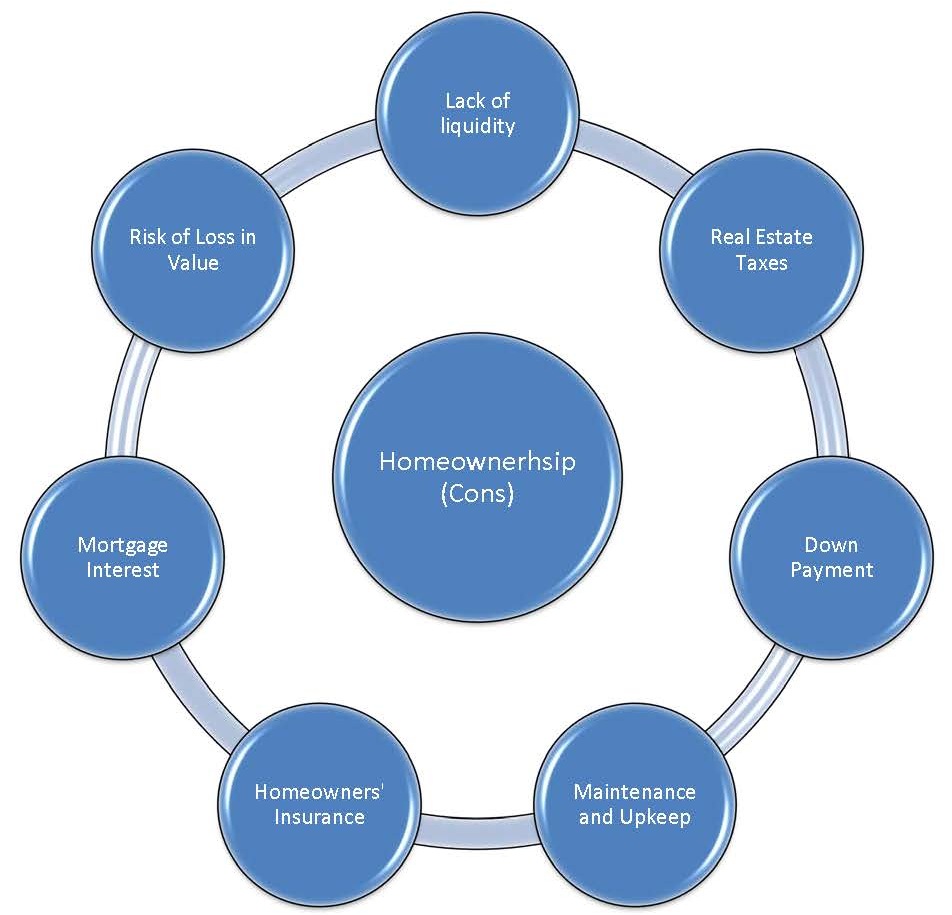
A house can be a wonderful thing and in the last two lessons, we discussed the upside (pros) of homeownership, but there is also a downside.    The diagram below depicts some of the additional burdens that come with homeownership.

 photo

Hands down, the absolute best explanation that I have seen on this topic comes from Khan Academy.  Please take a moment to view this video because Khan will totally change the way that you think about the rent versus buy conundrum.

Resources: 

Khan Academy  – Not-for-profit with the goal of changing education for the better by providing a free world-class education for anyone anywhere.

Important terms from this lesson:

Term

Definition

Lack of Liquidity The inability to convert an asset to cash, if needed to take advantage of an alternative investment strategy or if cash is just needed.

 Action Step:       Click and Complete!

Go to http://www.kmsykescpa.com/calc-section.php?calc=hom06)

Complete the worksheet to help determine which makes sense for you at this time – to RENT or to BUY.

Lesson #10– Building wealth – Step 1: Create/Develop Assets – Is you HOUSE underwater?

After yesterday’s lesson, I received the following comment and question.

Comment:  I know the depreciation due to the horrid market. That now investment property is a loss.
Question:  How do we mitigate the risk if our numbers are bad?

Are you Underwater? 

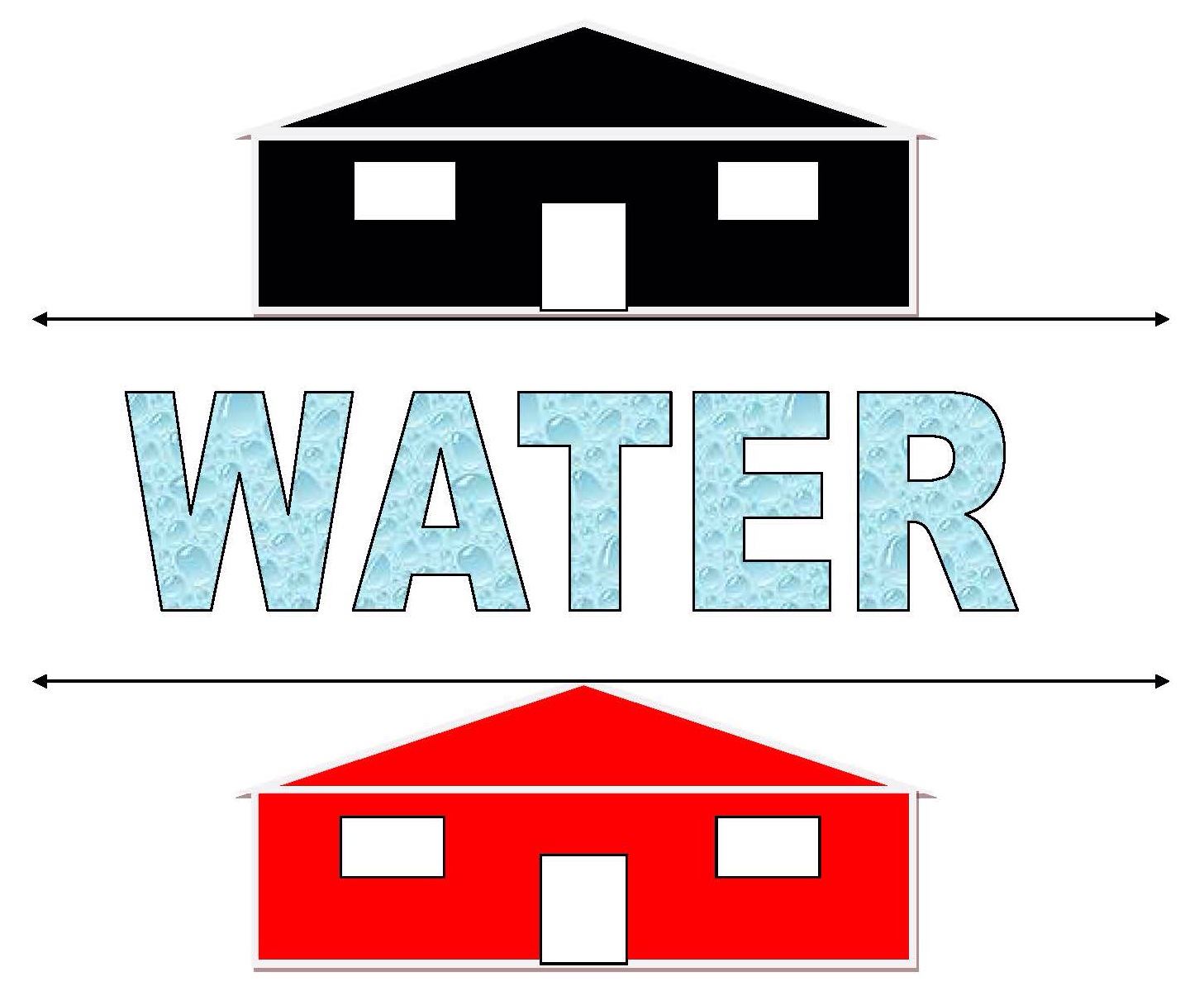
 HOUSES

The black house is a house of equity (possibilities), the red house is house of decisions (risk mitigation).  In the black house, that is what we call ,“being in the black” and your equity gives you additional flexibility like “refinancing”.  The red house is self-explanatory and although I love the color red, it’s never good when it comes to “being in the red” on your home.

Education:

Yesterday, we spoke about the equity and appreciation in your home, but after the housing crash of 2008, this may no longer apply to you.  The truth is that the economic crisis left many homeowners “underwater”, a condition which results when the amount that you owe on your  home (mortgage) is greater than the fair market value of your home.  That is just a fancy way of saying that even if you sold your home,  you would still owe money to the bank.  What?  Yes, you could give up your home and still owe money on it. What?  Yes, it’s true, but there are ways to mitigate this if you understand the strategies available to you.  Let’s call this the Underwater Mitigation Strategy (UMS).  First let me say that this is nothing to be embarrassed about because this affected millions of homeowners, some who have had to make tough decisions.  To determine the best UMS for you, let’s review the chart below.

Strategy

Pros

Cons

Tax Consequences

Stay and Hold

You keep the house (shelter) and wait to see if the value rebounds. An increase in value can restore your equity. This delays the UMS. You may never recover your lost equity, you are paying for something which lacks value, refinancing usually is not available until equity is restored. None

Loan Modification

The lender helps you stay in your home. Government offers programs to assist you like the Home Affordable Modification Program (HAMP) Requires approval and the lender may not be willing to work with you. None for now

Refinance

Same as Loan Modification May not be a good option for homeowners with negative equity.  

Sell or short sale (no bank approval)

Get rid of the cause of your stress. You must find a new place to live; you still owe money to the bank (difference between what you received on the home and the mortgage); May trigger COD; Negative affect to your credit COD Income MAY result in a tax bill in the worst possible time (income without cash)

Walk away (deed in lieu)

Get rid of the cause of your stress by giving the house back to the bank, but you walk away owing nothing else. You must find a new place to live; Requires bank or lender approval which is hard to get; No real impact on credit None

Foreclosure

You get to stay in the house during the foreclosure process. You must find a new place to live; you still owe money to the bank (difference between what you received on the home and the mortgage); May trigger COD; Negative affect to your credit COD Income MAY result in a tax bill in the worst possible time (income without cash)

Bankruptcy

You may be able to stay in your home.  Gives you additional time to make a decision. Won’t erase mortgage debt;  may eliminate other debts which will allow you to afford your mortgage; None for now


Resources: 

Makinghomeafforable.gov – The Making Home Affordable Program  (MHA) ® is a critical part of the Obama Administration’s broad strategy to help homeowners avoid foreclosure, stabilize the country’s housing market, and improve the nation’s economy.

 Important terms from this lesson:

Term

Definition

Underwater Mortgage or Negative Equity Mortgage balance exceeds the current market value of the loan.
Short Sale Selling the home for less than then the mortgage balance.
Deed in Lieu Strategy which allows you (upon approval) to simply give the home (deed) back to the lender and walk away fairly unscathed.
Cancellation of Debt (COD) Income Phantom, but potentially taxable income which results when you sell the home for less than the mortgage.  The difference between the mortgage balance and the amount received on the short sale OR for foreclosures, the entire unpaid mortgage.

 Action Step:       Find out if you are underwater.

Before you can address it, you must first diagnosis it.  Pull up yesterday’s worksheet on Equity and Appreciation.  Drop in your numbers to determine if you are underwater.  If you are, then go through the UMS chart and determine which option or options may be best for you.

Go to http://www.makinghomeaffordable.gov to see if you qualify for a program.

Lesson #9– Building wealth – Step 1: Create/Develop Assets – The asset you sleep in!

Let’s take a quiz!

What do the following three songs have in common?

1. Brick House

2. Love is a House

3. A House is not a Home

Did you figure it out?

They all reference the asset that is the epitome and cornerstone of wealth building, the home.  The three little pigs huffed and puffed about it, Dorothy clicked her heels to get back to it, Diana thought of home and so should you!  A house is a magical thing because it has triple purpose.  You can live in it, you can make money with it or you can use it to cease new opportunities in other areas of your life.

When you examine the net worth of wealthy individuals, they generally share one thing – they all own real estate or real property.  There is that word again, OWN.  Unless you live in New York, LA, San Francisco or some other city where home prices are ungodly, wealthy people do not rent because as we learned in the last lesson, your money should work while you sleep.  What is a better illustration of money working while you sleep than in a house?   A home can be a house, condominium, cooperative apartment (prevalent in urban areas like NY), or investment property.  Speaking of wealthy people, here is a picture of the house Tyler Perry purchased for $7.6 million dollars that I add to inspire you.

 Dean-Gardens-Hooked

A home falls into a category of assets called ‘real estate’, which is property consisting of lands, buildings, mineral rights, and the like.  This lesson and the next will be dedicated to discussing this asset because you should either be a homeowner now or a future homeowner.

How do I make money with a house?  I am glad you asked.  Here is how.

  1. Appreciation
  2. Equity

Homes generally appreciate.  That simply means that the value of the property increases while you live in it.  To illustrate how appreciation works, if you purchase a house for $100,000 and then someone comes to you and offers to pay you $120,000 for your house, the difference is appreciation.  In that case, you made a cool 20% profit simply from appreciation. That is new money or new wealth that you created.   We will continue discussing real estate in Lesson #10.

Resources:

  1. Zillow.com                  – Online real estate database.

Important terms from this lesson:

Term

Definition

Real Estate or Real Property Property consisting of lands, buildings, mineral rights and the like.
Appreciation The difference between your original purchase price and the fair market value of the home.
Equity Your investment or ownership in the home.  The portion that is not subject to mortgage…you own it outright.
Fair Market Value (FMV) The price that you receive if you sold your home TODAY. The price that a willing, unrelated third party would pay creates its ‘fair’ market value.

Action Step:       Dual assignment based on whether you already own a home.

For Home Owners – Figure out the amount of Equity and Appreciation in your home.

  1. Equity = (Fair Market Value of Your Home Today – Your Mortgage Balance)
  2. Appreciation = (Fair Market Value of Your Home Today – Your Original Purchase Price)

You should always know this.  To find the fair market value, go to Zillow.com and type in your address.  They will give you a little guidance about what your house would sell for today.

For Future Home Owners – Find a picture of a home and put it on your Vision Board.  Then make a goal that you will purchase a home in ________ years.

Lesson #8 – Building wealth – Step 1: Create/Develop Assets – Exploring Savings Alternatives

Make you money get a job…make it work…while you sleep!

Did you know that a dollar a day could grow into a million dollars?

Now that I have your attention, I want to teach you to RESPECT YOUR DOLLARS!

In Matthew 25:14-30, Jesus teaches the timeless Parable of the Talents.  You can and should read it for yourself, but it teaches the principal of being profitable and that no matter what you have, it can be increased if invested properly.  Verse 25:27 in particular reads, “So you ought to have deposited my money with the bankers, and at my coming I would have received back my own with interest.” Wow, the bible never ceases to amaze me, but in this instance, Jesus was actually acting as a financial advisor by giving very sound advice.  I will let the theologians analyze that, but I will take the lesson at face value.

Now that you have diagnosed your financial health through your net worth, found a ripple through your cash flow budget and created a vision, you are ready to begin the real work.  In this lesson, I would like to teach you about the different methods to save your money and earn INTEREST…that is putting your money to work.

First, think about money as a seed.  If you hold the seed in your hand, then it will remain just a seed and/or die. However, if you plant or sow the seed, then the seed has the opportunity to grow and produce fruit.  For financial purposes, WE WANT FRUIT!  Fruit will enable you to reach your goals and live a life of financial freedom. Fruit creates more fruit!

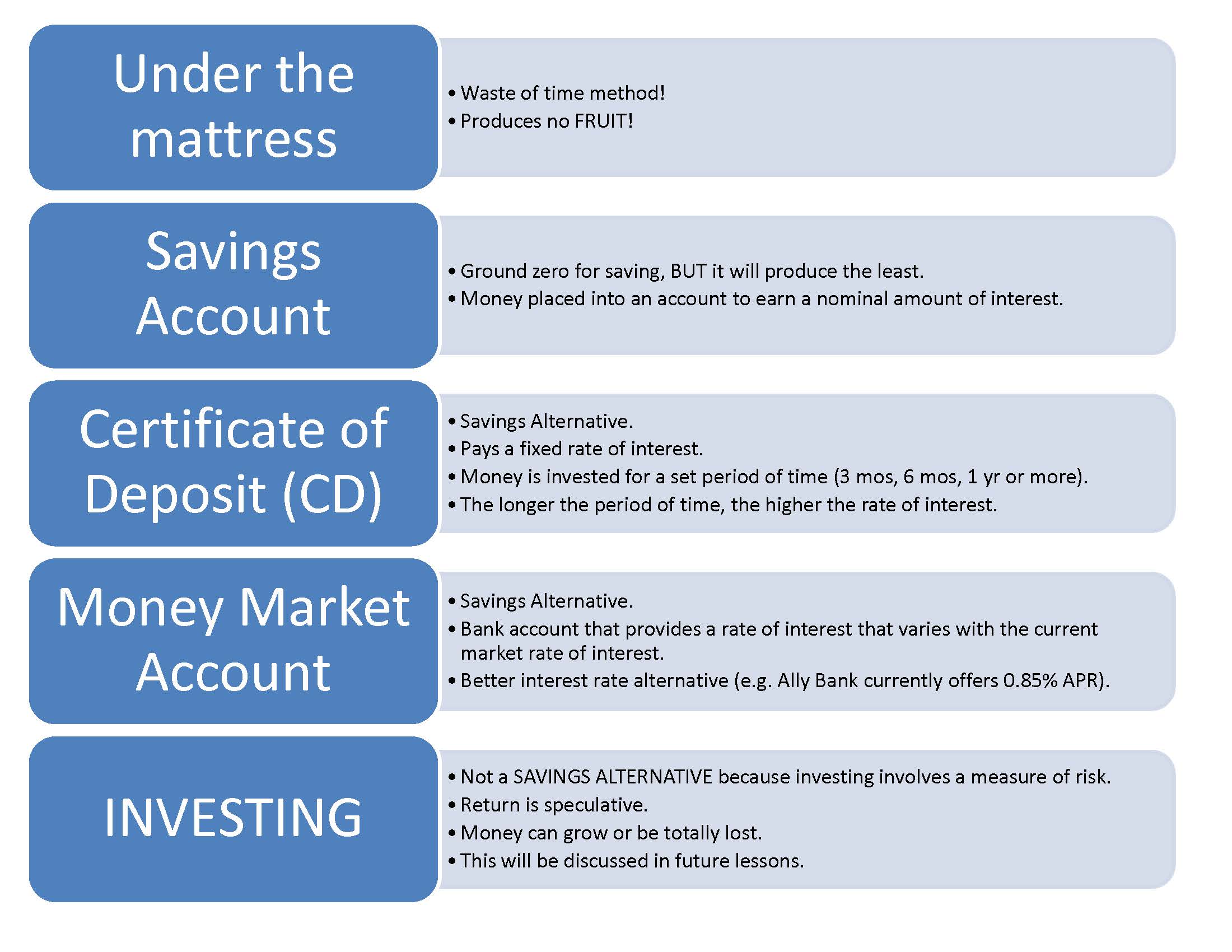
Here are some Savings Alternatives that you may aid you to produce fruit.

 Savings Alternatives

Resources:

  1. Bankrate.com    – Great consumer finance website to compare financial products.
  2. Ally.com               – Offers competitive rates for its savings, CD and Money Market Accounts.

Important terms from this lesson:

  1. Interest                – Return on the use of your money
  2. APR                        – Annual Percentage Rate is the rate that you will receive if your money is invested for a full annual period. For example, if you invest $1000 at a 1% APR, you would earn $10 annually on your investment.

Action Step:       Pick a Savings Alternative for 2014.

  1.        Go to bankrate.com
  2.        Click the BANK ACCOUNTS tab.
  3.        Play with the menu options to see the different savings alternatives available to you.
  4.        Pick a new one for 2014 and begin saving today.

Lesson #7 – Building wealth – Step 1: Create/Develop Assets – Vision setting

“Vision without execution is hallucination.”  – Thomas A. Edison

Yesterday, we kicked off Step One of our journey to create and develop assets.  In the last lesson, I asked you to create your monthly cash flow budget.  The budget is such a vital part of this process, so please continue working on that until you have an honest depiction of your monthly income and expenses. You cannot save or invest, if you don’t first find a ripple (refer to Lesson #6).

I found this quote in 2013 and it was an aha moment in my life.  “Vision without execution is hallucination”, has become my personal mission statement.  With that said, I would like to turn the quote around a bit and say, “execution without vision is a prelude to failure”.  That was my wrinkle to the quote, but it is germane to our goal of ‘financial freedom’.

I want you to envision financial freedom and what that would look like in your life.  I challenge you to document this vision on a VISION BOARD.  Here is a picture of a vision board on Oprah. images

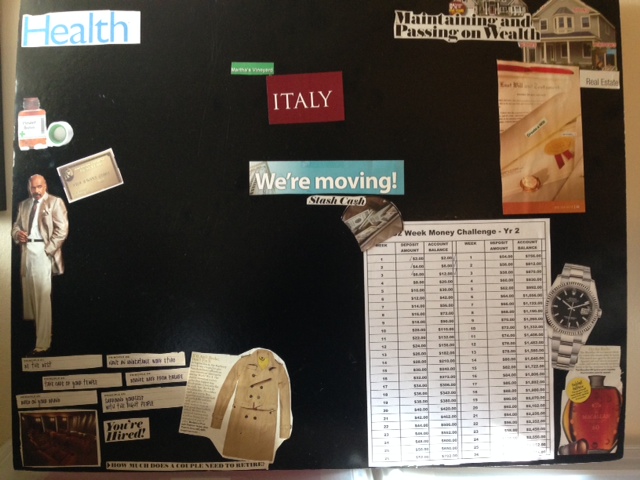
Here is a copy of my Vision Board for 2014 that I’m working on.  As you will see, it is not yet finished because this is my process.  When I find items that line up with my vision, they go on the board.  Remember the movie, Field of Dreams?  Well, this is my canvas of dreams.  a tangible reminder of my goals and when I sacrifice a moment of instant gratification, then I can go back to the board and be realigned by seeing my goals.

photo

Important terms from this lesson:

1.       Vision Board      – Visual canvas depicting your goals.

Action Step:       Create your VISION BOARD for 2014!

  1. Go to a local store (CVS, Rite Aid, etc.) and purchase a poster board and either glue or tape.  It doesn’t have to be fancy.
  2. Think about why you are embarking on this journey.  What are your goals?
  3. Begin finding items, clippings, articles, affirmations, or anything that reminds you of your goal.  Throughout 2014, I want you to add more and more things to the board.  At the end of this process, I want to help you see a way to manifest these items in your life.

Lesson #6 – Building wealth – Step 1: Create/Develop Assets – What is your monthly cash flow?

“You have to do something if you are going to get something.” TD Jakes

Ecclesiastes 7:12 “For wisdom is a defense as money is a defense, But the excellence of knowledge is that wisdom gives life to those who have it.”

Ecclesiastes 10:19 “A feast is made for laughter, and wine makes merry; But money answers everything.”

  • Money is provision.
  • Money is protection.
  • Money must be tied to purpose.

 photo

The first step to a life of wealth is the creation and development of assets.  The first few lessons were to introduce and explain the concept of assets.  To create something to OWN, we must assess what materials or resources are currently available to you.  We began with net worth to enable you to diagnosis the current state of your wealth.  Now it is time to roll up your sleeves and get to work. What resources do you have now?  Do you know?

A cash flow statement can help you evaluate your personal income and expenses and see if you are running ‘in the red or the black’ each month.  This will help you free up money to save or invest.  A wave first begins with a ripple.  In this lesson, let’s find the ripples.

cropped-ripple-full-size

Important terms from this lesson

1.       Cash Flow Budget   – An estimate of income and expenditure for a set period of time.

Action Step:       Create your monthly cash flow (budget) statement.

  1. Pull out your last three monthly bank and credit card statements.  (This will help you  pull the information to complete the cash flow statement)
  2. Go to http://www.kmsykescpa.com/calc-section.php?calc=bud09 and enter the information, then hit submit to generate your monthly or annual cash flow statement.
  3. Print out the completed statement, date and sign it.
  4. Find an area or category that you can exploit or cut-back.  This will be your first ripple.
  5. Challenge yourself and see if you can find at least three ripples to save $200 for the first month.

Ripple #1:____________________________________________________

Ripple #2:____________________________________________________

Ripple #3:____________________________________________________


Lesson #5 – Find a role financial role model!

“Whatever you can do, or dream you can, begin it; boldness has genius, power, and magic in it.” (Goethe)”

Saturday is a day of rest and reflection for many of us.  Today, I encourage you to become a student of the lives and teachings of successful people.  The only way to transform your financial life, is to do the work.  A part of that work is finding your financial role model.  Today’s lesson is to listen to a financial giant who teaches on wealth and success, Tony Robbins.

Important terms from this lesson:

1.       Financial Freedom                      –  Having enough wealth to live a life without limitations.

Action Step:       Find a financial role model!

My financial role models are Oprah Winfrey and Sean “Diddy” Combs, two wealthy individuals who came from meager beginnings to build successful lives of wealth, influence and prestige.

Who is your financial role model?  Learn about this person, follow them, read about them, hang a picture of them in your cubicle or office (okay, that’s a bit much), but you get the picture.  Remember when Rocky was going to fight the Russian in Rocky IV (one of my favorite movies)?  Well, he hung a picture of him on his mirror as his daily reminder of his goal.  Once you decide on your financial role model, make them a focal point of motivation.


Lesson #4: What is your net worth?

Image

Income inequality is a false precept! I know the politicians, namely the Democrats, pontificate about “income inequality” in an effort to arouse the electorate, but check this out.

 “At least 268 of the 534 current members of Congress had an average net worth of $1 million or more in 2012, which amounts to just over half. The congressional median net worth was $1,008,767.”
 

The top 10 richest members of Congress; Average Net Worth (rounded to the nearest million):

1. Darrell Issa (R-Calif); $464 million
2. Mark Warner (D-Va.); $257 million
3. Jared Polis (D-Colo.); $198 million
4. John K. Delaney (D-Md.); $155 million
5. Michael McCaul (R-Texas); $143 million
6. Scott Peters (D-Calif.); $112 million
7. Richard Blumenthal (D-Conn.); $103 million
8. Jay Rockefeller (D-W.Va.); $101 million
9. Vernon Buchanan (R-Fla.); $89 million
10. Nancy Pelosi (D-Calif.); $88 million

(Note: Taken from Slate.com article entitled “Most Members of Congress are Millionaires” by Katie Long)

So don’t be fooled!  The reason that income inequality is a false precept is that there is no equality in sacrifice or effort.  If you bust your hump, sacrifice instant gratification in pursuit of your goal and your income increases because of that, should someone who did not do those things have an income equal to yours?  Certainly not!

Income inequality should be rephrased to “Opportunity Inequality”.  That gap can be closed through education and information. So instead of politicians advocating against wealthy people, they should work to promote “Opportunity Equality” or teach us how they created their wealth.

Did you know that there are 85 people who are as wealthy as half the WORLD?  If you don’t believe, read for yourself at http://huff.to/1dUFcD4.  But I say, DON’T HATE…EMULATE!  The reason that these individuals are wealthy is because they are ASSET RICH…remember that term from Lesson #1?  Instead of envying them, we need to follow their model.  Many of them achieved wealth through business, some through real estate, some through investments, and some were beneficiaries of a prior generation.  You know what makes them different from you? NOTHING!

The first three lessons were dedicated to driving home this simple formula (Assets – Liabilities = Net Worth).  It is the same, exact formula that businesses use to determine their value.  And why not use this?…YOU ARE THE CEO OF YOUR FAMILY!  Think about that for a moment.  I bet you didn’t realize that, did you?  In the days to come, I will teach you how to put together your own personal financial statements.  But this lesson is to gauge your understanding of this formula.  Your net worth can be either “positive” or “negative”.  So what is yours?

Important terms from this lesson:

  1. Positive Net Worth                       –  Your ASSETS are greater than your LIABILITIES.
  2. Negative Net Worth                      –  Your LIABILITIES are greater than your ASSETS.
  3. Income inequality                          – The false precept that suggests that income should be equal. 
  4. Opportunity inequality                   The precept that suggests that opportunities are unequal.

Action Step:       What is your NET WORTH?

Please print out and complete the Net Worth Worksheet.  Short worksheet with 4 short steps.  

Click the link to download the Net Worth Worksheet – http://bit.ly/1jt8uej