Lesson #43 – Building wealth – Step 1: Create/Develop Assets – Education Savings Accounts – 529 Plans

Some things that are too good to be true, actually are GOOD and TRUE!

GTY_piggy_bank_jef_130913_16x9_992


The 529 College Savings Plan should be rephrased, “the plan that keeps on giving”.  The 529 plan is what we call the triple whammy because if used properly, it is perhaps the only investment account that can wield three powerful tax benefits.

1.       Tax-free distributions if used to pay qualified education expenses.

2.       Potential state tax deduction for contributions (Connecticut, Michigan, New York and Pennsylvania are among the states where the maximum deduction for a couple is at least $10,000)

3.       Contributions and earnings grow tax-free.

Bonus: Powerful when coupled with the American Opportunity Tax Credit, Hope Credit or Lifetime Learning Credit.

Education:

There are several ways to save for the impending costs of college.  Some of the investment or savings vehicles that are available to taxpayers are as follows:

1.       Coverdell Education Savings Accounts

2.       529 Plans

3.       Prepaid College Plans

In this lesson, we will focus on the 529 Plan, a tax-advantaged investment vehicle in the U.S. designed to encourage saving for the future higher education expenses of a designated beneficiary. A 529 plan (named after a section of the tax code) is a powerful way to shelter investment income from tax. It works like a Roth retirement account. There’s no deduction on your federal income tax return for the money you put in, but any money coming out is free of income tax. So a 529 account is way better than most tax shelters (like variable annuities), which merely defer tax

Advantages

Disadvantages

Anyone can set up an account for either themselves, their spouse, dependents, grandchildren, neighbor, etc. (you get the picture) Low rate of return
Broad application for educational purposes If the money is ultimately not used for eligible education purposes, any growth is taxed as ordinary income, and subject to a 10 percent penalty.
Principal grows tax-deferred The ongoing investment of the account is handled by the plan, not by the donor.
Distributions for the beneficiary’s college costs are exempt from tax An account owned by a parent for a dependent student is reported on the Free Application for Federal Student Aid (FAFSA) as a parental asset.
No contribution limit  
Great to use with Sec. 2503 giving  
Donor maintains control of the account  
Account is out of the owner’s (donor) estate  
There are no income limitations that make you ineligible for an account  
Most states have no age limit for when the money has to be used. If the child gets a scholarship, any unused money can be withdrawn without paying a penalty (just the tax)  
Money not used for one beneficiary, may be used for another who is a family member.  
Simple Enrollment  
Low contribution amounts allowed (as low as $25)  
Nearly all states sponsor their own plan.


Example:

Say you put $10,000 in now, then withdraw the money five years later when it has grown to $13,000. The $3,000 gain is exempt from state and federal income tax, provided the entire $13,000 is used for higher education.

Resources:

College Savings Plans Network (CSPN) (http://www.collegesavings.org/viewState.aspx?state=FL) – works to improve 529 plans at the federal and state level and serves as a clearinghouse for information among existing programs.

Important terms from this lesson:

Term

Definition

529 Plans A tax-advantaged investment vehicle in the U.S. designed to encourage saving for the future higher education expenses of a designated beneficiary


Action Step:   Watch Dave Ramsey on the 529 Plan.

http://www.youtube.com/watch?v=GR_JV_nAxvE

Lesson #42 – Building wealth – Step 1: Create/Develop Assets – Education Savings Accounts – Coverdell ESAs

According to the College Board, the average cost of tuition and fees for the 2013–2014 school year was $30,094 at private colleges, $8,893 for state residents at public colleges, and $22,203 for out-of-state residents attending public universities.

 images2

As the cost of college becomes more preventative,  it may be helpful for parents of future college students to begin to utilize the various education savings accounts available to help save for the costs of rising tuition.  Sure, it would be wonderful if your child received a scholarship or grant, but the truth is, that may not happen.  Yes, student loans may be an option, but that comes with its own set of challenges by saddling the student with debt.  While these savings plans may not cover the full costs of tuition and fees, it puts you (the taxpayer) in the driver seat by giving your control of the process and outcome. 

Education:

There are several ways to save for the impending costs of college.  Some of the investment or savings vehicles that are available to taxpayers are as follows:

1.       Coverdell Education Savings Accounts

2.       529 Plans

3.       Prepaid College Plans

In this lesson, we will focus on the Coverdell Education Savings Account (ESA), which is a savings account that is set up to pay the qualified education expenses of a designated beneficiary.  As stated on the website saving forcollege.com, “this is perhaps one of the least-understood investment vehicles around.”  Because of that, many taxpayers default to 529 plans, but the Coverdell ESA may actually be a better option for you and your beneficiary.  The Coverdell ESA functions much like the Roth IRA account so while the contributions are not deductible, future distributions may be 100% deductible.

To help you understand how the Coverdell ESA works, let’s take a look at some of the advantages and disadvantages of the Coverdell ESAs.

Advantages of Coverdell ESAs

  • Can be opened in the United States at any bank or other IRS-approved entity that offers Coverdells ESAs.
  • Contributions can be made until the due date of the contributor’s tax return, without extensions (that is April 15th for most taxpayers).
  • Distributions are tax-free as long as they are used for qualified education expenses.
  • There is no tax on distributions if they are for enrollment or attendance at an eligible educational institution. The Hope and lifetime learning credits can be claimed in the same year the beneficiary takes a tax-free distribution from a Coverdell ESA, as long as the same expenses are not used for both benefits.
  • The designated beneficiary can be changed.
  • Assets can be rolled over from one Coverdell ESA to another.
  • The beneficiary’s interest can be transferred to a spouse or former spouse because of divorce.

images3

Disdadvantages of Coverdell ESAs

  • Contributions are not tax deductible (made from aftertax dollars)
  • Tax law prohibits ESA funding once the beneficiary reaches age 18. Total contributions limited to $2,000 per year, per beneficiary.
  • Balance in the account generally must be distributed within 30 days after the beneficiary reaches age 30, unless the beneficiary is a special needs beneficiary or the beneficiary’s death.
  • If the distribution exceeds qualified education expenses, a portion will be taxable to the beneficiary and will usually be subject to an additional 10% tax.  Exceptions to the additional 10% tax include the death or disability of the beneficiary or if the beneficiary receives a qualified scholarship.
  • Contribution limits may apply based on the contributor’s Modified Adjusted Gross Income.
  • The beneficiary must pay a 6% excise tax each year on excess contributions that are in a Coverdell ESA at the end of the year.
  • The relatively low contribution limit means that even a small annual maintenance fee charged by the financial institution holding your ESA could significantly affect your overall investment return.

Example – Contribution

When Maria Luna was born in 2012, three separate Coverdell ESAs were set up for her, one by her parents, one by her grandfather, and one by her aunt. In 2013, the total of all contributions to Maria’s three Coverdell ESAs cannot be more than $2,000. For example, if her grandfather contributed $2,000 to one of her Coverdell ESAs, no one else could contribute to any of her three accounts. Or, if her parents contributed $1,000 and her aunt $600, her grandfather or someone else could contribute no more than $400. These contributions could be put into any of Maria’s Coverdell ESA accounts.

In the next lesson, we will discuss 529 plans as a alternative investment option.

Resources:

Savingforcollege.com – Savingforcollege.com was established as a private company in 1999 with a mission to help individuals and professional advisors better understand how to meet the challenge of paying higher education costs.

Important terms from this lesson:

Term

Definition

Coverdell Education Savings Accounts A savings account set up in the United States solely for paying qualified education expenses for the designated beneficiary of the account
Qualified Education Expenses Such as tuition and fees, required books, supplies and equipment and qualified expenses for room and board.
Eligible Education Institution This includes any public, private or religious school that provides elementary or secondary education as determined under state law. Eligible institutions also include any college, university, vocational school or other postsecondary educational institution eligible to participate in a student aid program administered by the Department of Education. Virtually all accredited public, nonprofit, and proprietary (privately owned profit-making) postsecondary institutions are eligible.
Beneficiary The individual (student) who is to be the recipient of future distributions.
Contributor The owner or custodian of the account.

Action Step:       Use the World’s Simplest College Cost Calculator to calculate how much your child will need for college.

1.       Click the link World’s Simplest College Cost Calculator and enter your child’s age.

2.       Change the inputs to see how the results will change.

3.        Download the report and use this to begin planning for how you will finance your child’s education

Lesson #41 – This week’s recap!

Monday, February 24, 2014

Lesson #35 – Building wealth – Step 1: Create/Develop Assets – Saving For Retirement

Tuesday, February 25, 2014

Lesson #36 – Building wealth – Step 1: Create/Develop Assets – Individual Retirement Arrangements (IRA vs. Roth IRA)

Wednesday, February 26, 2014

Lesson #37 – Building wealth – Step 1: Create/Develop Assets – Employment-related Retirement Plans

Thursday, February 27, 2014

Lesson #38 – Building wealth – Step 1: Create/Develop Assets – MyRA – Understanding President Obama’s Retirement Savings Plan

Friday, February 28, 2014

Lesson #39 – Financial Freedom Friday for Kids

Saturday, March 1, 2014

Lesson #40 – Encouragement Saturday!

Lesson #40 – Encouragement Saturday!

Each Saturday, I will find ways to encourage you to reach your goals.  Whether it’s a video, an inspirational message, a poem, or whatever…I want to keep you focused on achieving your goals.  Remember that you are the sun and you will provide the light for the people around you to believe.  By embarking on this journey, you have already proven that you are a standout in the crowd, a leader.  You have shown the desire and willingness to improve your life by implementing new strategies and lessons.  I strongly believe that you will be the catalyst for a seismic shift in your family.

Today, our encouragement comes from Invictus by William Ernest Henley

Out of the night that covers me,
Black as the Pit from pole to pole,
I thank whatever gods may be
For my unconquerable soul.

In the fell clutch of circumstance
I have not winced nor cried aloud.
Under the bludgeonings of chance
My head is bloody, but unbowed.

Beyond this place of wrath and tears
Looms but the Horror of the shade,
And yet the menace of the years
Finds, and shall find, me unafraid.

It matters not how strait the gate,
How charged with punishments the scroll.
I am the master of my fate:
I am the captain of my soul.


Have a beautiful Saturday!

Action Step:  Be encouraged and do not forget to Feed The Pig!

Lesson #39 – Financial Freedom Friday for Kids

“Train up a child in the way he should go, And when he is old he will not depart from it. “ – Proverbs 22:6

index

It is no coincidence that I grew up to become a Certified Public Accountant because my fascination with money began at a very young age. When I was a kid, one of the things that my family would do is play board games.  One of my favorite board games was Monopoly, the quintessential game about MONEY.  I’m sure that Charles Darrow, the creator of Monopoly, never envisioned how vital his board game would be to teaching the value of a dollar to the youth of America and ultimately the world.  I can proudly say that I still own this board game and it continues to excite me to play it with friends.

Education:

 images

Today’s lesson will focus on Monopoly.   Through the use of Monopoly money, the game teaches the value of a dollar and its PURCHASING POWER.    In addition, the game teaches about life through various aspects of society and wealth, including:

  1. The Bank (teaches the central purpose of the banking system, to lend and exchange money)
  2. The Banker (the individuals who make money decisions that affect your life)
  3. Chance (many things in life as a result of chance)
  4. Community Chest (the importance of the community to your success)
  5. Jail (the consequences of making bad moves and decisions in life)
  6. Properties (how ownership creates wealth)
  7. Mortgaging (the cost of property ownership – evaluating mortgage options)
  8. Bankruptcy (the consequences of poor financial management)
  9. Utilities (municipal obligations)
  10. Infrastructure (real estate and railroads)

Later versions of the game teach about banking, the stock market, currencies, international markets, etc.  As our financial world changes, the game evolves to teach the new batch of kids about the world.  Never underestimate the value of games to teach critical lessons about life.

Resources:

Hasbro (maker of Monopoly)    (http://www.hasbro.com/monopoly/en_us/) – Visit the site to learn about the game.

Important terms from this lesson:

Term

Definition

Purchasing Power The financial ability to buy products and services.

Action Step:       Play the game

1.       Buy the Monopoly board game for a child in your and play it with them.

OR

2.       Play the online version for free (http://www.ea.com/1/monopoly)

Lesson #38 – Building wealth – Step 1: Create/Develop Assets – MyRA – Understanding President Obama’s Retirement Savings Plan

Let’s do more to help Americans save for retirement. Today, most workers don’t have a pension. A Social Security check often isn’t enough on its own. And while the stock market has doubled over the last five years, that doesn’t help folks who don’t have 401(k)s. That’s why … I will direct the Treasury to create a new way for working Americans to start their own retirement savings: myRA.
— President Barack Obama, State of the Union, January 28, 2014

MW-BT506_sotu1__MD_20140128213319

It is a fact that most Americans, namely low-income citizens, have not and do not adequately save for retirement.  I fear that we are becoming an entitlement nation where we shift personal responsibility to someone other than the man or woman in the mirror.  As we discussed in Lesson #36, Social Security is a fleeting reality for many of us.  In thirty or forty years, it may be a figment of a distant past.  It’s YOUR responsibility to prepare yourself and your family for retirement.  It is NOT the government’s responsibility to provide for you in your retirement years. Given that many of you will live up to twenty and some thirty years after your retire, it is imperative that you begin to take advantage of any opportunity provided to save for your golden years.

President Obama would like to help American save for retirement. Listen to him describe the initiative in his own words.

Obama Launches MyRA Retirement Account Initiative

Education:

 The MyRA Retirement Savings Plan

Advantages

Disadvantages

Low contribution amounts (as low as $5) Low rate of return (rate tied to US Treasury Securities)
Contribution directly from your paycheck Opportunity costs
Safe, no risk Accounts will solely invest in government savings bonds
Government guarantee against loss of principal Contributions limited to $5,500 per year
Great for low-income taxpayers It will not be enough for retirement – additional retirement assets will be needed
May qualify some taxpayers for Retirement Savings Tax Credit Potential automatic enrollment for workers
Function like a Roth IRA (invest after-tax dollars and withdraw the money in retirement tax-free)  
Portability (workers will be able to keep the accounts when they switch jobs or contribute to the same account from multiple part-time jobs)  
Tax-Free distribution of original contributions  
No Fees  

Practical Example:

With an average 2% interest rate, for example, a worker contributing $100 a month would accumulate around $6,300 in savings after five years, including around $300 in interest.

 021114_sotu_retirement_slide2


Resources:

Whitehouse.gov – For the latest information about the MyRA Savings Plan.

Important terms from this lesson:

Term

Definition

MyRA Savings Plan MyRA is a new type of savings account for Americans who don’t have access to an employer-sponsored retirement savings plan.

Action Step:       Read the WhiteHouse Fact Sheet

White House Fact Sheet

Lesson #37 – Building wealth – Step 1: Create/Develop Assets – Employment-related Retirement Plans

My employer is better than your employer.

images

I have several friends who work for the government and believe it or not, they still receive the old-fashioned employee pension.  It’s no doubt that benefit is a result of a very powerful union.  However, for the reminder of us, we are not as lucky and our employers don’t offer the same benefits as others.

In the 20th Century as this country was undergoing a boom in industry and enterprise, the employee pension was a norm.  However, over the past several decades, we have seen the disintegration of the good ole’ employee pension plan.  In the past, the manufacturing base and the government were the primary providers of employee pension plans or Defined Benefit Plans (DBP).  With the advent of globalization, the manufacturing companies in particular, saw their employee costs skyrocket.  As a result, many of them relocated their operations to other countries in an effort to reduce employee costs. Unfortunately, the companies who could not relocate, saw their businesses fold and in some cases, bankrupt.  Companies who decided to stay and fight had to find a way to lower their employee costs.  To accomplish that, one of the most expensive fringe benefits was the employee pension plan.  Companies decided to shift the burden of saving for retirement to the employee and with that, Defined Contribution Plans (DCP) were created.

Education:

A QUALIFIED RETIREMENT PLAN is a plan that meets requirements of the Internal Revenue Code and as a result, is eligible to receive certain tax benefits. These plans must be for the exclusive benefit of employees or their beneficiaries. That would make a NON-QUALIFIED RETIREMENT PLAN a plan that does NOT meet requirements of the Internal Revenue Code and as a result, is ineligible to receive certain tax benefits.

There are two kinds of qualified retirement plans: Defined Benefit Plans (DBP) and Defined Contribution Plans (DCP).  The easiest way to explain how these plans differ is to ask the question – what is defined?

Defined Benefit Plans (DBP)

Defined Benefit Plans provide for an actuarially determined benefit that you will receive in your retirement years is what is defined.  The classic example of a defined benefit plan is the old employee pension (refer to the introduction).  With an employee pension plan, the employer agrees to pay the employee a defined amount during their retirement in exchange for a certain number of years of service.  The years of service are also known as, the vesting period, which is beyond the scope of today’s lesson. Moreover, a defined benefit plan means that the Plan specifies, or defines, a formula for calculating the benefit that will be paid to you.

The Plan’s formula for determining the amount of your pension benefit includes:

  • Your years of pension service.
  • Your pensionable pay.
  • Your estimated Social Security benefit.

DBP Formula:

Your basic pension benefit is determined by this formula:

  • 1.6% x years of pension service x final average pensionable pay
  • minus
    your Social Security offset
  • Your basic pension benefit is a monthly amount payable to you starting at age 65 as a Basic Annuity. If you elect to begin your benefit before age 65 or elect a different payment option, the basic pension benefit may be adjusted.

Example — Basic Pension Benefit:
Here is an example of how the basic pension benefit is calculated.

Pat has 30 years of pension service, final average pensionable pay of $7,000 a month and a Social Security offset of $662 a month.

1.6% x 30 years x $7,000                                          $  3,360

Less: Social Security offset                                   –        662

Pat’s monthly basic pension                               $   2,698

          Advantages

Disadvantages

Employer MUST contribute   Must be vested to receive future benefits
Employee does not contribute   Employee has no control
Allows loans   Distributions taxable in retirement years
Virtually free employee benefit   No rollovers
    No control of benefit after termination of job

Defined Contribution Plans (DCP)

Defined Contribution Plans provide for a fixed or discretionary contribution to an account balance maintained on behalf of each employee. Plans with a 401(k) employee savings feature allow employees to contribute a portion of their compensation to the plan. Some employers match employee 401(k) contributions. The ultimate retirement benefit is based upon the periodic distributions, which can be provided by the accumulated account balance upon retirement.

DCP Formula: 

Starting with the basics, all retirement plans are based on a very simple formula:

C + I = B

C stands for contributions made. I represents investment earnings—in other words, the market returns generated by investing the contributions. And B is the benefits paid out to the retiree.

Example – Basic Contribution:

If you earn $35,000 a year and your employer limits contributions to 20 percent of pay, you could only contribute up to $7,000 a year ($35,000 X 0.20 = $7,000).  If you employer matches your contributions up to 3 percent of pay, then you would have a total of $8,050 contributed a year.

Advantages

Disadvantes

Employer may contribute (match)   No vesting required on employee contributions
Employee has control   Distribution are taxable
May allows loans and hardship withdrawals   Early distribution penalties may apply
Pretax contributions   Investment options may be limited
Tax-Deferred Earnings   Required Minimum Distributions
Rollovers allowed (with exceptions)  

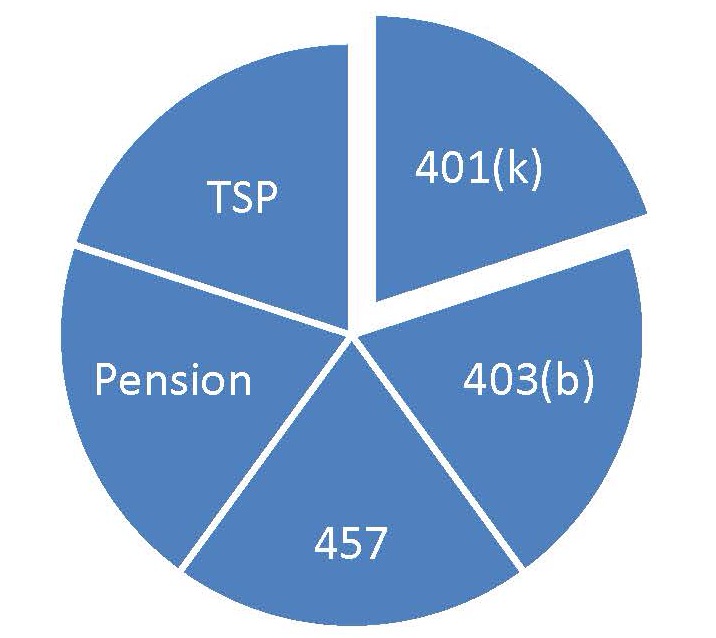
Some examples of defined-contribution plans are 401(k) plans (most common type of DCP), 403(b), 457s, and TSPs.

 photo


In the next lesson, we will discuss President’s Obama new retirement initiative, the MyRA account.

Resources:

The Pension Benefit Guarantee Corporation (PBGC). Defined benefit plans are the only type of pension insured by the PBGC. The insurance works similarly to the federal deposit insurance that backs up your bank accounts. If your plan is covered and the sponsoring company goes bust, PBGC will take over benefit payments up to a maximum amount. The insurance protection helps make your pension more secure, but it is not a full guarantee that you will get what you expected.

 Important terms from this lesson:

Term

Definition

Defined Benefit Plan (DBP) An employer-sponsored retirement plan where employee benefits are sorted out based on a formula using factors such as salary history and duration of employment.
Defined Contribution Plan (DCP) A retirement plan in which a certain amount or percentage of money is set aside each year by a company for the benefit of the employee.
Qualified Retirement Plan Eligible to receive certain tax benefits.
Non Qualified Retirement Plan Ineligible to receive certain tax benefits.
401(k) 401(k)s are the version that corporations offer to their employees.
403(b) 403(b)s are for employees of public education entities and most other nonprofit organizations.
457 457s are for state and municipal employees, as well as employees of qualified nonprofits.
Thrift Savings Plans (TSPs) Thrift Savings Plans (TSPs) are for federal employees.

 Action Step:       Watch and Learn.

Lesson #36 – Building wealth – Step 1: Create/Develop Assets – Individual Retirement Arrangements (IRA vs. Roth IRA)

“I am the master of my fate,

I am the captain of my soul.” – Invictus, William Ernest Henley

 index

The 1935 Social Security Act signed into law by President Franklin D. Roosevelt was a game changer in this nation.  Having witnessed the devastation caused by the great depression, the Act was an attempt to limit what were seen as dangers in the modern American life, including old age, poverty, unemployment, and the burdens of widows and fatherless children. By signing this Act on August 14, 1935, President Roosevelt became the first president to advocate federal assistance for the elderly.

Fast forward to the 21st Century; our relationship to Social Security has changed drastically.  Most Americans realize that Social Security as our grandparents knew it, may not be around or may be materially different by the time we are eligible to receive it.  As a result, as a prudent wealth builder, you should proceed as if Social Security will NOT be available.

So how would you save for retirement as if there were NO social security available to you?

Take your retirement into your own hands!

Education:

I love America!  I love this country because you can be anything that you want to be, including wealthy.  There are no barriers to creating wealth for yourself to enjoy now or in your retirement years.  The only problem is that many people don’t take advantage of the information available to them to better their situation.  Today’s lesson is about taking your retirement into your own hands.  One of the products that will enable you to be the master of your fate and the captain of your soul is the INDIVIDUAL RETIREMENT ACCOUNT (IRA).  The two type of IRAs are the Traditional IRA and the Roth IRA.

Traditional and Roth IRAs

Traditional and Roth IRAs allow you to save money for retirement. This chart highlights some of their similarities and differences.

Features Traditional IRA Roth IRA
Who can contribute? You can contribute if you (or your spouse if filing jointly) have taxable compensation but not after you are age 70½ or older. You can contribute at any age if you (or your spouse if filing jointly) have taxable compensation  and your modified adjusted gross income is below certain amounts.
Are my contributions deductible? You can deduct your contributions if you qualify. Your contributions aren’t deductible.
How much can I contribute? The most you can contribute to all of your traditional and Roth IRAs is the smaller of:

  • for 2012, $5,000, or $6,000 if you’re age 50 or older by the end of the year ($5,500 or $6,500 for 2013); or
  • your taxable compensation for the year.
What is the deadline to make contributions? Your tax return filing deadline (not including extensions). For example, you have until April 15, 2013, to make your 2012 contribution.
When can I withdraw money? You can withdraw money anytime.
Do I have to take required minimum distributions? You must start taking distributions by April 1 following the year in which you turn age 70½ and by December 31 of later years. Not required if you are the original owner.
Are my withdrawals and distributions taxable? Any deductible contributions and earnings you withdraw or that are distributed from your traditional IRA are taxable. Also, if you are under age 59 ½ you may have to pay an additional 10% tax for early withdrawals unless you qualify for an exception. None if it’s a qualified distribution (or a withdrawal that is a qualified distribution). Otherwise, part of the distribution or withdrawal may be taxable. If you are under age 59 ½, you may also have to pay an additional 10% tax for early withdrawals unless you qualify for an exception.

Tax Planning Tip – (When to contribute to a Traditional IRA or a Roth IRA.)

  • Traditional IRA (Pretax contributions)
    • High tax bracket years
    • Money is not needed within a five-year window
  • Roth IRA (After-tax contributions)
    • Make contribution if you are in a low tax bracket

Advantages of IRA Accounts:

  1. Ability to invest in a variety of assets – other plans like 401(k)s are limited to mutual fund types of investment.  The IRA will enable you to invest in almost any type of asset including gold, other businesses, etc.
  2. Allows rollovers from other qualified retirement plans (term will be discussed in the next lesson).
  3. Earnings grow tax free (Roth IRA only)
  4. Distribution allowed to pay for qualified education expenses or medical expenses.
  5. Easy setup – virtually no administration involved.
  6. Offered by nearly all financial institutions.

Disadvantages of IRA Accounts:

  1. No loans are permitted.
  2. Cannot rollover to a 401(k) type plan.
  3. Traditional IRA and Roth IRA (other than rollover IRAs) may be subject to creditor claims, including IRS levies.
  4. Subject to early distribution penalties, unless exception applies.
  5. Required Minimum Distributions (Traditional IRA only)
  6. Fees

Resources:

RothIRA.com – Online resource to help investors understand Individual Retirement Accounts.

Important terms from this lesson:

Term

Definition

Individual Retirement Account (IRA) An investing tool used by individuals to earn and earmark funds for retirement savings.
Traditional IRA An individual retirement account (IRA) that allows individuals to direct pretax income, up to specific annual limits, toward investments that can grow tax-deferred (no capital gains or dividend income is taxed). Individual taxpayers are allowed to contribute 100% of compensation up to a specified maximum dollar amount to their Traditional IRA. Contributions to the Traditional IRA may be tax-deductible depending on the taxpayer’s income, tax-filing status and other factors.
Roth IRA An individual retirement plan that bears many similarities to the traditional IRA, but contributions are not tax deductible and qualified distributions are tax free. Similar to other retirement plan accounts, non-qualified distributions from a Roth IRA may be subject to a penalty upon withdrawal.


Action Step:       Watch and Learn.

Roth IRA vs Traditional IRA

Lesson #35 – Building wealth – Step 1: Create/Develop Assets – Saving for Retirement

“Hope is an expected end.” – TD Jakes

 images

Hope is a great thing, but hope alone won’t get you to your goal.  Saving for retirement is all about hope coupled with some concrete action.  I can hear you grumbling about today’s excursion into the world of retirement.  If I close my eyes, I can visual you you saying, “I have thirty years until I retire so why should I save now”.  While I empathize, it’s never too early to begin saving for retirement.  Did you know that in 2011, the average life expectancy in the United States was 78.64 years (World Bank)?  Let’s do a bit of math.

Normal Retirement Age                       65

Average Life Expectancy                    78.64

Difference                                          13.64 years

Sure, that’s pretty modest given the fact that people are living longer and longer these days, many well into their eighties and nineties.  If someone had a crystal ball and they told you that you would live to see your 90th birthday, would you have enough money to last for 25 years?  I’m sure that there are some people out there who could answer in the affirmative, but for the majority of us, this is nothing more than wishful thinking at this point.

index2

Education:

In Lesson #1, I introduced the wealth-building continuum.  Right now, you are most likely in the ACCUMULATION phase of your life.  Retirement, on the other hand, can be viewed as  the DISTRIBUTION phase of your life.  Simply stated, your accumulation years are your working years.  This is the time when you can make mistakes and then make the adjustments needed to ensure that you have or are creating the resources that you will need to be comfortable during your retirement years.

The reason that we want to begin saving for retirement now is that we want to take advantage of something called the, Time Value of Money (TVM).  The TVM is the idea that money available today is worth more than the same amount in the future due to its potential earning capacity.  The earning capacity is why you want to get into the game now.  If you determine that you need $1 million dollars during your retirement years and you only have $1,000 saved now, that would suggest that you have some serious work to do.  However, it’s not impossible, if you begin saving for retirement today.

Since you have twenty to thirty years to earn and preserve money, you can take on more risk in an effort to increase your earning capacity during the accumulation phase.  Once you reach the protection phase of your life, your focus will shift to preserving what was earned during the accumulation phase.  This long-term horizon gives you maximum flexibility to take advantage of the products that are available to help you reach your goal.

For an example of the Time Value of Money, click the link below to see a brief video and example.

Time Value of Money

This week, we will concentrate on creating, understanding and exploring retirement assets.  Some of the things that we will discuss this week will include the following:

  1. Defined Benefit Plan vs. Defined Contribution Plan
  2. IRA vs. Roth IRA
  3. Qualified Retirement Plan vs. Non-qualified Retirement Plan
  4. 401(K), including UniK or Solo 401(k) Plans
  5. 403(B)
  6. 457 Plans
  7. SEP
  8. SIMPLE
  9. Keogh
  10. MyRA (President Obama’s new retirement option)
  11. Tax Benefits of saving for retirement
  12. Your number – how much you will need to retire.

Resources:

KMSYKESCPA.COM Knowledge Center – Financial calculators and guides available to help educate

Important terms from this lesson:

Term

Definition

Time Value of Money (TVM) The idea that money available today is worth more than the same amount in the future due to its potential earning capacity. 

Action Step:        Calculate your life expectancy. 

Click of the link and fill in the questions to calculate your life expectancy.

Life Expectancy Calculator

Keep this number handy and refer to it in future lessons.

Lesson #34 – This Week’s Recap!

Monday, February 17, 2014

Lesson #28 – Building wealth – Step 1: Create/Develop Assets – Mutual Funds 101

Tuesday, February 18, 2014

Lesson #29 – Building wealth – Step 1: Create/Develop Assets – Mutual Funds 101 – Knowledge is power – do not ignore your roadmap!

Wednesday, February 19, 2014

Lesson #30 – Building wealth – Step 1: Create/Develop Assets – Introduction to ETFs

Thursday, February 20, 2014

Lesson #31 – Building wealth – Step 1: Create/Develop Assets – Exploring ETFs and the companies who offer them.

Friday, February 21, 2014

Lesson #32 – Financial Freedom Friday for Kids

Saturday, February 22, 2014

Lesson #33 – Encouragement Saturday!