• About

Education and Action

~ Improving Financial Literacy and Teaching Wealth Building Principles

Education and Action

Category Archives: Basic Personal Finance

Lesson #30 – Building wealth – Step 1: Create/Develop Assets – Introduction to ETFs

19 Wednesday Feb 2014

Posted by kenyasykes in Basic Personal Finance

≈ Leave a comment

You may know your ABCs, but do you know your ETFs?

index

The above image depicts a favorite dish from my youth, alphabet soup.  Have you ever heard of S&P, NYSE, NASDAQ or FTSE?  A better question may be, do you understand what these acronyms mean?

In the world of investing, it can often feel like you are in stuck in a bowl of alphabet soup.  When most people see these titles, they are understandably intimidated.  In this lesson, I will provide an introduction to Exchange-Traded Funds (ETFs) and discuss how they can be used to help you reach your investment goals.

Education:
 photo

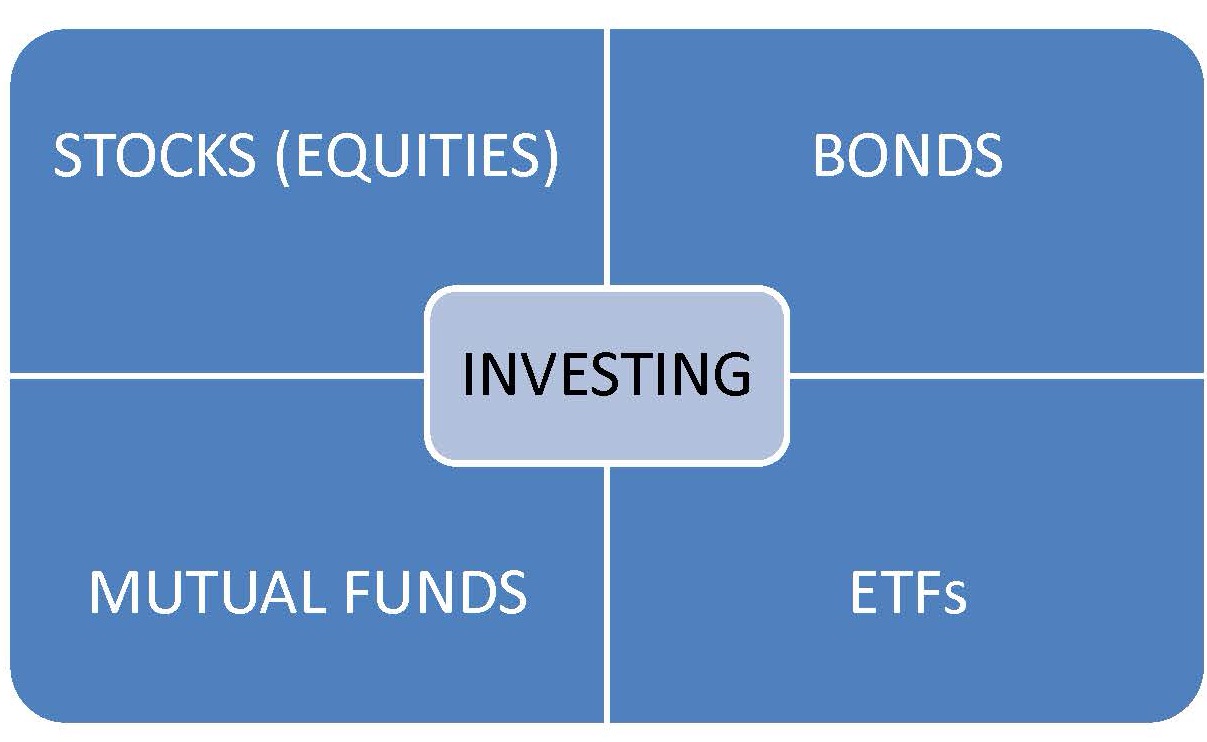
The last category in the investing diagram is ETFs or Exchange Traded Funds.

An exchange-traded fund (ETF) is an investment fund traded on stock exchanges, much like stocks.  An ETF holds assets such as stocks, commodities, or bonds. Most ETFs track an index, such as a stock index or bond index.  The purpose of an ETF is to match a particular market index.   Because, technically, you cannot actually invest in an index, exchange-traded funds allow investors to invest in securities which seek to replicate the index.

In the case of financial markets, an index is an imaginary portfolio of securities representing a particular market or a portion of the market.  Indexes can be based on various categories of stocks. There are the widely known market indexes, such as the Dow Jones Industrial Average, the NASDAQ Composite, or the S&P 500. The Standard & Poor’s 500 (aka S&P 500) is one of the world’s best known indexes, and is the most commonly used benchmark for the stock market. The S&P 500 is a stock market index based on the market capitalizations of 500 large companies having common stock listed on the NYSE or NASDAQ.

When you buy shares of an ETF (e.g. Vanguard S&P 500), you are buying shares of a portfolio that tracks the yield and return of its native index, or the S&P 500 in this instance.  Although the Vanguard fund was an example of overall stock market index, there are indexes based on market sectors, such as tech, healthcare, financial; foreign markets; market cap (micro-, small-, mid-, large-, and mega-cap); asset type (small growth, large growth, etc.); even commodities.  ETFs provide great flexibility for niche investors.
etf-coins

Benefits of ETFs

  1. ETFs combine the range of a diversified portfolio with the simplicity of trading a single stock.
  2. Investors can purchase ETF shares on margin, short sell shares, or hold for the long term.
  3. Passive management, fund or money manager makes only minor, periodic adjustments to keep the fund in line with its index.
  4. ETFs mitigate the element of “managerial risk” that can make choosing the right fund difficult.
  5. ETFs allows you to harness the power of the market itself.
  6. Fewer administrative costs than actively managed portfolios.
  7. Tax efficiency – fewer taxable distributions.
  8. Highly efficient investment
  9. Diversification
  10. High liquidity – enabling investors to get into and out of investment positions with minimum risk and expense.
  11. ETF shares trade exactly like stocks.


  1. Resources:


CNN Money ETF Finder (http://bit.ly/1oTHzJH) – provides a tool to help investors find funds to fit their individual criteria.

The Vanguard S&P 500 fund –   The Fund is a low cost way to gain diversified exposure to the U.S. equity market. The fund invests in 500 of the largest U.S. companies, which span many different industries and account for about three-fourths of the U.S. stock market’s value

Important terms from this lesson:

Term

Definition

Exchange Traded Fund (ETF) A mutual fund that is traded on a stock exchange.

Action Step:        Watch the video, An Introduction to Exchange Traded Funds

Lesson #29 – Building wealth – Step 1: Create/Develop Assets – Mutual Funds 101 – Knowledge is power – do not ignore your roadmap

18 Tuesday Feb 2014

Posted by kenyasykes in Basic Personal Finance

≈ Leave a comment

“Life is like a box of chocolates, you never know what you’re gonna get. “ –Forrest Gump index Eureka! Forrest Gump was on to something when he uttered one of the most famous movie quotes in history.

On Friday, we celebrated Valentine’s Day and I commemorated the occasion by giving my partner a large heart-shaped box of chocolates.  Because the box was so large, four days later, we are still enjoying those bite-sized edible rays of joy.  Upon removing the lid, all that is visible to the eye is the shape of the chocolate.  Because we lack the x-ray vision of Superman, the only way to know what is on the inside of the chocolate, the filling (e.g. nougat, almonds, caramel, etc.) is to examine the map that is included in the box, a cheat sheet of sorts which tells you exactly what is in each chocolate.  Although they appear similar to the naked eye, each chocolate has its own characteristics.  Some are made of dark chocolate, some of milk chocolate, some contain nuts, some do not and so on.  Using this map, my partner knew to steer clear of caramel because she hates it.  However, I love caramel, so I used the map to zero in on my favorite filling.

If I can take a few liberties with Mr. Gump’s quote, I would say that Mutual Funds are like a box of chocolates, however, the map tells you exactly what you are going to get. In the world of mutual funds, this map is called a prospectus.

 2

Education:

In Lesson #28, we began our discussion of mutual funds and how they can be used to give a small investor the purchasing power or wherewithal of a large investor.  In this lesson, we will discuss how to pick the right chocolate!

A prospectus, is the map that teaches what each chocolate contains.  It is absolutely critical that you read a prospectus before investing in a mutual fund.  Would you eat a chocolate with almonds if you were allergic to nuts?  Maybe…if you didn’t know, but would you take the risk?  The prospectus gives you all of the information about the mutual fund, including the following.

  1. What shareholder services is available in the fund
  2. Distribution information
  3. Tax information
  4. Fees and expenses *
  5. Performance results
  6. The investment goals of the fund
  7. The investment holdings

3

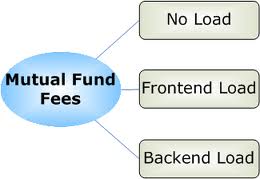
Of the seven items listed above, the most important items to understand are the fees and expenses.  For Mutual Funds, so

  • Load Fees (Front-end, No Load or Backend Load)
  • Contingent (CDSL)
  • 12b-1 fee
  • Management Fees
  • Redemption Fees

Example:  If you invest $10 and the investment earns $5, then you would think that you $15, right?  Wrong, read the fine print.

Mutual Fund fees can turn your potential $15 into $3 without using magic.  BEWARE OF FEES!

ALWAYS READ THE PROSPECTUS!

Resources:

FINRA (http://www.finra.org/ ) – The Financial Industry Regulatory Authority is an independent, not-for-profit organization authorized by Congress to protect America’s investors by making sure the securities industry operates fairly and honestly.

Important terms from this lesson:

Term

Definition

Prospectus A document that contain the facts that an investor needs to make an informed investment decision.
Front-end Sales Load A type of fee that investors pay when they purchase fund shares.
No Load Fund A mutual fund in which shares are sold without a commission or sales charge.
Backend Sales Load A type of fee that investors pay when they sell fund shares.
Contingent (CDSL) Fees A type of fee that investors pay only when they redeem fund shares
12b-1 fee An annual fee paid by the fund for distribution and/or shareholder services

Action Step:        Watch the animated video and learn about mutual fund fees.

Your mutual fund: an animated guide

Lesson #28 – Building wealth – Step 1: Create/Develop Assets – Mutual Funds 101

17 Monday Feb 2014

Posted by kenyasykes in Basic Personal Finance

≈ Leave a comment

Do you have a 401(k)?

Do you have a 403(b)?

Do you have a 457 plan?

images

On May 22, 1980, my life changed when the Pac-Man video game was released.  I’m sure you are wondering why I would use an image of Pac-Man to discuss Mutual Funds.  Well, the video game provides a great way to demonstrate how Mutual Funds give you PURCHASING POWER.  Think of yourself as Pac-man.  When the game opened, you were being chased by larger investors who could literally swallow you up.  However, if you were able to make it to a power pill, it gave you super powers to chomp up the pellets (investments).  Well, mutual funds are your power pill.  Without it, most investors are intimidated by the investing landscape; however, with the assistance of a power pill, you could magnify your potential to swallow up investments.  Most of us lack the capital resources to invest effectively in large companies.  However, when we pool our resources, we have the ability to invest on a large scale.

  images2

Education:

In Lesson #15, the INVESTING diagram was used to introduce the most popular  investment alternatives for the average investor. Because of the pervasiveness and utility of stocks and bonds, I dedicated two full weeks of lessons to discuss them in greater detail.  Because those are the most common investments, it only made sense to begin our focus on those two areas.  Today’s lesson will be dedicated to exploring Mutual Funds.

photo

Do you have a 401(k)?

Do you have a 403(b)?

Do you have a 457 plan?

If you answered yes to any of those questions, then either you are an employee or have been an employee of an organization that offered these qualified retirement plan options to you.  However, did you know these plans are only able to invest in mutual funds?  HMMMM…

If you are astute, then you will notice that I did not ask you if you had an IRA plan.  That’s because IRA plans are unqualified plans.  What does that mean?  It means that they are NOT tax-advantaged plans.  Let’s just keep it at that level for now because the mechanics of the IRA plan is not the intention of this lesson.  We will table that discussion for another day.

What is a MUTUAL FUND?  Let’s analyze this by breaking it down to bit-sized pieces.

Mutual –  to hold in common by two or more parties, a pool.

Fund – a source of money that is allocated to a specific purpose.

A mutual fund is an:

  1. Investment vehicle
  2. Consists of a pool of money collected from people (investors) with a common purpose (to invest)
  3. Organized into classes (stocks, bonds, cash)
  4. Operated by money managers who are in charge of the pool
  5. To achieve diversification

Consider this – you and your friends decide that you want to start a fund to invest in small businesses in your area.  Is this a mutual fund?

Let’s test our simple definition:

Is it an investment vehicle?         Yes

Does it consists of a pool of money collected from people with a common purpose?       Yes

Is it organized into classes (stocks, bonds, cash)?         Yes

Is it operated by a money manager?       Yes, the group

Does it seek to achieve diversification?  Yes, it will invest in multiple businesses

Then yes, this is a mutual fund.  Of course, that example is quite innocuous, but it’s critical to chop these terms into bit-sized pieces that you can ingest.  Now that we have a basic framework, let’s advance the discussion.

Mutual Fund Investment Classes

  1. Equity Fund (invest mostly in stocks)
    1. Large Cap
    2. Mid-cap
    3. Small Cap
    4. Growth
    5. Value
    6. Blend
    7. International
    8. Funds of Funds
    9. And so on…
    10. Bond (invest mostly in bonds)
      1. Government Bonds
      2. Corporate Bonds
      3. Long-term Bonds
      4. Short-term Bonds
      5. Fixed Income (invest in municipal bonds)

As you can see, the mutual fund investment classes can be broken down and targeted to achieve your investment objective.  Since most of us do not have the capital or wherewithal of a Warren Buffett or Karl Icahn, who can invest large amounts of money in individual investments, mutual funds give small investors (the majority of us) the ability to pool our resources with other investors to purchase the same type of investments.  A mutual fund is formed for PURCHASING POWER.  For example, let’s take the tech industry.  Within that industry, you may have companies like Microsoft, Apple, Intel, Google.  The individual stock prices of all of those companies are extremely expensive.  Even if you could buy a few shares, that wouldn’t make a difference.  However, if you teamed up with others, then together you would have a large pool of funds to invest in all of these companies.

Advantages of Mutual Funds

  • Purchasing Power
  • Plethora of mutual fund classes (can target investments)
  • Diversification
  • Experienced Money Manager
  • Dividend reinvestment (buy more shares)
  • Some mutual funds offer investors different types of shares

Disadvantages of Mutual Funds

  • Hidden Fees (BE CAREFUL HERE)
    • Load vs No load (to be discussed in Lesson #29)
    • Limited exposure to lone investments (your favorite investment may only represent a small portion of the fund’s holdings)
    • Unscrupulous money manager
    • Tax issues (capital gain distributions)
    • Poor trade execution (may not give you the best price)
    • Some mutual funds offer investors different types of shares

If you noticed, one item was listed as both an advantage and a disadvantange of mutual fund investing.  In the next lesson, we will explore this in greater detail.

Resources:

Money Control Investor Education (http://www.moneycontrol.com/investor-education/) – Online classroom providing tutorials on Mutual Funds.

Important terms from this lesson:

Term

Definition

Mutual Fund An investment program funded by shareholders that trades in diversified holdings and is professionally managed.
Qualified Retirement Plan A plan that meets requirements of the Internal Revenue Code and as a result, is eligible to receive certain tax benefits. These plans must be for the exclusive benefit of employees or their beneficiaries.
Money Manager A business or bank responsible for managing the securities portfolio of an individual or institutional investor.

 Action Step:        Watch the video, An Introduction to Mutual Funds.

Lesson #27 – This week’s recap!

16 Sunday Feb 2014

Posted by kenyasykes in Basic Personal Finance

≈ Leave a comment

Monday, February 10, 2014

Lesson #21 – Building wealth – Step 1: Create/Develop Assets – Bonds 101

Tuesday, February 11, 2014

Lesson #22 – Building wealth – Step 1: Create/Develop Assets – Bonds 101 – How to pick bonds

Wednesday, February 12, 2014

Lesson #23 – Building wealth – Step 1: Create/Develop Assets – Bonds 101 – U.S. Savings Bonds

Thursday, February 13, 2014

Lesson #24 – Building wealth – Step 1: Create/Develop Assets – Bonds 101 – U.S. Treasury Securities

Friday, February 14, 2014

Lesson #25 – Building wealth – Step 1: Create/Develop Assets – Bonds 101 – Munis and Corporate Bonds

Saturday, February 15, 2014

2/15/14 Lesson #26 – Encouragement Saturday! (With Warren Buffett)

Lesson #25 – Building wealth – Step 1: Create/Develop Assets – Bonds 101 – Munis and Corporate Bonds

14 Friday Feb 2014

Posted by kenyasykes in Basic Personal Finance

≈ Leave a comment

Happy Valentine’s Day!

index

Given that today is Valentine’s Day, I will be the first to admit that bonds are not the sexiest investment to talk about. However, it is critical that you understand how this fixed income security fits into your overall investment portfolio.  First, it provides stability to counterbalance other more risky investments in your portfolio.  Even the riskiest people among us, loves a little certainty.  This past week was spent demystifying the world of bonds to make it more accessible to you.  You may not like bonds now, but if you live long enough, then they will make a great bed fellow in your latter years.

Education:

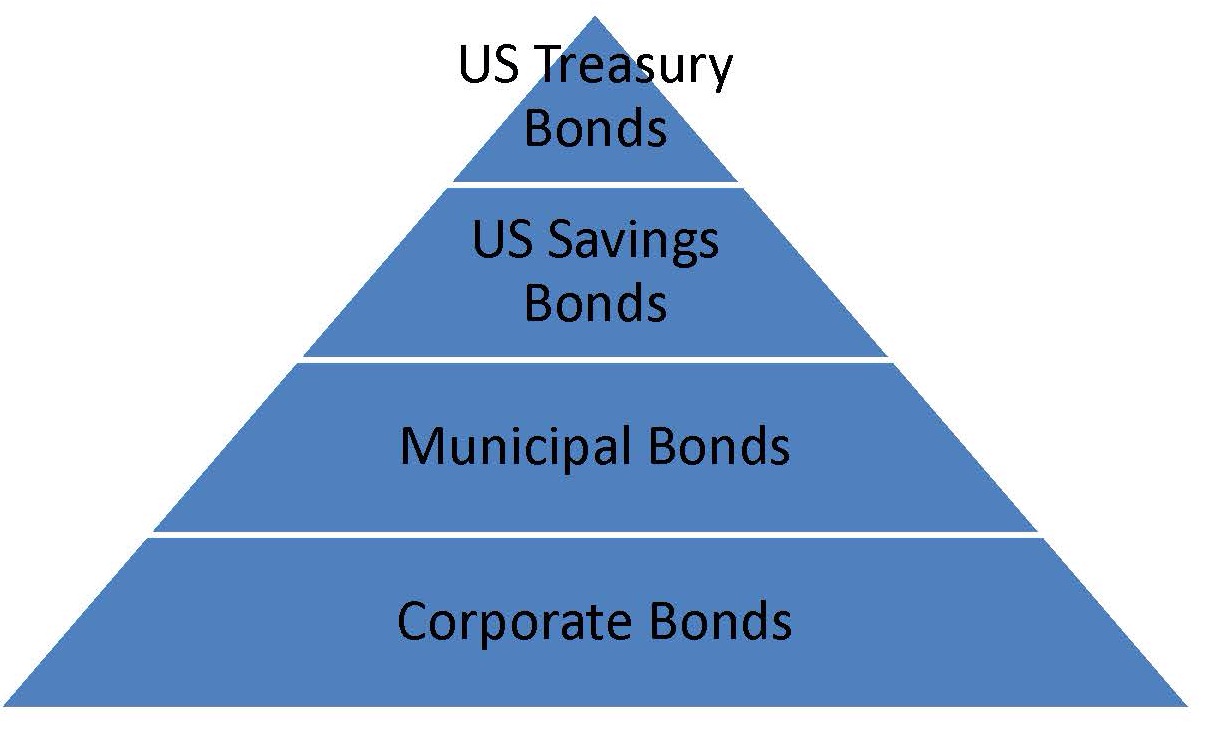
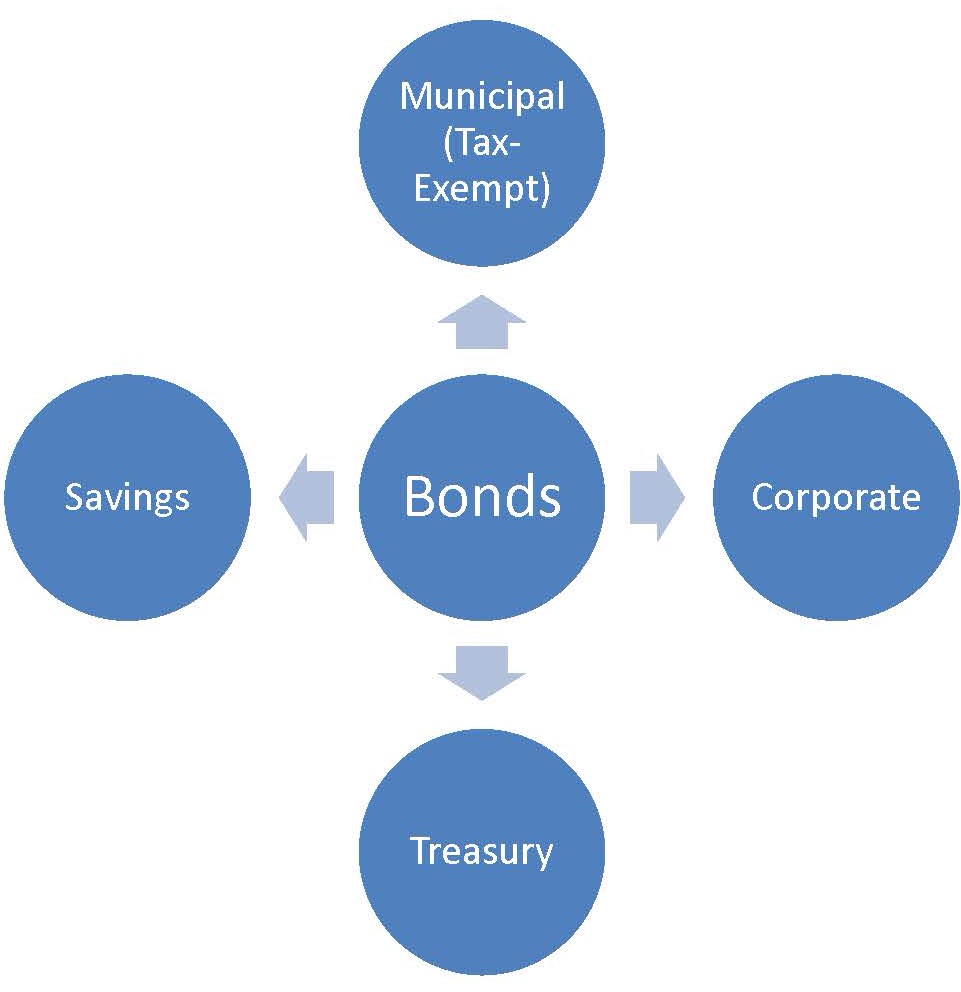
In this lesson, we will close out out the bond pyramid that was introduced in Lesson #22.  In case you forgot the hierarchy, let’s take another look.

photo

I dedicated the last two lessons to discussing the benefits of investing with our very own United States Government.  It felt good for the government to owe us some money for a chance.  As a creditor of the U.S. Government holding either Treasury Securities or Savings Bonds, your money is in good hands.  We can now shift our focus to the distant relative of those secure investments – Municipal Bonds and Corporate Bonds.

Municipal Bonds, or Munis are debt securities issued by a state, municipality or county to finance its capital expenditures. Municipal bonds are exempt from federal taxes and from most state and local taxes, especially if you live in the state in which the bond is issued. Municipal bonds may be used to fund expenditures such as the construction of highways, bridges or schools. “Munis” are bought for their favorable tax implications, and are popular with people in high income tax brackets.

The primary reason that people invest in Municipal Bonds is – Tax-exempt interest.

EXAMPLE: If you buy $10,000 worth of municipal bonds with a 4% coupon, the $400 you receive every year is tax-free. Kaboom!  Anytime you can earn tax-free income, that’s a Kaboom!

Corporate Bonds are debt securities issued by a corporation and sold to investors. The backing for the bond is usually the payment ability of the company, which is typically money to be earned from future operations. In some cases, the company’s physical assets may be used as collateral for bonds. Corporate bonds are considered higher risk than government bonds. As a result, interest rates are almost always higher, even for top-flight credit quality companies.

The primary reason that people invest in Corporate Bonds is – Higher Interest Rates.

EXAMPLE: If you buy $10,000 worth of municipal bonds with a 4% coupon, you will receive $400 in interest.  However, if you buy $10,000 worth of corporate bonds with a 6% coupon, you will receive $600 in interest.

It’s not rocket science.  You are simply looking for the angel which will earn you more money.  That’s it!

While those definitions provide a conceptual framework, bonds are quite complicated and these lessons serve only to introduce these investment alternatives to you.  You certainly do not want to attempt to invest in Municipal or Corporate Bonds without a sound financial advisor (refer to Lesson #18).

Resources:

MunicipalBonds.com (http://www.municipalbonds.com/) – The Premiere Site for Municipal Bond Investors

Important terms from this lesson:

Term

Definition

Municipal Bond A debt security issued by a state, municipality or county to finance its capital expenditures
Corporate Bond A debt security issued by a corporation and sold to investors.

 Action Step:        Read the article entitled, ‘The 5 Basic Elements of Bond Investing’

The 5 Basic Elements of Bond Investing

Lesson #24 – Building wealth – Step 1: Create/Develop Assets – Bonds 101 – U.S. Treasury Securities

13 Thursday Feb 2014

Posted by kenyasykes in Basic Personal Finance

≈ Leave a comment

Bills, Notes and Bonds…OH MY!

Here’s a joke. A bill, a note and a bond walk into a bar. Who leaves first?

At the end of this lesson, you will be able to answer that question.

Education:

In the last lesson, we introduced the U.S. Savings Bonds.  Today, we will discuss the other investment alternative offered by the United States Government – U.S. Treasury Securities.

U.S. Treasury Securities come in three different classes based on their length to maturity.

Class #1 – U.S. Treasury Bills (maturities range from a few days to 52 weeks)

Class #2 – U.S. Treasury Notes (maturities of 2, 3, 5, 7 and 10 years)

Class #3 – U.S. Treasury Bonds (matures in 30 years)

Treasury Bills

Treasury bills, or T-Bills mature in one year or less, they do not pay interest prior to maturity; instead, they are sold at a discount of the par value to create a positive yield to maturity or profit for the investor.

For instance, you might pay $990 for a $1,000 bill. When the bill matures, you would be paid $1,000. The difference between the purchase price and face value is profit.

Treasury Notes

Treasury Notes, or T-Notes mature in two to ten years, pays interest every six months, and have denominations of $1,000. In the basic transaction, one buys a “$1,000” T-Note for say, $950, collects interest over 10 years of say, 3% per year, which comes to $30 yearly, and at the end of the 10 years cashes it in for $1000. So, $950 over the course of 10 years becomes $1300.

Treasury Bonds

Treasury bonds mature more than ten years (up to 30 year).  Treasury bonds pay a fixed rate of interest every six months until they mature. When a bond matures, the owner is paid the face value of the bond. Bonds can be held until maturity or sold before maturity.

Let’s recap:

Type of Security

Maturity

Pays Interest

Treasury Bills (T-Bills) Less than 1 year No
Treasury Notes (T-Notes) 2 – 10 years Yes, every 6 months
Treasury Bonds More than 10 years Yes, every 6 months

Advantages of U.S. Treasury Bond

  1. Safe, risk-free investment
  2. Backed by the full faith and credit of the U.S. Government
  3. Purchased directly from the U.S. Treasury in $100 increments
  4. Pays a fixed amount of interest (based on the discount rate)
  5. Interest earned is exempt from state and local income tax
  6. Great for retirement
  7. T-bills and T-Notes are great short term investments
  8. Diversify your investment portfolio
  9. T-Bills can be purchased in virtually every type of investment account, including Coverdell ESA’s, UTMA/UGMA custodial accounts, and educational trusts. Additionally, many Section 529 plans offer a low-risk mutual fund option that is heavily invested in T-Bills.

Disadvantages of U.S. Savings Bonds

  1. Interest rate varies with maturity of security – still comparatively low based on other types of investments
  2. High purchase limit (up to $5 million)
  3. Interest earned is subject to federal income tax
  4. Opportunity Costs of money tied up especially in Notes and Bonds

 Resources:

Treasury Direct (www.treasurydirect.gov)  – TreasuryDirect is the first and only financial services website that lets you buy and redeem securities directly from the U.S. Department of the Treasury in paperless electronic form. The website offers product information and research across the entire line of Treasury securities, from Series EE Savings Bonds to Treasury Notes. Our TreasuryDirect accounts offer Treasury Bills, Notes, Bonds, Inflation-Protected Securities (TIPS), and Series I and EE Savings Bonds in electronic form in one convenient account.

Important terms from this lesson:

Term

Definition

Treasury Bills or T-Bills A bill is a short-term investment issued for a year or less.
Treasury Notes or T-Notes Are government securities that are issued with maturities of 2, 3, 5, 7, and 10 years and pay interest every six months.
Treasury Bonds Pay interest every six months and mature in 30 years.
Discount Means a purchase price that is less than the face value of the security.
Discount Rate Another name for the coupon or interest rate given to a security.
Opportunity Costs The cost of an alternative that must be forgone in order to pursue a certain action. Put another way, the benefits you could have received by taking an alternative action.

 Action Step:        Watch the short video to drive this lesson home.

Bonds, notes and bills

Lesson #23 – Building wealth – Step 1: Create/Develop Assets – Bonds 101 – U.S. Savings Bonds

12 Wednesday Feb 2014

Posted by kenyasykes in Basic Personal Finance

≈ Leave a comment

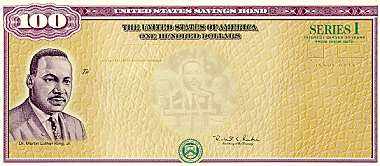
Did you know that Dr. Martin Luther King Jr. is pictured on the Paper Series I $100 Bond?

sbimlk1

Now that’s a great bit of trivia to test your kids during Black History Month.  I guess it’s not all about the Benjamin’s after all. LOL…a little accountant’s humor interjected there.  Okay, let’s get started.

Now that you have a basic understanding of how to make money with bonds and how to pick them based on the two features of quality and duration, we can now advance this discussion to explaining the different types of bonds. The United States Government offers two main classes of bonds – treasury bonds and savings bonds.  In this lesson, we will delve into the U.S. Savings Bonds.

Since the government cannot go to a bank and ask for money, when it needs to raise money for wars, deficits, or policy, it has to borrow it from people like you and I.  As a result, US backed bonds, like Savings Bonds, are issued to the public when the government needs to raise money.

Education:

On February 1, 1935, President Franklin D. Roosevelt signed legislation that allowed the U.S. Department of the Treasury to sell a new type of security, the U.S. Savings Bond.  Since the inception, the U.S. Savings Bond has evolved in form and function. The bonds are now offered in a variety of denominations, including $25 (Series EE), $50, $100, $500, $1,000, $5,000, and $10,000. Besides denomination, the bonds are also offered in different series with varying benefits and restrictions. The table below shows the different series which are still in effect.

Series

Description

E

No longer available – replaced by Series EE. If owned, they can still be redeemed.  The Series E bond was known as the War Bond.

EE

To help Americans finance their dream of a college education, Congress created the Education Savings Bond program. Under this program, Series EE Savings Bonds purchased by qualified taxpayers on or after January 1, 1990, are tax-free if used to pay tuition and fees at eligible educational institutions.

H

H Bonds offered a current income bond that paid interest every six months — and earned interest for 30 years. They were replaced by Series HH Savings Bonds in January 1980.

HH

No longer being issued by the US Government.

I

The Treasury Department introduced the Series I Savings Bond to encourage more Americans to save for the future while protecting their savings against inflation. The new bond series, launched at an official ceremony led by Vice President Al Gore, is indexed to the Consumer Price Index in denominations as small as $50.

How US Savings Bonds Work:

Remember the television game show, Let’s make a deal?  Well, let’s play.

The Offer:

Uncle Sam approaches you and indicates that he will give you $50 on 2/12/44, if you let him borrow $25 today 2/12/14.

Why would you even entertain such an offer?  The answer is – INTEREST!

Uncle sam is offering you this deal because he needs your money today. Since money isn’t free and you worked hard for it, he must compensate you while you are waiting to collect your $50. This compensation comes in the form of interest.  He must pay you interest while you hold the bond to maturity or 2/12/44 in this example.   The trick is that you will only receive the $50 if you agree to collect on 2/12/44 and not a day before. If you demand your money before that date, then you will not receive $50, you would receive some smaller amount between the original $25 that you loaned and the $50.

That’s it.  Would you accept?  Before you answer that, let’s examine some of the advantages and disadvantages of U.S. Savings Bond.

Advantages of U.S. Savings Bond

  1. Safe, risk-free investment
  2. Endorsed by the U.S. Government
  3. Multiple denominations are available (from $25 to $10,000)
  4. Income Tax-free (state and local)
  5. Certain bonds can be redeemed after a short period of time
  6. Interest generally compound monthly
  7. Tax benefits may be available when you use the money for higher education
  8. Series I bonds may be purchased with your income tax refund
  9. Electronic bonds are now available – no longer are they only offered in paper
  10. Some employers allow you to purchase them through payroll deductions
  11. Great for retirement – buy now and cash them in your retirement years
  12. Interest on Series HH Bonds are paid in cash

Disadvantages of U.S. Savings Bonds

  1. Extremely low interest rate
  2. Highest bond denomination available is $10,000
  3. Not easily transferrable
  4. Non-negotiable
  5. Interest penalty for early redemption
  6. Meant to be long-term investment (up to 30 years to receive full face value)
  7. Interest may be subject to federal income tax
  8. Interest may be included in the value of the bond (Series I and Series EE) – this means that the interest earned will NOT be paid to you in cash.

Resources:

Treasury Direct (www.treasurydirect.gov)  – TreasuryDirect is the first and only financial services website that lets you buy and redeem securities directly from the U.S. Department of the Treasury in paperless electronic form. The website offers product information and research across the entire line of Treasury securities, from Series EE Savings Bonds to Treasury Notes. Our TreasuryDirect accounts offer Treasury Bills, Notes, Bonds, Inflation-Protected Securities (TIPS), and Series I and EE Savings Bonds in electronic form in one convenient account.

Important terms from this lesson:

Term

Definition

Savings Bond A U.S. government savings bond that offers a fixed rate of interest over a fixed period of time.
Redemption The return of an investor’s principal in a fixed income security.
Redemption Value Is the price at which the issuing company may choose to repurchase a security before its maturity date.

 Action Step:       Replace a kid’s gift with a United States Savings Bond.

Click the link to watch the demo to see how to buy a Savings Bond as a gift http://www.treasurydirect.gov/indiv/planning/plan_giftsdemo.htm

2012_gift-certificate

Lesson #22 – Building wealth – Step 1: Create/Develop Assets – Bonds 101 – How to pick bonds

11 Tuesday Feb 2014

Posted by kenyasykes in Basic Personal Finance

≈ Leave a comment

Do you have junk in your money trunk?

As we continue our discussion on bonds, it must be noted that not all bonds are created equal.  Like people and everything else in life, there are good bonds (investment grade) and there a bad bonds (junk).  In this lesson, we will introduce two features that will help you pick the right bond for your portfolio.

Education:

 photo  

A bond is best known for its two features – quality and duration.  The quality of the bond speaks to its safety or the risk of default.  Yesterday, I told you that the safest bond was the US Treasury Bond.  Because the US Government can print money, there is no possible risk of default.  The more susceptible a bond is to default, the lesser the quality.  This quality is expressed in a term called, bond or credit rating. 

Think of a bond or credit rating like school grades.  If you are an A student, that typcially means that you are an excellent student and a college would be wise to offer you a full scholarship.  On the other hand, if you are an F student, that means that you may not be a great student and a college would take a large risk to offer you a scholarship when there are other A students available.  I know that’s a pretty tough analogy, but you get the picture.

To illustrate the bond ratings and their meaning, we’ll use the Standard & Poor’s format:

Investment Grade

AAA and AA:      High credit-quality investment grade
AA and BBB:      Medium credit-quality investment grade

Junk Bonds

BB, B, CCC, CC, C:    Low credit-quality (non-investment grade), or “junk bonds”
D:            Bonds in default for non-payment of principal and/or interest

Naturally, AAA bonds would be considered the highest quality.  That’s pretty easy to follow, so let’s move on to the second feature.

images2

The second feature of the bond is its duration, the period expressed from the date of purchase to the date of maturity.

Duration = Purchase Date – Maturity Date

Example:  Hint – It’s not rocket science!

A 90-day bond would mature in…you guessed it…90 days.  That means that if you purchased the bond for $100 (its face value or par value),  in exactly 90 days, the bond would mature and you would receive the face value or par value of the bond, $100 plus whatever interest was earned during that period.

A 1-year bond would mature in…you guessed it…1 year.  That means that if you purchased the bond for $100 (its face value or par value),  in exactly 1-year, the bond would mature and you would receive the face value or par value of the bond, $100 plus whatever interest was earned during that period.

Of course, the longer the duration, the higher the coupon (interest) rate that you would have to be offered to tie up your money.  Let’s test your understanding of duration and quality using three scenarios.

Scenario #1 – Enron is issuing a 5-year bond with a D rating with a coupon rate of 8.0%.

Scenario #2 – US Government is issuing a 5-year bond with an AAA rating with a coupon rate of  1.48%.

Scenario #3 – The City of Detroit is issuing a 5-year bond with a BB rating with a coupon rate of 2.5%

Which bond would you choose based on quality and duration?

It makes sense for Enron to offer the highest coupon rate because it has the lowest quality.  The company would have to offer a fairly high rate to entice you to invest your hard-earned money into something so risky.  However, Enron is offering the best return on your money.  So what do you do?

The first thing that you need to do is to figure out what type of investor you are.  Are you a RISK SEEKER or are you RISK ADVERSE (See Lesson #14)?

Second, do your research!  There is no shortage of information available to help you research bond options.  A great place to start is by reviewing the bond  or credit ratings.  This is easy because there are companies that do the research for you.  Companies like Standard & Poor’s, Moody’s and Fitch are great places to begin.  These agencies provide a credit rating, or an opinion on the general creditworthiness of an issuer, or the creditworthiness of an issuer with respect to a particular debt security or other financial obligation.  In other words, they vouch for quality of bonds.

Tomorrow, we will begin exploring the different types of bonds beginning with US Treasury Bonds.

Resources:

Standard & Poor’s (http://www.standardandpoors.com/ratings/en/us/):  Publishes financial research and analysis on stocks and bonds.

Moody’s (https://www.moodys.com/researchandratings) – Publishes financial research and analysis on stocks and bonds.

Important terms from this lesson:

Term

Definition

Bond or Credit Rating A grade given to bonds that indicates their credit quality.
Bond Rating Agency The agencies that provide the grades given to bonds.
Investment Grade A rating that indicates that a municipal or corporate bond has a relatively low risk of default.
Junk Bond Junk bonds are risky investments, but have speculative appeal because they offer much higher yields than safer bonds.
Face Value or Par Value
In bond investing, face value, or par value, is commonly referred to the amount paid to a bondholder at the maturity date, given the issuer doesn’t default

Action Step:       Watch the video, An Introduction to Bonds, presented by Khan Academy.

Lesson #21 – Building wealth – Step 1: Create/Develop Assets – Bonds 101

10 Monday Feb 2014

Posted by kenyasykes in Basic Personal Finance

≈ Leave a comment

 photo 1


Bonds may have the distinction of being the least sexy investment instrument.  Where stocks are sexy and risky and generally yield higher returns, bonds, on the other hand, are known for their stability. Sounds boring, huh?  Maybe, but let’s look closer.

Investing in bonds is typically less risky than investing in stocks. Consequently, bonds are a preferred investment alternative for people who are “risk adverse”, who may not be able to take on additional risk or who prefer a certain return on their investment.  Bonds are known as “fixed income” securities.  Immediately, it conjures up thoughts of elderly people who are on a fixed income. Yes, it may not drip sex appeal, but whatever it lacks, it makes up for it in other areas.  The investment is “fixed” because you know exactly what you’re going to get.  There is no gambling involved. It it (the bond) says that it will pay 10%, then you will get 10%.  On the other hand, if it (the bond) says that it will pay .05%, then that’s all that what you will get.  Which return is more sexy, a guaranteed 1% or a potential 10%? Hmmm…

Education:

Last week, we focused solely on stocks.   It was important to spend the time needed to introduce stocks because for the majority of us, stocks will be the best investment vehicle to build wealth at this stage in our lives (the creation/development phase).  However, as we move through the wealth building continuum from creating to accumulating to protecting and then distributing, our focus will move towards conservation.  As we grow older and near retirement, our capacity to create and accumulate assets will likely diminish.  Given that, it will be imperative to protect those investments to ensure that they are available during your golden years.

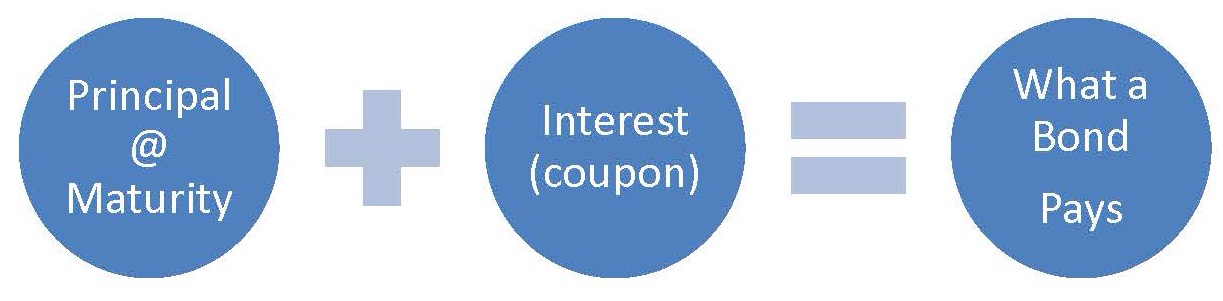
A BOND is a debt investment in which an investor loans a “fixed” amount of money for a “fixed” period of time at a “fixed” interest rate.  Stated another way, the indebted person (issuer) issues a bond that states the following two things:

  1. The interest rate (coupon) that will be paid, and
  2. When the loaned funds (bond principal) are to be returned (maturity date).

 photo 2

The best example of this is a student loan.

Example:

Sallie Mae loans Dave MBA $10,000.  Dave MBA does not have to pay the loan back for four years, but he must pay Sallie Mae 10% each year for the funds or $1,000 ($10,000 x 10%) per year.  Sallie Mae likes to receive those payments every six months, so Dave MBA pays Sallie Mae $500 every six months.

To illustrate:

Year 1

1/1/X1 – Dave MBA gets $10,000 from Sallie Mae

6/30/X1 – Dave MBA pays Sallie Mae $500

12/31/X1 – Dave MBA pays Sallie Mae $500

Year 2

6/30/X2 – Dave MBA pays Sallie Mae $500

12/31/X2 – Dave MBA pays Sallie Mae $500

Year 3

6/30/X3 – Dave MBA pays Sallie Mae $500

12/31/X3 – Dave MBA pays Sallie Mae $500

Year 4

6/30/X4 – Dave MBA pays Sallie Mae $500

12/31/X4 – Dave MBA pays Sallie Mae $500 plus gives back the $10,000

Sallie Mae made $4,000 (or 40%) on the $10,000 that it loaned to Dave MBA – Kaboom!

Sure, I tainted it for illustration purposes, because who would borrow money at 10% when interest rates are historically low?  In my example, we would rush to loan the money to Dave MBA if we knew that we would get a definite 10% return.  However, that is not always the case for most bonds.  The chart below shows the interest rates on some US Treasury and Corporate bonds.

U.S. Treasury Yields


Maturity

Last
Yield

Previous
Yield

3 Month 0.06% 0.07%
2 Year –% —
5 Year 1.48% 1.46%
10 Year 2.68% 2.68%
30 Year 3.66% 3.66%


Corporates

Index Name

Last
Yield

Previous
Yield

Investment Grade 3.08% 3.12%
High Yield 5.59% 5.65%

Of course, risk is not completely diminished and remains a factor because not all bonds are equal.  The safest bond is the Treasury bond, which is issued by the US Government.  Because the government can effectively print money, these investments are safe and possess no risk at all.  As a result, the return on the investment is extremely low.  In essence, you give up a potentially higher return for safety.  Conversely, the riskiest bond is a corporate bond because your return is tied to the health of that entity.  Because it is riskier, the coupon or interest rate that they would need to offer you to invest your money with them would naturally be higher.

Over the next few days, we will delve into the different types of bonds available to investors.

Resources: 

CNN Money (http://money.cnn.com/data/bonds/) – CNNMoney.com is a business website. The site is the online home of Fortune and Money.

Important terms from this lesson:

Term

Definition

Bond It is a debt security, under which the issuer owes the holders a debt and, depending on the terms of the bond, is obliged to pay them interest (the coupon) and/or to repay the principal at a later date, termed the maturity date
Coupon Interest rate on bond.
Maturity Date Due date of the bond. When the bond principal must be repaid.
Bond Prinicpal The original amount loaned.

 Action Step:       Name the Bond components.

Go back to the example above and identify the following:

1.       Who is the issuer of the bond?

2.       Who is the borrower?

3.       What is the coupon rate of the bond?

4.       What is the bond period?

Lesson #18 – Building wealth – Step 1: Create/Develop Assets – Investing 101 – Building an investment team.

07 Friday Feb 2014

Posted by kenyasykes in Basic Personal Finance

≈ Leave a comment

“Team work makes the dream work.”  What the Justice League can teach you about investing.

 huge-justice-league-superhero-movie-may-be-coming-in-2017

I grew up on cartoons, so it will come as no surprise that the Justice League was my favorite cast of characters growing up.  I spent countless days of my youth watching Superman, Batman, and Wonder Woman.  As an adult, I can see the valuable lessons that they taught me about teamwork.  Someone once told me that, “team work makes the dream work.”  I’m not sure where I heard this adage, but it stuck with me.  I am a TEAM player and I believe that the power of WE is preferable to one person going it alone.  Investing is no different.  You need a great TEAM!

Education:

Investing is not an easy exercise and although sites like E*Trade, Sharebuilder and Scottrade have sprung up over the past 20 years, investing is still an activity that is better done with a sound team.  Who’s on first?  Remember the skit from Abbott and Costello where Costello would become frustrated by Abbott’s response that Who was on First?  Well, investing is like a game, and you need to know WHO IS ON FIRST so this lesson is to help you build your investment team.

On any team, it functions best when you have the strongest players at each position.  In the game of investing, your players would be called financial advisors or financial planners.  A financial advisor is a person who provides financial advice or guidance to customers for compensation. Financial advisors can provide many different services, such as investment management, income tax preparation and estate planning. Think of them as the investment coach who teaches you the basics.

1.       Who are you investing for?

2.       What to invest in?

3.       When to invest?

4.       Where to invest?

5.       Why to invest?

Individually, each member of the Justice League was powerful.  However, as a TEAM, no opponent defeated them.  You need a strong team to help you create and accomplish your investment goals.  There is no shortage of financial advisors available to you.  Firms like Merrill Lynch, Morgan Stanley, Ameriprise Financial, Raymond James, Edward Jones and many more will help you be a better investor and reach your investment goals.  Don’t be intimidated by your perception of financial advisors.  Sure, some firms require that you have a large amount of money to invest before they will accept you as a client.  However, there are firms like Edward Jones that accept clients with as little as $100 to open an account.

Other types of financial advisors include Registered Financial Advisor, Chartered Financial Consultant (ChFC), Certified Financial Planners (CFP) and Personal Financial Specialist (PFS).

Don’t go it alone – get a strong TEAM!

 index


Resources: 

Financial Planning Association – Online community of financial planners.

Ameriprise Financial (www.amerirpise.com) –  financial advisory firm that offers financial planning advice and retirement investment advice.

Edward Jones (www.edwardjones.com) – financial advisors that offer a personal approach to investing and retirement planning to help you reach your long-term financial goals.

Important terms from this lesson:

Term

Definition

Financial Advisor One who provides financial advice or guidance to customers for compensation.  Financial advisors can provide many different services, such as investment management, income tax preparation and estate planning.
Registered Financial Advisor Investment advisor that receive compensation for giving advice on investing in securities such as stocks, bonds, mutual funds, or exchange traded funds.
Chartered Financial Consultant (ChFC) Chartered Financial Consultant designations are granted by The American College upon completion of seven required courses and two elective courses. Those who earn the designation are understood to be knowledgeable in financial matters and to have the ability to provide sound advice.
Certified Financial Planner (CFP) The Certified Financial Planner (CFP) designation is a professional certification for financial planner conferred by the Certified Financial Planner Board of Standard (CFP Board). CFPs have met the education, examination, experience and ethics requirement to be certified.
Personal Financial Specialist (PFS) A specialty credential awarded by the American Institute of Certified Public Accountants (AICPA) to CPAs who specialize in helping individuals plan all aspects of their wealth.

 Action Step:        Find a financial advisor!

Click the link to read the white paper, Selecting a Financial Advisor

← Older posts
Newer posts →

Recent Posts

  • Never Stop Learning!
  • Lesson #83 – Financial Freedom Friday for Kids
  • Lesson #82 – Black CEO: Do More Than Save if You Want to Be Wealthy
  • Lesson #81 – Last-Minute Tax Tips to Maximize Your Savings (reposted from The Huffington Post)
  • Lesson #80 –Can Paying Your Taxes Late Affect Your Credit Score? (reposted from The Huffington Post)

Recent Comments

kenyasykes's avatarkenyasykes on Lesson #26 – Encouragement…
kenyasykes's avatarkenyasykes on Lesson #52 – The Flipside : 10…
Unknown's avatarLesson #52 – The Fli… on Lesson #52 – The Flipside : 10…
TheKnowledgeofWords's avatarcocolaelle on Lesson #26 – Encouragement…

Archives

  • September 2014
  • May 2014
  • April 2014
  • March 2014
  • February 2014
  • January 2014

Categories

  • Assets
  • Basic Personal Finance
  • Encouragement
  • Kids' Money
  • Uncategorized

Meta

  • Create account
  • Log in
  • Entries feed
  • Comments feed
  • WordPress.com

Enter your email address to follow this blog and receive notifications of new posts by email.

Join 22 other subscribers

Recent Posts

  • Never Stop Learning!
  • Lesson #83 – Financial Freedom Friday for Kids
  • Lesson #82 – Black CEO: Do More Than Save if You Want to Be Wealthy
  • Lesson #81 – Last-Minute Tax Tips to Maximize Your Savings (reposted from The Huffington Post)
  • Lesson #80 –Can Paying Your Taxes Late Affect Your Credit Score? (reposted from The Huffington Post)

Recent Comments

kenyasykes's avatarkenyasykes on Lesson #26 – Encouragement…
kenyasykes's avatarkenyasykes on Lesson #52 – The Flipside : 10…
Unknown's avatarLesson #52 – The Fli… on Lesson #52 – The Flipside : 10…
TheKnowledgeofWords's avatarcocolaelle on Lesson #26 – Encouragement…

Archives

  • September 2014
  • May 2014
  • April 2014
  • March 2014
  • February 2014
  • January 2014

Categories

  • Assets
  • Basic Personal Finance
  • Encouragement
  • Kids' Money
  • Uncategorized

Meta

  • Create account
  • Log in
  • Entries feed
  • Comments feed
  • WordPress.com

Facebook

Facebook

Blog at WordPress.com.

Privacy & Cookies: This site uses cookies. By continuing to use this website, you agree to their use.
To find out more, including how to control cookies, see here: Cookie Policy
  • Subscribe Subscribed
    • Education and Action
    • Already have a WordPress.com account? Log in now.
    • Education and Action
    • Subscribe Subscribed
    • Sign up
    • Log in
    • Report this content
    • View site in Reader
    • Manage subscriptions
    • Collapse this bar
 

Loading Comments...