• About

Education and Action

~ Improving Financial Literacy and Teaching Wealth Building Principles

Education and Action

Author Archives: kenyasykes

Lesson #74 – Financial Freedom Friday for Kids

04 Friday Apr 2014

Posted by kenyasykes in Kids' Money

≈ Leave a comment

Hey kid, make your own destiny!

1396289235000-Kwasi-Enin-William-Floyd-High-School-2jpg

(Photo Credit: ABC)

I couldn’t end the week without paying homage to a remarkable young man who just made his own bit of history. By now, everyone has heard of Mr. Kwasi Enin, a 17-year-old, first-generation American who applied and was accepted to all eight Ivy League Universities. This young man brought hope to the masses this week and he proved that in this country, the sky is the limit as long as you are willing to work hard. Now, I could use this entire blog post to just brag and celebrate Kwasi, but I want to use his story to fuel other young people in the effort to use his example to pave your way to financial freedom. You knew that I would bring it back to the dollars and cents, didn’t you? Well, that is exactly what we will do in today’s lesson.

Education:

“The Mind is a Terrible Thing to Waste” – UNCF

Everyone know the tagline for the United Negro College Fund (UNCF). In an interview with the CBS Morning Show, Kwasi’s father spoke of his child as being a regular kid with no extraordinary ability. As a first-generation American, his parents came to this country to give their children a better opportunity, a chance to achieve the American dream. They realized that in America using your mind can be the key to a future of financial freedom. We want to teach this example to other kids.

Kwasi’s parents realized that education would be the key to unlock a fruitful future for their children. With that said, they set a high expectation that anything less than 95% was not good enough and their two kids bought into their philosophy. Academic achievement is the key.

index

So kids…take a page from Kwasi and write your own check to a successful future. Not only does Kwasi has his choice among the eight elite universities, his education will most likely be subsidized by the university that he chooses. That means a FREE education, which will save his parents money now and prevent him from taking on excessive student loans…that’s what I call a win-win situation.

So my advice to kids is to STUDY HARD and do not take your education for granted because it can be your ticket to the life that you want. Hey kid…it’s time to punch your ticket!

index2

Resources:

  • The Princetown Review (http://in.princetonreview.com/) – Your guide to college admissions.
Term Definition
Ivy League A group of long-established colleges and universities in the eastern US having high academic and social prestige. It includes Harvard, Yale, Princeton, Columbia, Dartmouth, Cornell, Brown, and the University of Pennsylvania.


Action Step:       Watch Kwasi and be inspired!

How Kwasi Enin Did It!

Lesson #73 – Building wealth – Step 1: Create/Develop Assets – The Buffett Way

03 Thursday Apr 2014

Posted by kenyasykes in Basic Personal Finance

≈ Leave a comment

“Anytime you invest, you have expectation.” – TD Jakes

index 


Since I started this blog, my senses have been heightened to find any information to help the normal guy on main street succeed by teaching financial principles. It is very gratifying to be in such a receptive head space that I find inspiration from the unlikeliest of sources. Last night, I found inspiration on CNBC’s American Greed, a show that I have been watching faithfully for years. It is like soft porn to a seasoned CPA like me. Each episode tells the story of unwitting investors losing their hard-earned money to scoundrels and crooks. Last night was no exception. I watched in angst as several elderly people gave away their life savings to invest in a pipe dream. This lesson is to teach you how to spot an unscrupulous investment opportunity based on advice from the most famous investor of all time, Mr. Warren Buffett.

Education:

The Buffett Philosophy

I love Warren Buffett! There, I said it! No really…I love this down-to-earth, investing genius who teaches by living. In Lesson #26, I assigned a video of him speaking about his investment philosophy and how he makes money. Since American Greed shows no signs of airing its last episode, you would be wise to listen to sound advice for the legend himself.

 images


  1. “Rule No. 1: Never Lose Money. Rule No. 2: Never Forget Rule No. 1.”
  2. “Never invest in a business you cannot understand.”
  3. “Always invest for the long term.”
  4. “Buy a business, don’t rent stocks.”
  5. “If you don’t feel comfortable owning something for 10 years, then don’t own it for 10 minutes.”
  6. “Price is what you pay. Value is what you get.”
  7. “By periodically investing in an index fund, the know-nothing investors can actually outperform most investment professionals.”
  8. “Investing is laying out money now to get more money back in the future.”
  9. “I don’t look to jump over 7-foot bars: I look around for 1-foot bars that I can step over.”
  10. “For some reason, people take their cues from price action rather than from values. What doesn’t work is when you start doing things that you don’t understand or because they worked last week for somebody else. The dumbest reason in the world to buy a stock is because it’s going up.”
  11. “Only buy something that you’d be perfectly happy to hold if the market shut down for 10 years.”
  12. “Why not invest your assets in the companies you really like? As Mae West said, ‘Too much of a good thing can be wonderful.”
  13. “The most important thing to do if you find yourself in a hole is to stop digging.”
  14. “Unless you can watch your stock holding decline by 50% without becoming panic-stricken, you should not be in the stock market.”
  15. “I never buy anything unless I can fill out on a piece of paper my reasons. I may be wrong, but I would know the answer to that …I’m paying $32 billion today for the Coca Cola Company because… If you can’t answer that question, you shouldn’t buy it. If you can answer that question, and you do it a few times, you’ll make a lot of money.“

Stay within your circle of confidence. “ – Warren Buffett

Resources:

  • http://www.businesspundit.com/10-investing-books-recommended-by-warren-buffett/ – 10 Investing Books Recommended by Warren Buffett

Important term!s from this lesson:

Term Definition
Investment Philosopy A set of guiding principles that inform and shape an individual’s investment decision-making process.

 Action Step:       Watch and Learn – Billionaire Investing Secrets

http://www.youtube.com/watch?v=NizR0KXjhhM

Lesson #72 – Building wealth – Step 1: Create/Develop Assets – Mortgage Refinancing

02 Wednesday Apr 2014

Posted by kenyasykes in Basic Personal Finance

≈ Leave a comment

Do you know how to squeeze dollars out of your home?

index

In the last lesson, we discussed interest rate arbitrage as a means to save money. Other than credit cards, mortgage refinancing may be the ultimate way to use interest rates to save money. In today’s lesson, we will discuss how refinancing your home loan may result in huge savings.

Education:

In general, mortgage refinancing is a good move when you can save money by locking in a lower interest rate or payment, shorten your loan term, or restructure debt optimally.

Refinancing is the practice of paying off an existing loan with the proceeds from a new loan, usually of the same size size, and using the same property as collateral. In order to decide whether this is worthwhile, the savings in interest must be weighed against the fees associated with refinancing. The difficult part of this calculation is predicting how much the up-front money would be worth when the savings are received.

Other reasons to refinance include:

  • Reducing the term of a longer mortgage
  • Switching between a fixed-rate and an adjustable-rate mortgage

Benefits of Mortgage Refinancing

By refinancing, you can improve your financial situation. In particular, you can:

  • Lower monthly payment
  • Lower lifetime interest costs
  • Reduce risk
  • Get cash out for other purposes
  • Consolidate debt and possibly get tax benefits
  • Opportunity to use savings for investment alternatives

Disadvantages of Mortgage Refinancing


  • Prepayment fees – If there are prepayment fees attached to the existing mortgage, refinancing becomes less favorable because of the increased cost to the borrower at the time of the refinancing.
  • Closing costs
  • Loan term
  • Equity reduction

Examples – What a 3% difference really means.

200k loan @ 6.25% 200k loan @ 3.25% Savings
$1231 per month $870 per month $361 per month
$443,316 total cost $313,348 total cost $129,967 total cost

 That’s real $$$. Do not ignore this important opportunity to save money.

Resources:

  • Quicken Loans (www.quickenloans.com) – Providing valuable information resources and lending options for homeowners.

Important term!s from this lesson:

Term Definition
Mortgage Refinancing A mortgage refinancing transaction happens when you swap out an old loan for a new (ideally better) one. You pay off the old loan with the proceeds of a new one.


Action Step:       Watch and learn to find out if you should refinance your mortgage.

Lesson #71 – Building wealth – Step 1: Create/Develop Assets – Introducing Arbitrage: How to Manage Interest Rates

01 Tuesday Apr 2014

Posted by kenyasykes in Basic Personal Finance

≈ Leave a comment

Are interest rates draining your wallet?

images

Managing interest rates can mean HUGE savings in your pocketbook. Today’s lesson will focus on interest rate arbitrage. I will teach you how to understand and manage interest rates to hold on to your hard-earned money.  Believe it not, credit card companies and banks make billions (with a capital B) on the interest that they charge to customers like you.  It is time to take a bite out of their profits!

Education:

Arbitrage is the practice of taking advantage of a price difference between two or more markets: striking a combination of matching deals that capitalize upon the imbalance, the profit being the difference between the market prices. That clinical definition typically describes a complicated investment strategy, but if we strip away the investment focus, the applicability of this term has valuable meaning and practical application for basic personal finance. Here are a few examples to illustrate interest rate arbitrage for practical purposes.

Basic Example: Interest Rate Arbitrage

You have a credit card with an interest rate of 15%. You receive an offer in the mail to transfer your balance to a card with a 0% APR. Arbitrage would be the difference between the 15% and the 0%.

 Arbitrage = MONEY SAVED or MONEY EARNED

In the example above, instead of paying the 15% to a lender, you would keep that 15% in your pocket. This is an area where people lose money because they don’t know their interest rate. If you have a loan (car, house, etc.), credit card, or outstanding tax balance, you should always know what rate of interest you are paying. The higher the federal funds rate, the more expensive it is to borrow money.

Practical Example: XYZ Bank

Banks lend money to other banks at the Federal Funds Rate or the interest rate at which a depository institution lends funds maintained at the Federal Reserve to another depository institution overnight. Currently, the Federal Funds Rate is .25%. If XYZ Bank borrow funds at .25% and then lend it to you for 5%, they just made a profit of 4.75%. This is how banks make money.

Practical Example: Credit Card Co.

 2

You are a customer of Credit Card Co. and the interest rate on your cash purchases is 20%. If you pay off your balance each month, then you will never have to worry about paying interest. However, if you are like most Americans, you will maintain a monthly balance. In that case, Credit Card Co. would receive a stipend (inject sarcasm here) from you of 20% interest on top of the balance that you owe them. What if you could have kept that 20% in your pocket?

Most people don’t think about interest rates when they slam the credit card on the counter to make an impulse purchase.  But interest rate ignorance is taking more money out of your pocket.  To be prudent and to ensure that you are keeping every penny that you can in your pocket, please take this concept to heart and apply it in your everyday life.

 Resources:

  • Federal Reserve (www.federalreserve.gov) – The Federal Reserve System is the central bank of the United States. It was founded by Congress in 1913 to provide the nation with a safer, more flexible, and more stable monetary and financial system

Important term!s from this lesson:

Term Definition
Arbitrage The practice of taking advantage of a price difference between two or more items, the profit being the difference between the two prices.
Federal Funds Rate The interest rate at which banks and other depository institutions lend money to each other.


Action Step:       Find out the interest rates on your borrowings.

  1. Review your Liabilities Inventory Worksheet (see Lesson #3).
  2. Find the interest rates on all borrowings listed on your Liabilities Inventory Worksheet.
  3. Credit a plan to pay off the balance or shift

Lesson #70 – Important Message: Deadline to enroll for coverage this year: March 31

31 Monday Mar 2014

Posted by kenyasykes in Uncategorized

≈ Leave a comment

 Are you covered?

 r-OBAMACARE-huge


Today is the deadline to enroll in the Affordable Care Act and get covered for 2014. This is the most important lesson for you and your family today, especially if you are NOT covered.  You have until MIDNIGHT to get covered.

Click on the link below to apply.

Get Covered NOW!

Lesson #68 – Encouragement Saturday!

29 Saturday Mar 2014

Posted by kenyasykes in Encouragement

≈ Leave a comment

Each Saturday, I will find ways to encourage you to reach your goals. Whether it’s a video, an inspirational message, a poem, or whatever…I want to keep you focused on achieving your goals. Remember that you are the sun and you will provide the light for the people around you to believe. By embarking on this journey, you have already proven that you are a standout in the crowd, a leader. You have shown the desire and willingness to improve your life by implementing new strategies and lessons. I strongly believe that you will be the catalyst for a seismic shift in your family.
Today, our encouragement comes from Amar’e Stoudemire who wants to inspire a new generation to read, namely middle school boys. You may know him as the superstar power forward for the New York Knicks, but he is much more than a basketball player. I am always looking for encouragement from wherever I can find it. Earlier today, I saw a broadcast which featured Amar’e and his book series called Stat. I was especially intrigued because African American men are often portrayed as pariahs, which ignores all of the wonderful contributions that they make to our society. Those generalizations enrage me because there are men like Amar’e who are doing remarkable things and leading by example. When so much negativity is highlighted in the media and our culture, I wanted to shed light on a gentleman who has defied all odds to become a great role model for men and boys.

photo 1


photo 2

Order these books for the boys in your life.
STAT: STANDING TALL AND TALENTED BOOK #1: HOME COURT
By Amar’e Stoudemire
Scholastic Paperbacks
Publication Date: August 1, 2012
STAT: STANDING TALL AND TALENTED BOOK #2: DOUBLE TEAM
By Amar’e Stoudemire
Scholastic Paperbacks
Publication Date: October 2012

STAT: STANDING TALL AND TALENTED BOOK #3: SLAM DUNK
By Amar’e Stoudemire
Scholastic Paperbacks
Publication Date: January 2013
To order books, visit your favorite book retailer.

Have a beautiful Saturday!

Action Step: Be encouraged and do not forget to Feed The Pig!

Lesson #67 – Financial Freedom Friday for Kids

28 Friday Mar 2014

Posted by kenyasykes in Kids' Money

≈ Leave a comment

Are you teaching your kids to spend smart?

Kids-page-banks


The best way to learn a skill is to practice!

Education:

Watch out parents – your kid is watching you! With that piece of information, you should realize that kids mimic the behavior of their parents. Frugal parents raise frugal children. Extravagant parents raise extravagant children. Pensive parents raise pensive children. I think you get the picture. What that teaches is that kids will learn to save or spend based on the example that you provide for them. Today’s lesson is to give you a fun tool to help teach your child about smart spending habits.

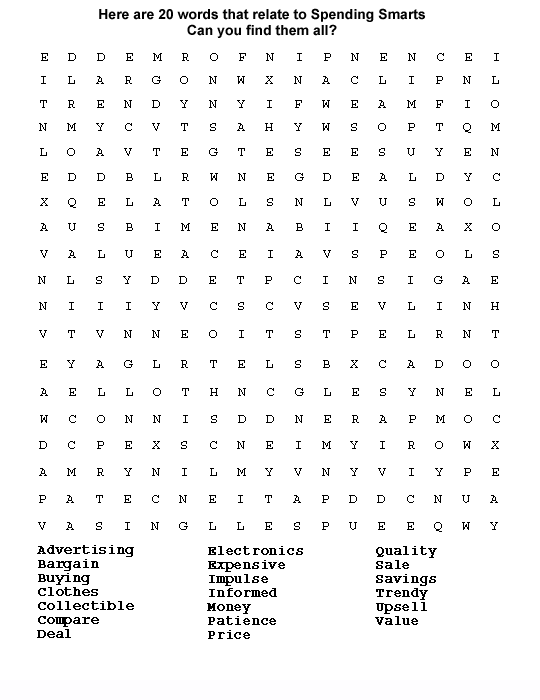
word_search_spendingsmarts

Spending Smarts Word Search

Resources: 

• PBSkids.org (http://pbskids.org/itsmylife/money) – financial resources for kids.

Important terms from this lesson:

Term

Definition

FUN No definition needed!

 Action Step:       Print and complete the Spending Smarts Word Search with your child. Split up the words between you and your child. Once completed, ask your child to explain their understanding of the words that they were given.

Spending Smarts Word Search


Image

Lesson #66 – Building wealth – Step 1: Create/Develop Assets – Choosing the right legal structure for your business – Partnership vs LLC

27 Thursday Mar 2014

“What’s in a name? that which we call a rose
By any other name would smell as sweet.” – William Shakespeare

index

Why would you NOT incorporate?

Yesterday, I asked you why you would incorporate. Today, we will examine why some businesses opt to form a partnership or LLC in lieu of a corporation. What’s in a name? Well, if there are two or more people involved in this entity, the question will likely be – nothing! But beware of the default button!
Who’s on first – partners or members?

Education:

Partnerships

images

A partnership is the relationship existing between two or more persons who join to carry on a trade or business. Each person contributes money, property, labor or skill, and expects to share in the profits and losses of the business.

Types of Partnerships
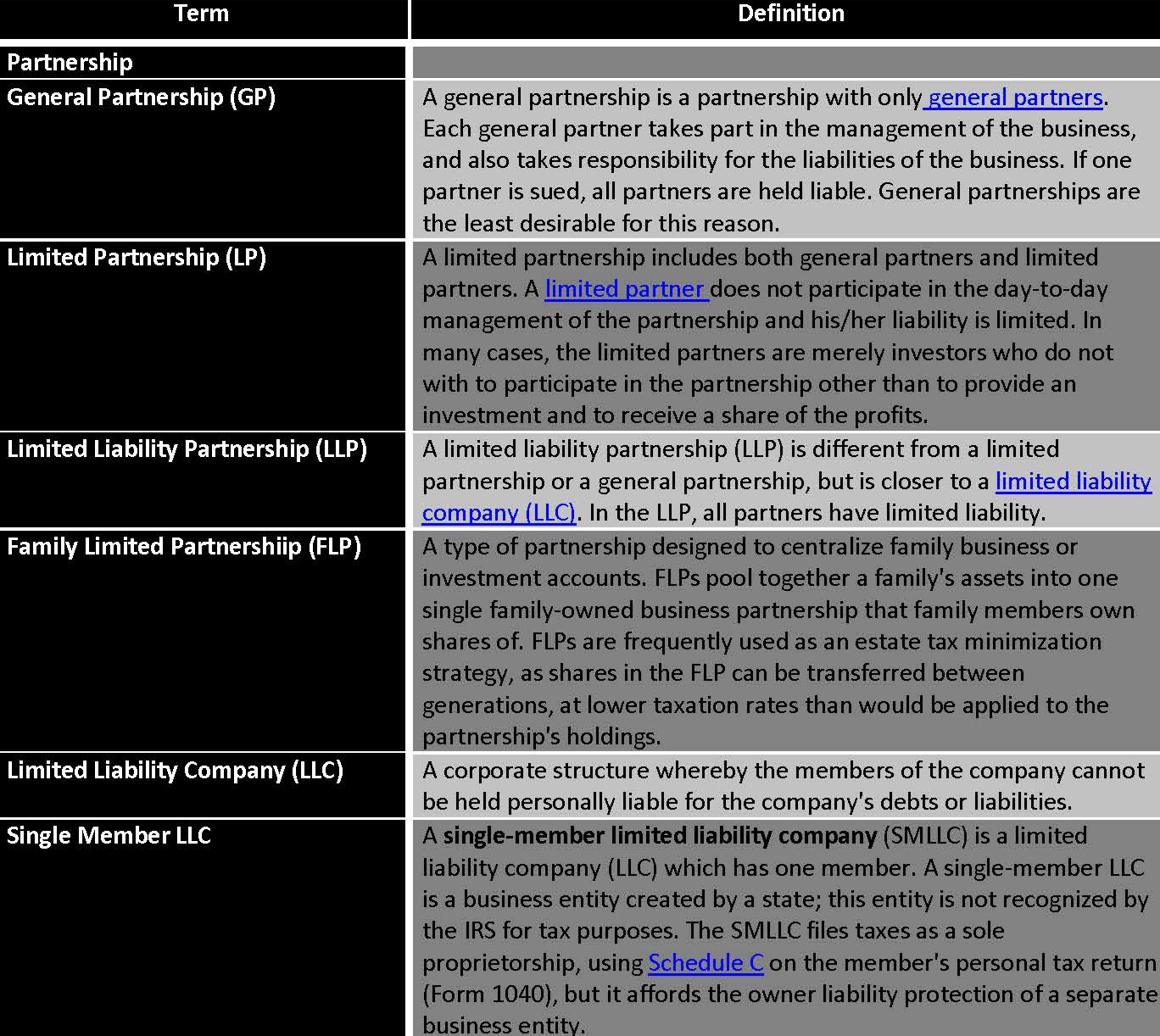
1. General Partnership (GP) – Beyond the scope of this lesson
2. Limited Partnership (LP) – Beyond the scope of this lesson
3. Limited Liability Partnership (LLP) – See comparison chart below
4. Family Limited Partnership (FLP) – To be discussed in a future lesson

Limited Liability Company

index2

A Limited Liability Company or LLC is a figment of your imagination. Well, sort of! Let me explain. Did you know that the Internal Revenue Service (IRS) does not recognize the LLC as an entity form? That’s a great bit of trivia to try out at the next cocktail party. No, the LLC is a function of state law, which simply means that it was created and envisioned by the state. As a result, you must apply to be an LLC with the Department of State in your jurisdiction. Formally, an LLC is a hybrid business organization that mixes the best of corporations, partnerships, and sole proprietorships. This legal structure offers the greatest level of flexibility and is a preferred structure for certain industries.

 
Types of Limited Liability Companies

1. Single Member LLC
2. Multi-Member LLC (partnership by default, and S or C Corporation (by election)

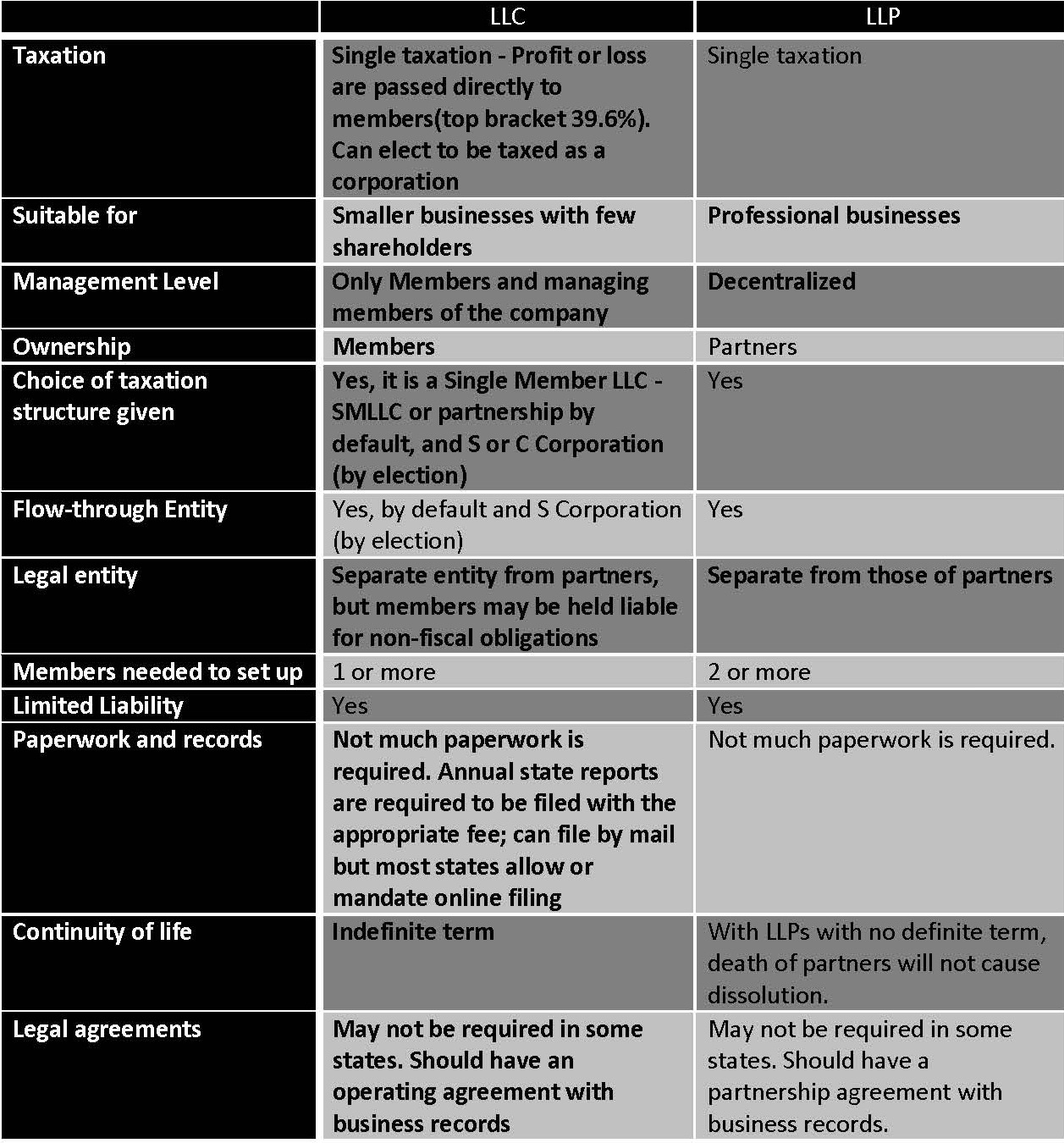
LLC vs LLP Comparison Chart

We just scratched the surface of this fairly complicated area of tax law.  There are many more characteristics that differentiate the LLC from the partnership, including the preferred structure based on your industry.  However, discussion that is beyond the scope of this lesson.

For more information or a free consultation of Entity Choice, visit me at http://www.kmsykescpa.com.

Resources:

• Legalzoom.com – Find resources and information to set up your partnership or LLC.

Important term!s from this lesson:

photo 2

Action Step: Watch and learn.

Posted by kenyasykes | Filed under Basic Personal Finance

≈ Leave a comment

Image

Lesson #65 – Building wealth – Step 1: Create/Develop Assets – Choosing the right legal structure for your business – Corporation

26 Wednesday Mar 2014

How many lumps (taxes) do you want, one or two?


photo 2


Why would your incorporate?

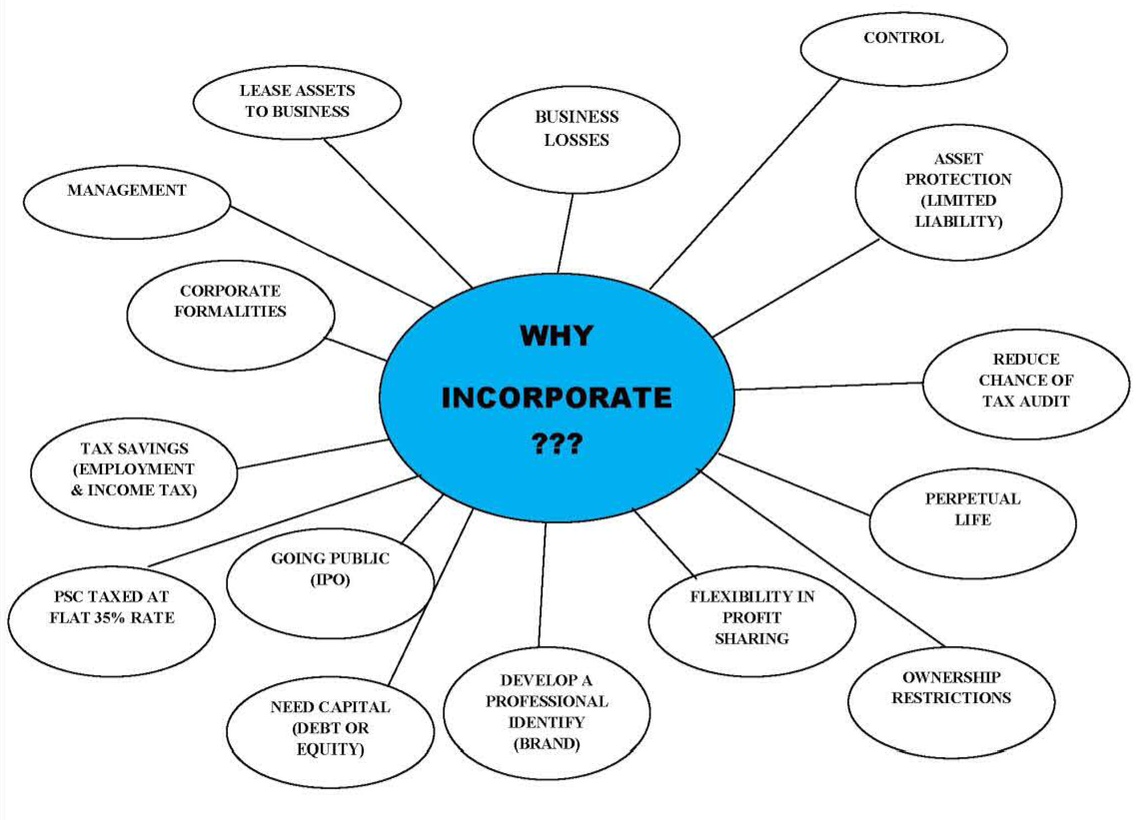
The answer to this question is usually – “because someone told me to”. Choosing the right legal structure for your business is the most important question that a new business owner must answer. This is an area where many costly mistakes are made by business owners and some overzealous tax preparers, who are not well versed in this area. When determining which legal structure makes the most sense for you, it is important to understand the tax and nontax factors to consider when making your decision.
About four years ago, I created this diagram as a discussion piece for a lecture to a class of aspiring entrepreneurs. Of course, this chart was like hieroglyphics to them because they had no idea that there were so many factors to consider when starting a business. Today, we will discuss the merits of operating your business as a corporation.

Education:
A Corporation is a legal entity that is separate and distinct from its owners. Corporations enjoy most of the rights and responsibilities that an individual possesses; that is, a corporation has the right to enter into contracts, loan and borrow money, sue and be sued, hire employees, own assets and pay taxes. The most important aspect of a corporation is limited liability. That is, shareholders have the right to participate in the profits, through dividends and/or the appreciation of stock, but are not held personally liable for the company’s debts.

photo 3

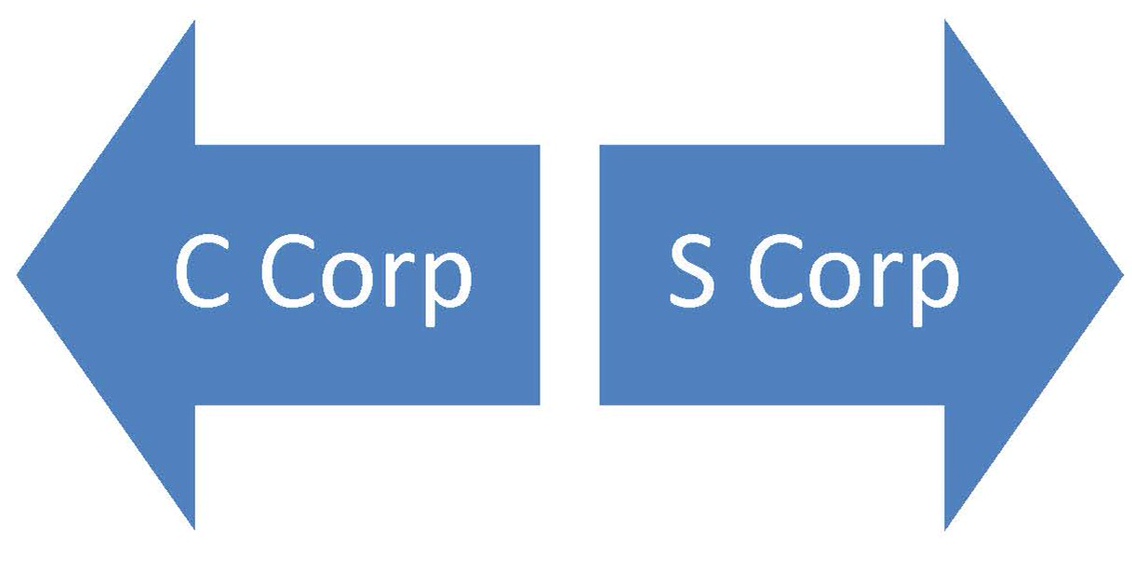
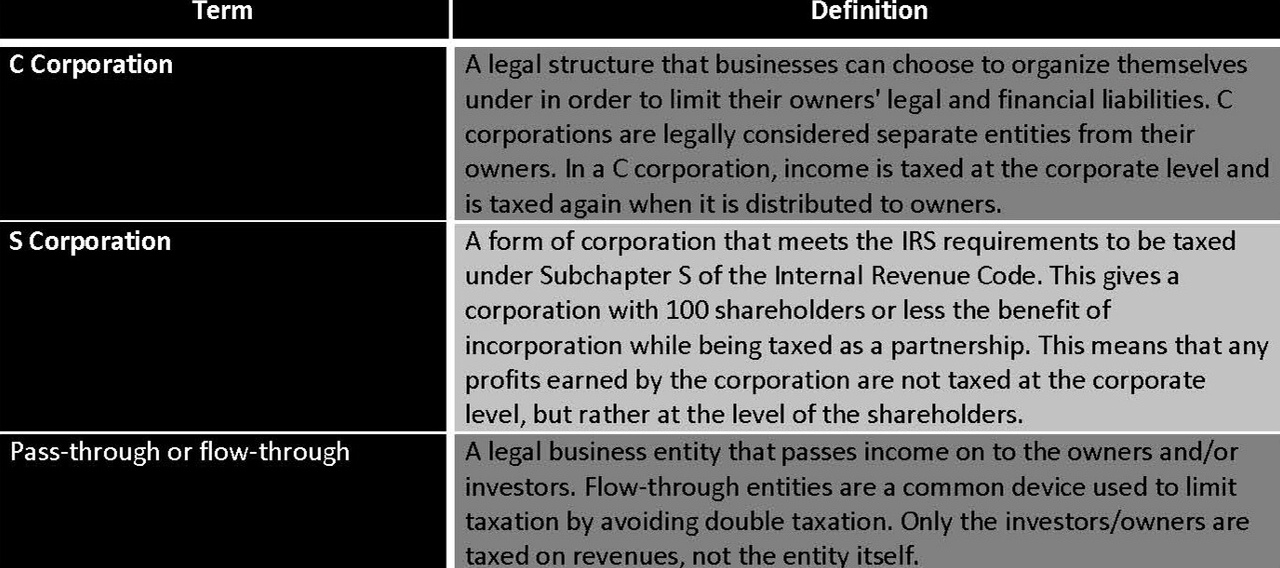
There are two types of corporations: “C Corporations” and “S Corporations”. The moniker comes from the section of the Internal Revenue Code which governs the legal business entity – Subchapter C or Subchapter S of the 1986 Code.

C or S Corporation choice is critical for small business. This choice is of C vs. S status is all about taxes. By default, when a business formally incorporates, it becomes a C Corporation. The S Status is a special category reserved for eligible businesses where they can elect to be taxed the same as an LLC or partnership. In other words, the S status gives a corporation the opportunity to be taxed as a “pass-through or flow-through” entity is a legal business entity that passes income on to the owners and/or investors. Flow-through entities are a common device used to limit taxation by avoiding double taxation. Only the investors/owners are taxed on revenues, not the entity itself. The chart below shows some of the differences between the two types of corporations.
photo 1

There are additional nuances to the C vs. S Conuudrum that are beyond the scope of this lesson. In the next lesson, we will discuss the LLC vs. the Partnership as the final legal business structure options available to business owners.

Resources:

• The Company Corporation (www.incorporate.com) – Find resources and information to incorporate your business.

Important term!s from this lesson:

photo 4


Action Step: Watch and learn.

http://www.youtube.com/watch?v=k02K1h6Ledc

Posted by kenyasykes | Filed under Basic Personal Finance

≈ Leave a comment

Aside

Lesson #64 – Building wealth – Step 1: Create/Develop Assets – Choosing the right legal structure for your business – Sole Proprietorship

25 Tuesday Mar 2014

Posted by kenyasykes in Basic Personal Finance

≈ Leave a comment

Choose right or pay the consequences!

photo

Choosing the right legal structure for your business is the most important question that a new business owner must answer. This is an area where many costly mistakes are made by business owners and some overzealous tax preparers, who are not well versed in this area. As far as the tax landscape goes, a business may as well be in another universe when it comes to taxes. But taxes are not the only factor to consider when choosing a structure for your business. Over the next few lessons, we will delve into this topic to give you the information needed to make the right decision.

Education:

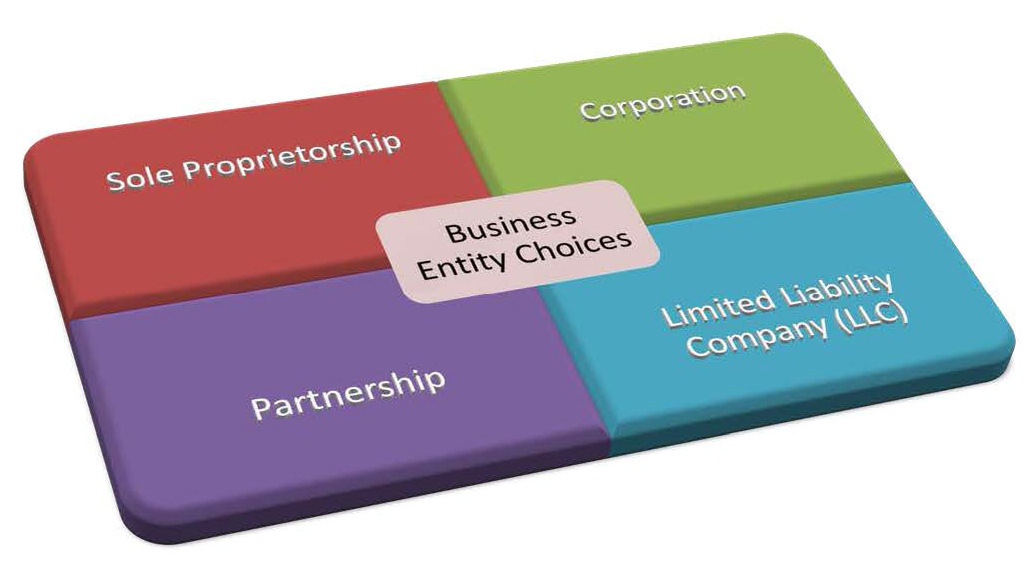
There are four primary entity choices that you can use to operate your business.

1. Sole Proprietorship
2. Corporation (C Corp or S Corp)
3. Limited Liability Company (LLC)
4. Partnership

Within the LLC and Partnership are some additional options, but that is beyond the scope of this lesson. For now, we will focus on these four entity choices. In today’s lesson, we will begin with entity choice #1 – Sole Proprietor.

Sole Proprietorship

A sole proprietorship is the simplest and most common structure chosen to start a business. It is an unincorporated business owned and run by one individual with no distinction between the business and you, the owner. You are entitled to all profits and are responsible for all your business’s debts, losses and liabilities.

Forming a Sole Proprietorship

You do not have to take any formal action to form a sole proprietorship. As long as you are the only owner, this status automatically comes from your business activities. In fact, you may already own one without knowing it. If you are a freelance writer, for example, you are a sole proprietor.

If you choose to operate under a name different than your own, you will most likely have to file a ficticious name (also known as an assumed name, trade name, or DBA name, short for “doing business as”). You must choose an original name; it cannot already be claimed by another business.

Sole Proprietor Taxes

Because you and your business are one and the same, the business itself is not taxed separately-the sole proprietorship income is your income. You report income and/or losses and expenses with a Schedule C and the standard Form 1040. The “bottom-line amount” from Schedule C transfers to your personal tax return. It’s your responsibility to withhold and pay all income taxes, including self-employment and estimated taxes.

Advantages of a Sole Proprietorship
• Owners can establish a sole proprietorship instantly, easily and inexpensively.
• Sole proprietorships carry little, if any, ongoing formalities.
• A sole proprietor need not pay unemployment tax on himself or herself (although he or she must pay unemployment tax on employees).
• Owners may freely mix business or personal assets.

Disadvantages of a Sole Proprietorship
• Owners are subject to unlimited personal liability for the debts, losses and liabilities of the business.
• Owners cannot raise capital by selling an interest in the business.
• Sole proprietorships rarely survive the death or incapacity of their owners and so do not retain value.

In the next lesson, we will discuss entity choice #2 – Corporation.

Resources: 

• IRS.gov (Small Business and Self Employed) – Find resources and information about legal business structures.

Important terms from this lesson:

Term

Definition

Sole Proprietorship A sole proprietorship is the simplest and most common structure chosen to start a business.


Action Step:   Watch and learn.

← Older posts
Newer posts →

Recent Posts

  • Never Stop Learning!
  • Lesson #83 – Financial Freedom Friday for Kids
  • Lesson #82 – Black CEO: Do More Than Save if You Want to Be Wealthy
  • Lesson #81 – Last-Minute Tax Tips to Maximize Your Savings (reposted from The Huffington Post)
  • Lesson #80 –Can Paying Your Taxes Late Affect Your Credit Score? (reposted from The Huffington Post)

Recent Comments

kenyasykes's avatarkenyasykes on Lesson #26 – Encouragement…
kenyasykes's avatarkenyasykes on Lesson #52 – The Flipside : 10…
Unknown's avatarLesson #52 – The Fli… on Lesson #52 – The Flipside : 10…
TheKnowledgeofWords's avatarcocolaelle on Lesson #26 – Encouragement…

Archives

  • September 2014
  • May 2014
  • April 2014
  • March 2014
  • February 2014
  • January 2014

Categories

  • Assets
  • Basic Personal Finance
  • Encouragement
  • Kids' Money
  • Uncategorized

Meta

  • Create account
  • Log in
  • Entries feed
  • Comments feed
  • WordPress.com

Enter your email address to follow this blog and receive notifications of new posts by email.

Join 22 other subscribers

Recent Posts

  • Never Stop Learning!
  • Lesson #83 – Financial Freedom Friday for Kids
  • Lesson #82 – Black CEO: Do More Than Save if You Want to Be Wealthy
  • Lesson #81 – Last-Minute Tax Tips to Maximize Your Savings (reposted from The Huffington Post)
  • Lesson #80 –Can Paying Your Taxes Late Affect Your Credit Score? (reposted from The Huffington Post)

Recent Comments

kenyasykes's avatarkenyasykes on Lesson #26 – Encouragement…
kenyasykes's avatarkenyasykes on Lesson #52 – The Flipside : 10…
Unknown's avatarLesson #52 – The Fli… on Lesson #52 – The Flipside : 10…
TheKnowledgeofWords's avatarcocolaelle on Lesson #26 – Encouragement…

Archives

  • September 2014
  • May 2014
  • April 2014
  • March 2014
  • February 2014
  • January 2014

Categories

  • Assets
  • Basic Personal Finance
  • Encouragement
  • Kids' Money
  • Uncategorized

Meta

  • Create account
  • Log in
  • Entries feed
  • Comments feed
  • WordPress.com

Facebook

Facebook

Create a free website or blog at WordPress.com.

Privacy & Cookies: This site uses cookies. By continuing to use this website, you agree to their use.
To find out more, including how to control cookies, see here: Cookie Policy
  • Subscribe Subscribed
    • Education and Action
    • Already have a WordPress.com account? Log in now.
    • Education and Action
    • Subscribe Subscribed
    • Sign up
    • Log in
    • Report this content
    • View site in Reader
    • Manage subscriptions
    • Collapse this bar
 

Loading Comments...