• About

Education and Action

~ Improving Financial Literacy and Teaching Wealth Building Principles

Education and Action

Monthly Archives: March 2014

Lesson #49 – Building wealth – Step 1: Create/Develop Assets – Health Savings Accounts (HSA)

10 Monday Mar 2014

Posted by kenyasykes in Basic Personal Finance

≈ Leave a comment

Is a HSA right for you?

What if you do NOT itemize your deductions?

What if you cannot deduct you out-of-pocket medical expenses?

 2

As we continue the march to the April 15th tax deadline, there are several tax benefits that may help you and your family in more ways than one.  Let’s face it, the rising costs of healthcare has had a negative impact on our government debt, an employers’ ability to raise wages and rank and file employees’ discretionary income.  To mitigate these costs and turn otherwise non-deductible items into tax-deductible items, you should seriously consider the Health Savings Account; one of the most beneficial, yet least understood tax benefits.

Education:

Health Savings Accounts (HSAs) were created in 2003 so that individuals covered by high-deductible health plans (HDHP) could receive tax-preferred treatment of money saved for medical expenses.  In today’s lesson, we will discuss how the HSA can be used to help you to save and invest money for future medical expenses.  To entice you, it may help to tell you that the HSA is a triple whammy account – it offers three tax advantages.

  1. Tax-free contributions.
  2. Tax-free earnings.
  3. Tax-free expenses (qualified medical expenses).

Now that I have your attention, let’s get into the nuts and bolts of the HSA.

Generally, an adult who is covered by a high-deductible health plan (and has no other first-dollar coverage) may establish an HSA.   A high-deductible health plan (HDHP) is a health insurance plan with lower premiums and higher deductibles than a traditional health plan.  Those premium and deductible limits are a function of federal regulation.  Each year, the IRS releases three key HSA limits – the HSA contribution limit, the HDHP minimum required deductible, and the HDHP out-of-pocket maximum. For 2013, those amounts were as follows:

HSA Contribution Limits. The 2013 annual HSA contribution limit for individuals with self-only HDHP coverage is $3,250 (a $150 increase from 2012), and the limit for individuals with family HDHP coverage is $6,450 (a $200 increase from 2012).
HDHP Minimum Required Deductibles. The 2013 minimum annual deductible for self-only HDHP coverage is $1,250 ($50 increase from 2012), and the minimum annual deductible for family HDHP coverage is $2,500 (a $100 increase from 2012).

HDHP Out-of-Pocket Maximum. The 2013 maximum limit on out-of-pocket expenses (including items such as deductibles, co-payments, and co-insurance, but not premiums) for self-only HDHP coverage is $6,250 (a $200 increase from 2012), and the limit for family HDHP coverage is $12,500 (a $400 increase from 2012).

index

The chart below lists some of the pros and cons of Health Savings Accounts (HSA).

Pros

Cons

Pretax contributions (or tax-deductible contributions, if you’re on your own). No new contributions allowed to the account after you have signed up for Medicare Part A or Medicare Part B.
Catch-up contributions of $1,000 per individuals age 55 and older. 20% penalty — plus an income-tax bill — if you use any of the money for nonmedical expenses before age 65.


Spend the HSA money tax-free on out-of-pocket medical expenses, such as your deductible, co-payments for medical care and prescription drugs, or bills not covered by insurance, such as vision and dental care. The account cannot be used to pay insurance premiums (except for limited exception for COBRA premiums).
Most plans provide a debit card and an online bill-payment option. Few  insurers in the Affordable Care Act offer HDHP with HSAs.
No use it or lose it.  HSA funds can be carried over from year to year future use. You must be enrolled in a HDHP to set up an HSA.
No income limits. Must meet certain Federal guidelines.
Portability (you can keep the money in an HSA account even if you switch jobs.) 20% penalty assessed on excess contributions over the federal limit.
Rollovers allowed from other HSA accounts.  
FDIC Insured  
Great tool for taxpayers who either do NOT itemize or whose medical expenses fall below the threshold.  
Contributions can be made through payroll deductions.  
Employer can make contributions to employee accounts.  


Resources:

HSAcenter (www.hsacenter.com) – a source of information for consumers looking for HSA options.

Important terms from this lesson:

Term

Definition

High-Deductible Health Plan (HDHP) A high-deductible health plan (HDHP) is a health insurance plan with lower premiums and higher deductibles than a traditional health plan. Being covered by an HDHP is also a requirement for having a health savings account.
Health Savings Account (HSA) A health insurance plan that has a high minimum deductible, which does not cover the initial costs or all of the costs of medical expenses.


Action Step:  Watch and Learn.

Carve out 18 minutes to watch the video and learn about the awesome benefits providing by using a HSA. 

Health Savings Accounts

Lesson #48 – This Week’s Recap!

09 Sunday Mar 2014

Posted by kenyasykes in Uncategorized

≈ Leave a comment

Monday, March 3, 2014

Lesson #42 – Building wealth – Step 1: Create/Develop Assets – Education Savings Accounts – Coverdell ESAs

Tuesday, March 4, 2014

Lesson #43 – Building wealth – Step 1: Create/Develop Assets – Education Savings Accounts – 529 Plans

Wednesday, March 5, 2014

Lesson #44 – Building wealth – Step 1: Create/Develop Assets – Education Savings Accounts – Prepaid College Plans

Thursday, March 6, 2014

Lesson #45 – Building wealth – Step 1: Create/Develop Assets – Tax Benefits for Education

Friday, March 7, 2014

Lesson #46 – – Financial Freedom Friday for Kids

Saturday, March 8, 2014

Lesson #47 – Encouragement Saturday!

Lesson #47 – Encouragement Saturday!

08 Saturday Mar 2014

Posted by kenyasykes in Encouragement

≈ Leave a comment

Each Saturday, I will find ways to encourage you to reach your goals.  Whether it’s a video, an inspirational message, a poem, or whatever…I want to keep you focused on achieving your goals.  Remember that you are the sun and you will provide the light for the people around you to believe.  By embarking on this journey, you have already proven that you are a standout in the crowd, a leader.  You have shown the desire and willingness to improve your life by implementing new strategies and lessons.  I strongly believe that you will be the catalyst for a seismic shift in your family.

Today, our encouragement comes from Steve Jobs and the commencement address that will change your life.

Have a beautiful Saturday!

Action Step:  Be encouraged and do not forget to Feed The Pig!

Lesson #46 – – Financial Freedom Friday for Kids

07 Friday Mar 2014

Posted by kenyasykes in Kids' Money

≈ Leave a comment

Budgeting  101 for Kids!

photo

Let’s face it, kids love to spend money!  The problem is that there is disconnect in the minds of children between the efforts it takes to earn money and the ease of hand to spend it.  That divide can be fixed if we take the time to teach kids about the value of budgeting. 

Education:

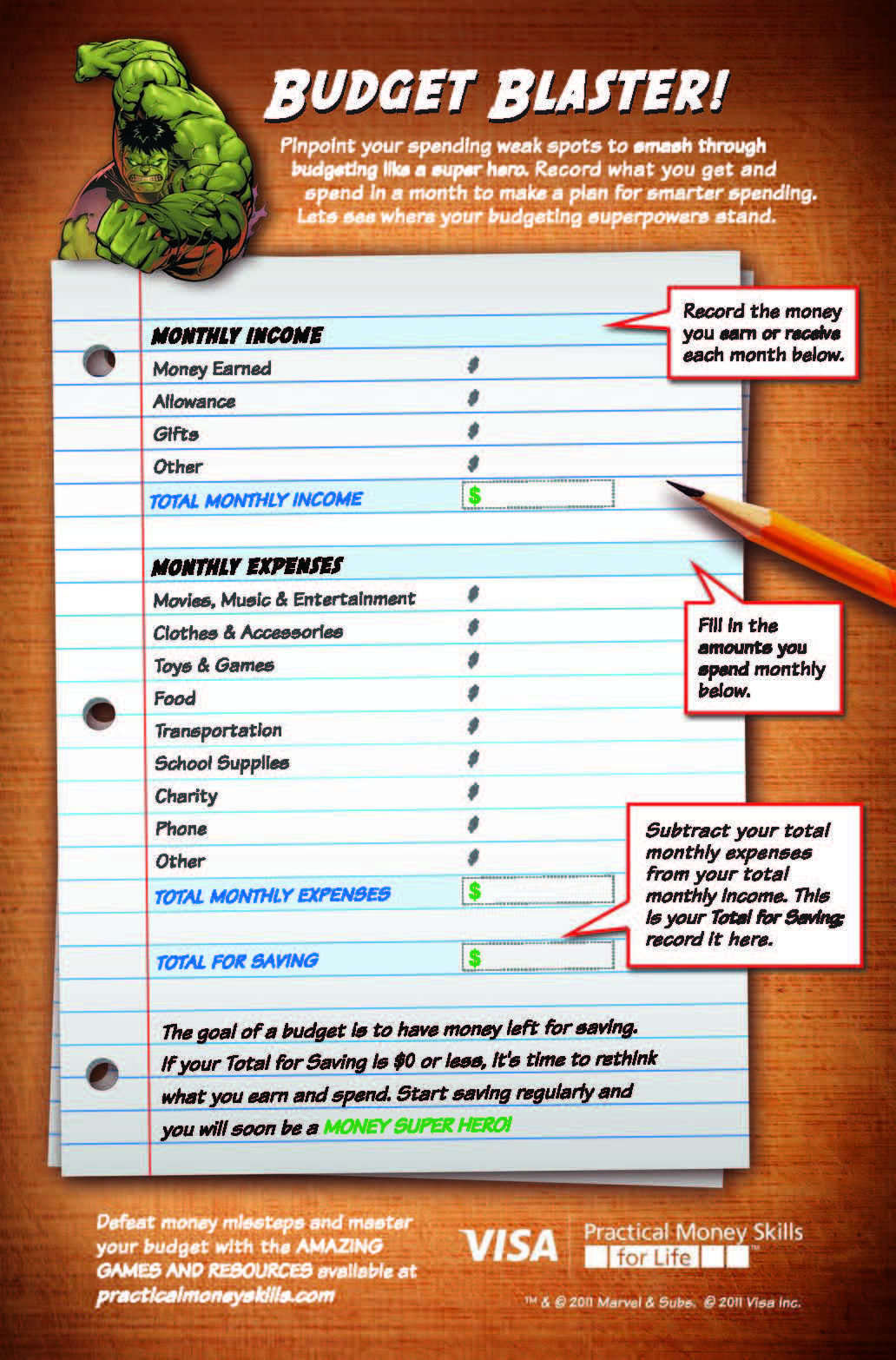
Today’s lesson is to teach kids about the value of Budgeting using Practical Money Skills’ Marvel Budget Blaster.  It’s important for kids to understand that unless you are Warren Buffet, money is a finite resource that must be used wisely.  This week they want the new Xbox, next week they want the new Air Jordans, and so on.  The problem is that parents have failed to paint the yellow brick road for them. The yellow brick road conjures up the journey that Dorothy took in the Wizard of Oz. In reality, parents travel that yellow brick road everyday and it’s called their JOB.  Kids don’t often see the work involved with to earn the money, so they don’t see it as a limited resource.  In the last few decades, we have moved from a cash society to a credit/debit card society.  Though that transition has made it more convenient for parents to consume and do personal banking, kids see the card as an unlimited source of money to make them happy.  Today, we will shatter their little perception and teach them how to prioritize the things they want with the money that they have.  Kids must learn the difference between two very important terms, disposable income and discretionary income.

Discretionary income – The amount of an individual’s income that is left for spending, investing or saving after taxes and personal necessities (such as food, shelter, and clothing) have been paid. Discretionary income includes money spent on luxury items, vacations and non-essential goods and services.

Disposal income –The amount of personal income an individual has after taxes and government fees, which can be spent on necessities, or non-essentials, or be saved.

Marvel Budget Worksheet


Resources:

Marvel Budget Worksheet and Resources – See Action Step below.

Important terms from this lesson:

Term

Definition

Budget An estimate of income and expenses.


Action Step:  Introduce the Marvel Budget Worksheet to your kids

  1. Click the link to download the Marvel Budget Blaster.
  2. Sit down and talk to you kids about budgeting and help them to complete the form for the month of March.
  3. If you need a little assistance, watch the video with your child – How To Build A Budget

Lesson #45 – Building wealth – Step 1: Create/Develop Assets – Tax Benefits for Education

06 Thursday Mar 2014

Posted by kenyasykes in Basic Personal Finance

≈ Leave a comment

Are you taking advantage of the Education Tax Credits and Deductions?

 photo 3

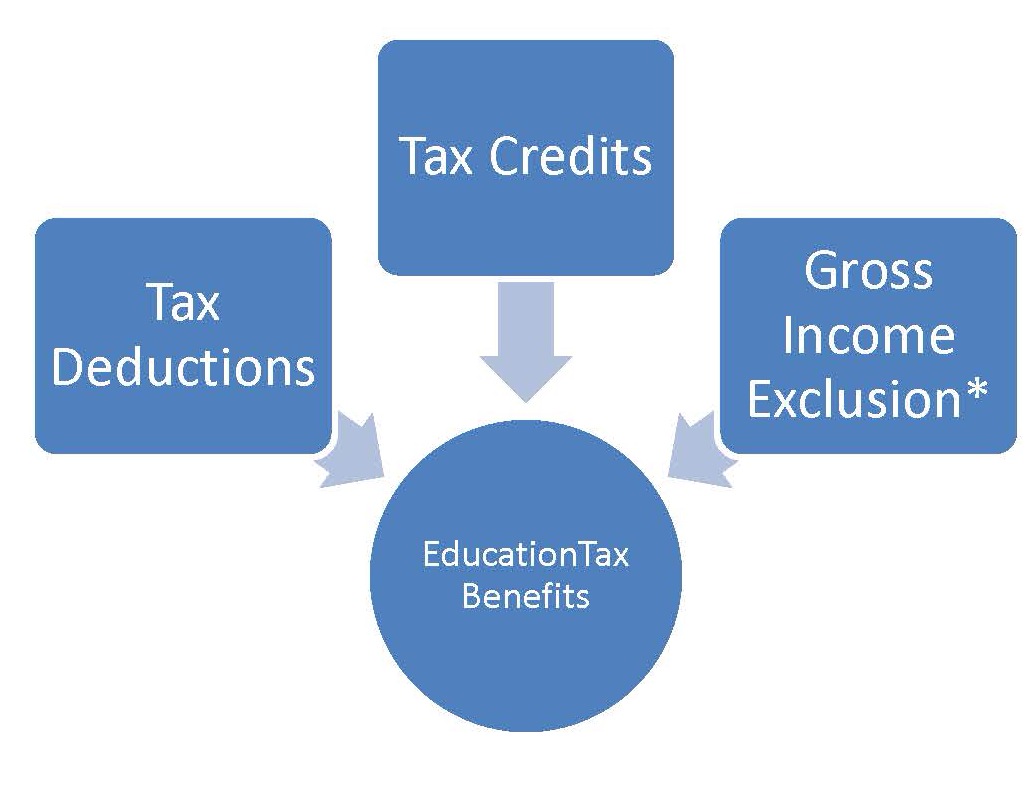
*To be discussed in a separate lesson.

Tax credits, deductions and savings plans can help taxpayers with their expenses for higher education. The calculus is to choose the one that will yield the best result – the lowest overall tax.  That’s it!  When coupled with the education savings plans that we discussed earlier this week, parents can use these additional incentives to help curb the cost of a child’s education.

Education:

There are three types of education tax benefits.  In today’s lesson, we will help you understand the different benefits that are available to you and how they can be used to save you MONEY!

Tax Benefit

What is does

Preference

Tax Deduction

Reduces the amount of income tax that you pay dollar-for-dollar.

Least preferred

Tax Credit

Reduces the amount of your income that is subject to tax.

Preferred

Gross Income Exclusion

No income tax is paid on this benefit, but you may be prevented from using additional tax-free benefits (deductions and credits).

Most preferred


EDUCATION TAX CREDITS

The diagram below depicts the education-related tax credits that may be available for parents.

 photo 2

It is important that you understand the difference between the education tax credits available to you.   To make it easier to compare the two most predominate tax credits currently available, please refer to the comparison chart below.


American Opportunity Tax Credit

Lifetime Learning Credit

Maximum credit Maximum credit up to $2,500 credit per eligible student. Up to $2,000 ($4,000 if a student in a Midwestern disaster area) credit per return .
Limit on modified adjusted gross income (MAGI) $180,000 if married filling jointly adjusted gross $90,000 if single, head of household, or qualifying widow(er). $120,000 if married filling jointly; $60,000 if single, head of household, or   qualifying widow(er).
Refundable or nonrefundable 40% of credit may be refundable; the rest is nonrefundable.
Number of years of postsecondary education Available only for the first 4 years of postsecondary education. Available for all years of postsecondary and for courses to acquire or improve job skills.
Number of tax years credit available Available only for 4 tax years per (including any year(s)  Hope Scholarship Credit was claimed.) Available for an unlimited number of years.
Type of degree required Student must be pursuing an undergraduate degree or other recognized education credential. Student does not need to be pursuing a degree or other recognized education credentials.
Number of courses Student must be enrolled at least half time for at least one academic period  beginning during the year. Available for one or more courses.
Felony drug conviction No felony drug convictions on student’s records. Felony drug convictions are permitted.
Qualified expenses Tuition and required enrollment fees.  Course-related books, supplies and equipment do not need to be purchased from the institution to qualify.
Payments for academic periods Payments made in 2010 for academic periods beginning in 2011 and in the first 3 months of 2011. Payments made in 2009 for academic periods beginning in 2009 and in the first 3 months of 2010.

Example – Tax Credit

A married couple has a total TAXABLE income is $15,000, which results in a tax bill of $1,500 (10% tax bracket).  One spouse took a few courses during the year, for a total tuition and fees of $3,000.  The couple is ineligible for the American Opportunity Tax Credit because both spouses have undergraduate degrees.  The couple is able to claim the lifetime learning credit.

Total Tax                                                  $1, 500

Less: Lifetime Learning Credit                  <1,500>

Tax After Credits                                 $        0  <<< Yippie 🙂

EDUCATION TAX DEDUCTIONS

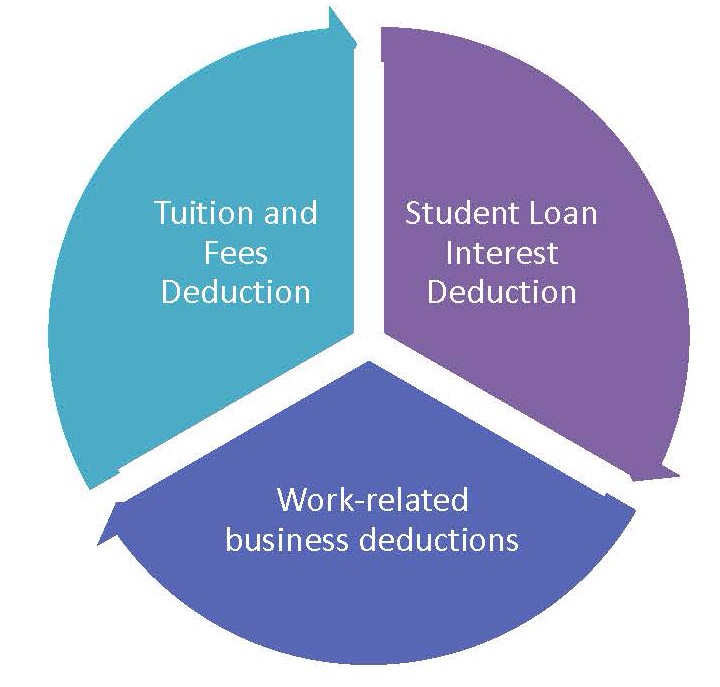
The diagram below depicts the education-related tax deductions that may be available for parents.  The work-related business deductions are beyond the scope of today’s lesson and will be discussed in the near future.

photo 1


Tuition and Fees Deduction

Pros

Cons

Deduct qualified education expenses paid during the year for yourself, your spouse or your dependent.   You cannot claim this deduction if your filing status is married filing separately or if another person can claim an exemption for you as a dependent on his or her tax return.
Can reduce the amount of your income subject to tax by up to $4,000. The qualified expenses must be for higher education.
You can claim this deduction even if you do not itemize deductions. Deduction is phased out if your modified adjusted gross income (MAGI) is more than $80,000 ($160,000 if filing a joint return).
Student-activity fees and expenses for course-related books, supplies and equipment are included in qualified education expenses only if the fees and expenses must be paid to the institution as a condition of enrollment or attendance.  Cannot be claimed if you were a nonresident alien for any part of the year and did not elect to be treated as a resident alien for tax purposes.


Student Loan Interest Deduction

Pros

Cons

Can reduce the amount of your income subject to tax by up to $2,500. Deduction is phased out if your modified adjusted gross income (MAGI) is less than $75,000 ($150,000 if filing a joint return),
You can claim this deduction even if you do not itemize deductions. Must be a qualified student loan.


Example – Tax Deduction

A married couple has a total TAXABLE income is $15,000, which results in a tax bill of $1,500 (10% tax bracket).  One spouse took a few courses during the year, for a total tuition and fees of $3,000.  The couple is ineligible for the American Opportunity Tax Credit because both spouses have undergraduate degrees.  The couple is able to claim the lifetime learning credit.

Total Taxable Income                              $15,000

Less: Tuition and Fees Deduction           <3,000>

Taxable Income after Deduction           $12,000

                Total tax $12,000 x 10%                      $1,200 <<< tax bill  😦

Resources:

FinAid – (http://www.finaid.org/otheraid/tax.phtml) – The smart student guide to financial aid.

Important terms from this lesson:

Term

Definition

Tax Credit Reduces the amount of income tax you may have to pay dollar-for-dollar.
Tax Deduction A deduction reduces the amount of your income that is subject to tax, thus generally reducing the amount of tax you may have to pay.
Gross Income Exclusion No tax is paid on the benefit.
Qualified Student Loan loan you took out solely to pay qualified education expenses


Action Step:   Find out if you are eligible to claim an Education Credit

http://www.youtube.com/watch?v=8w24hxuBwF0

Use the IRS Interactive Tax Assistant to see if you are eligible to claim an education credit.

This application will help you determine if you are eligible for certain educational credits or deductions including the American Opportunity Credit, the Lifetime Learning Credit and the Tuition and Fees Deduction.

Am I Eligible to Claim an Education Credit

Lesson #44 – Building wealth – Step 1: Create/Develop Assets – Education Savings Accounts – Prepaid College Plans

05 Wednesday Mar 2014

Posted by kenyasykes in Basic Personal Finance

≈ Leave a comment

Are Prepaid College Tuition Plans Right For You?

index2

When you have a kid, everyone says “it goes by so fast,” and they’re right. But when you’re talking about college savings, time is on your side when you start early. Prepaid tuition programs are exactly what the name implies: the chance to pay now and buy a certain number of educational credits/years of college at today’s tuition rates. Or so the promotional materials like to say.

Education:

There are several ways to save for the impending costs of college.  Some of the investment or savings vehicles that are available to taxpayers are as follows:

1.       Coverdell Education Savings Accounts

2.       529 Plans

3.       Prepaid College Plans or Prepaid Tuition Plans

In this lesson, we will focus on the Prepaid College Plans, which allow you to prepay for future tuition — typically at today’s prices. A popular college savings vehicles offered at one time in about 20 U.S. states are increasingly running on empty. Currently, only about 19 states still offer a variation of the original plan.  Massachusetts, Florida, Mississippi and Washington are the only four states that guarantee their plans through full faith and credit of the state, meaning that if the plan goes bust, the state has to pay the promised tuition amount. The Texas plan is guaranteed by the state universities and colleges.  The main issue with this savings vehicle is that the state sponsored plan could go broke before your child receives benefits.

There are pros and cons to prepaid plans. Let’s go through each.

Pros

Cons

Purchase tomorrow’s college education based on today’s costs – lock in future tuition costs Must attend a college included in the selected plan to receive full benefits
Professionally managed Often limited to use for only tuition and fees
If your child attends a state college or university, you will have gotten a good deal on tuition. Not all states have plans.
Low contribution amounts accepted Declining market returns
  Fees
  Plan may not guarantee payments when you need them in the future
  You could do better investing the money yourself in a college savings plan.
  Less control over account.
  You run the risk of your state becoming unable to back the funds.


Example (as originally envisioned):

A family could set a tuition rate for colleges within the state’s boundaries at $40,000 for four years when a child is five years old and spend the next 12 years contributing that. If the four-year course costs $60,000 when the child gets to college, the family still only pays $40,000, and will save $20,000.

index

The prepaid tuition plan is just another option for college savers.  Please evaluate all of your options before committing to a strategy to pay for your child’s education.

In the next lesson, we will discuss the tax incentives available to taxpayers to help curb the cost the rising costs of college.

Resources:

Mapping your future (https://mappingyourfuture.org/saving/programs.htm)  – for more information about Prepaid Tuition Plans.

Important terms from this lesson:

Term

Definition

Prepaid Tuition Plans Prepaid tuition plans allow donors to lock in the future cost of tuition in today’s dollars.


Action Step:   Watch and Learn.

Watch the U Plan and learn about how Prepaid Tuition Plans work.

http://www.youtube.com/watch?v=dt4Fo2eKuEg

Lesson #43 – Building wealth – Step 1: Create/Develop Assets – Education Savings Accounts – 529 Plans

04 Tuesday Mar 2014

Posted by kenyasykes in Basic Personal Finance

≈ Leave a comment

Some things that are too good to be true, actually are GOOD and TRUE!

GTY_piggy_bank_jef_130913_16x9_992


The 529 College Savings Plan should be rephrased, “the plan that keeps on giving”.  The 529 plan is what we call the triple whammy because if used properly, it is perhaps the only investment account that can wield three powerful tax benefits.

1.       Tax-free distributions if used to pay qualified education expenses.

2.       Potential state tax deduction for contributions (Connecticut, Michigan, New York and Pennsylvania are among the states where the maximum deduction for a couple is at least $10,000)

3.       Contributions and earnings grow tax-free.

Bonus: Powerful when coupled with the American Opportunity Tax Credit, Hope Credit or Lifetime Learning Credit.

Education:

There are several ways to save for the impending costs of college.  Some of the investment or savings vehicles that are available to taxpayers are as follows:

1.       Coverdell Education Savings Accounts

2.       529 Plans

3.       Prepaid College Plans

In this lesson, we will focus on the 529 Plan, a tax-advantaged investment vehicle in the U.S. designed to encourage saving for the future higher education expenses of a designated beneficiary. A 529 plan (named after a section of the tax code) is a powerful way to shelter investment income from tax. It works like a Roth retirement account. There’s no deduction on your federal income tax return for the money you put in, but any money coming out is free of income tax. So a 529 account is way better than most tax shelters (like variable annuities), which merely defer tax

Advantages

Disadvantages

Anyone can set up an account for either themselves, their spouse, dependents, grandchildren, neighbor, etc. (you get the picture) Low rate of return
Broad application for educational purposes If the money is ultimately not used for eligible education purposes, any growth is taxed as ordinary income, and subject to a 10 percent penalty.
Principal grows tax-deferred The ongoing investment of the account is handled by the plan, not by the donor.
Distributions for the beneficiary’s college costs are exempt from tax An account owned by a parent for a dependent student is reported on the Free Application for Federal Student Aid (FAFSA) as a parental asset.
No contribution limit  
Great to use with Sec. 2503 giving  
Donor maintains control of the account  
Account is out of the owner’s (donor) estate  
There are no income limitations that make you ineligible for an account  
Most states have no age limit for when the money has to be used. If the child gets a scholarship, any unused money can be withdrawn without paying a penalty (just the tax)  
Money not used for one beneficiary, may be used for another who is a family member.  
Simple Enrollment  
Low contribution amounts allowed (as low as $25)  
Nearly all states sponsor their own plan.


Example:

Say you put $10,000 in now, then withdraw the money five years later when it has grown to $13,000. The $3,000 gain is exempt from state and federal income tax, provided the entire $13,000 is used for higher education.

Resources:

College Savings Plans Network (CSPN) (http://www.collegesavings.org/viewState.aspx?state=FL) – works to improve 529 plans at the federal and state level and serves as a clearinghouse for information among existing programs.

Important terms from this lesson:

Term

Definition

529 Plans A tax-advantaged investment vehicle in the U.S. designed to encourage saving for the future higher education expenses of a designated beneficiary


Action Step:   Watch Dave Ramsey on the 529 Plan.

http://www.youtube.com/watch?v=GR_JV_nAxvE

Lesson #42 – Building wealth – Step 1: Create/Develop Assets – Education Savings Accounts – Coverdell ESAs

03 Monday Mar 2014

Posted by kenyasykes in Basic Personal Finance

≈ Leave a comment

According to the College Board, the average cost of tuition and fees for the 2013–2014 school year was $30,094 at private colleges, $8,893 for state residents at public colleges, and $22,203 for out-of-state residents attending public universities.

 images2

As the cost of college becomes more preventative,  it may be helpful for parents of future college students to begin to utilize the various education savings accounts available to help save for the costs of rising tuition.  Sure, it would be wonderful if your child received a scholarship or grant, but the truth is, that may not happen.  Yes, student loans may be an option, but that comes with its own set of challenges by saddling the student with debt.  While these savings plans may not cover the full costs of tuition and fees, it puts you (the taxpayer) in the driver seat by giving your control of the process and outcome. 

Education:

There are several ways to save for the impending costs of college.  Some of the investment or savings vehicles that are available to taxpayers are as follows:

1.       Coverdell Education Savings Accounts

2.       529 Plans

3.       Prepaid College Plans

In this lesson, we will focus on the Coverdell Education Savings Account (ESA), which is a savings account that is set up to pay the qualified education expenses of a designated beneficiary.  As stated on the website saving forcollege.com, “this is perhaps one of the least-understood investment vehicles around.”  Because of that, many taxpayers default to 529 plans, but the Coverdell ESA may actually be a better option for you and your beneficiary.  The Coverdell ESA functions much like the Roth IRA account so while the contributions are not deductible, future distributions may be 100% deductible.

To help you understand how the Coverdell ESA works, let’s take a look at some of the advantages and disadvantages of the Coverdell ESAs.

Advantages of Coverdell ESAs

  • Can be opened in the United States at any bank or other IRS-approved entity that offers Coverdells ESAs.
  • Contributions can be made until the due date of the contributor’s tax return, without extensions (that is April 15th for most taxpayers).
  • Distributions are tax-free as long as they are used for qualified education expenses.
  • There is no tax on distributions if they are for enrollment or attendance at an eligible educational institution. The Hope and lifetime learning credits can be claimed in the same year the beneficiary takes a tax-free distribution from a Coverdell ESA, as long as the same expenses are not used for both benefits.
  • The designated beneficiary can be changed.
  • Assets can be rolled over from one Coverdell ESA to another.
  • The beneficiary’s interest can be transferred to a spouse or former spouse because of divorce.

images3

Disdadvantages of Coverdell ESAs

  • Contributions are not tax deductible (made from aftertax dollars)
  • Tax law prohibits ESA funding once the beneficiary reaches age 18. Total contributions limited to $2,000 per year, per beneficiary.
  • Balance in the account generally must be distributed within 30 days after the beneficiary reaches age 30, unless the beneficiary is a special needs beneficiary or the beneficiary’s death.
  • If the distribution exceeds qualified education expenses, a portion will be taxable to the beneficiary and will usually be subject to an additional 10% tax.  Exceptions to the additional 10% tax include the death or disability of the beneficiary or if the beneficiary receives a qualified scholarship.
  • Contribution limits may apply based on the contributor’s Modified Adjusted Gross Income.
  • The beneficiary must pay a 6% excise tax each year on excess contributions that are in a Coverdell ESA at the end of the year.
  • The relatively low contribution limit means that even a small annual maintenance fee charged by the financial institution holding your ESA could significantly affect your overall investment return.

Example – Contribution

When Maria Luna was born in 2012, three separate Coverdell ESAs were set up for her, one by her parents, one by her grandfather, and one by her aunt. In 2013, the total of all contributions to Maria’s three Coverdell ESAs cannot be more than $2,000. For example, if her grandfather contributed $2,000 to one of her Coverdell ESAs, no one else could contribute to any of her three accounts. Or, if her parents contributed $1,000 and her aunt $600, her grandfather or someone else could contribute no more than $400. These contributions could be put into any of Maria’s Coverdell ESA accounts.

In the next lesson, we will discuss 529 plans as a alternative investment option.

Resources:

Savingforcollege.com – Savingforcollege.com was established as a private company in 1999 with a mission to help individuals and professional advisors better understand how to meet the challenge of paying higher education costs.

Important terms from this lesson:

Term

Definition

Coverdell Education Savings Accounts A savings account set up in the United States solely for paying qualified education expenses for the designated beneficiary of the account
Qualified Education Expenses Such as tuition and fees, required books, supplies and equipment and qualified expenses for room and board.
Eligible Education Institution This includes any public, private or religious school that provides elementary or secondary education as determined under state law. Eligible institutions also include any college, university, vocational school or other postsecondary educational institution eligible to participate in a student aid program administered by the Department of Education. Virtually all accredited public, nonprofit, and proprietary (privately owned profit-making) postsecondary institutions are eligible.
Beneficiary The individual (student) who is to be the recipient of future distributions.
Contributor The owner or custodian of the account.

Action Step:       Use the World’s Simplest College Cost Calculator to calculate how much your child will need for college.

1.       Click the link World’s Simplest College Cost Calculator and enter your child’s age.

2.       Change the inputs to see how the results will change.

3.        Download the report and use this to begin planning for how you will finance your child’s education

Lesson #41 – This week’s recap!

02 Sunday Mar 2014

Posted by kenyasykes in Encouragement

≈ Leave a comment

Monday, February 24, 2014

Lesson #35 – Building wealth – Step 1: Create/Develop Assets – Saving For Retirement

Tuesday, February 25, 2014

Lesson #36 – Building wealth – Step 1: Create/Develop Assets – Individual Retirement Arrangements (IRA vs. Roth IRA)

Wednesday, February 26, 2014

Lesson #37 – Building wealth – Step 1: Create/Develop Assets – Employment-related Retirement Plans

Thursday, February 27, 2014

Lesson #38 – Building wealth – Step 1: Create/Develop Assets – MyRA – Understanding President Obama’s Retirement Savings Plan

Friday, February 28, 2014

Lesson #39 – Financial Freedom Friday for Kids

Saturday, March 1, 2014

Lesson #40 – Encouragement Saturday!

Lesson #40 – Encouragement Saturday!

01 Saturday Mar 2014

Posted by kenyasykes in Encouragement

≈ Leave a comment

Each Saturday, I will find ways to encourage you to reach your goals.  Whether it’s a video, an inspirational message, a poem, or whatever…I want to keep you focused on achieving your goals.  Remember that you are the sun and you will provide the light for the people around you to believe.  By embarking on this journey, you have already proven that you are a standout in the crowd, a leader.  You have shown the desire and willingness to improve your life by implementing new strategies and lessons.  I strongly believe that you will be the catalyst for a seismic shift in your family.

Today, our encouragement comes from Invictus by William Ernest Henley

Out of the night that covers me,
Black as the Pit from pole to pole,
I thank whatever gods may be
For my unconquerable soul.

In the fell clutch of circumstance
I have not winced nor cried aloud.
Under the bludgeonings of chance
My head is bloody, but unbowed.

Beyond this place of wrath and tears
Looms but the Horror of the shade,
And yet the menace of the years
Finds, and shall find, me unafraid.

It matters not how strait the gate,
How charged with punishments the scroll.
I am the master of my fate:
I am the captain of my soul.


Have a beautiful Saturday!

Action Step:  Be encouraged and do not forget to Feed The Pig!

Newer posts →

Recent Posts

  • Never Stop Learning!
  • Lesson #83 – Financial Freedom Friday for Kids
  • Lesson #82 – Black CEO: Do More Than Save if You Want to Be Wealthy
  • Lesson #81 – Last-Minute Tax Tips to Maximize Your Savings (reposted from The Huffington Post)
  • Lesson #80 –Can Paying Your Taxes Late Affect Your Credit Score? (reposted from The Huffington Post)

Recent Comments

kenyasykes's avatarkenyasykes on Lesson #26 – Encouragement…
kenyasykes's avatarkenyasykes on Lesson #52 – The Flipside : 10…
Unknown's avatarLesson #52 – The Fli… on Lesson #52 – The Flipside : 10…
TheKnowledgeofWords's avatarcocolaelle on Lesson #26 – Encouragement…

Archives

  • September 2014
  • May 2014
  • April 2014
  • March 2014
  • February 2014
  • January 2014

Categories

  • Assets
  • Basic Personal Finance
  • Encouragement
  • Kids' Money
  • Uncategorized

Meta

  • Create account
  • Log in
  • Entries feed
  • Comments feed
  • WordPress.com

Enter your email address to follow this blog and receive notifications of new posts by email.

Join 22 other subscribers

Recent Posts

  • Never Stop Learning!
  • Lesson #83 – Financial Freedom Friday for Kids
  • Lesson #82 – Black CEO: Do More Than Save if You Want to Be Wealthy
  • Lesson #81 – Last-Minute Tax Tips to Maximize Your Savings (reposted from The Huffington Post)
  • Lesson #80 –Can Paying Your Taxes Late Affect Your Credit Score? (reposted from The Huffington Post)

Recent Comments

kenyasykes's avatarkenyasykes on Lesson #26 – Encouragement…
kenyasykes's avatarkenyasykes on Lesson #52 – The Flipside : 10…
Unknown's avatarLesson #52 – The Fli… on Lesson #52 – The Flipside : 10…
TheKnowledgeofWords's avatarcocolaelle on Lesson #26 – Encouragement…

Archives

  • September 2014
  • May 2014
  • April 2014
  • March 2014
  • February 2014
  • January 2014

Categories

  • Assets
  • Basic Personal Finance
  • Encouragement
  • Kids' Money
  • Uncategorized

Meta

  • Create account
  • Log in
  • Entries feed
  • Comments feed
  • WordPress.com

Facebook

Facebook

Create a free website or blog at WordPress.com.

Privacy & Cookies: This site uses cookies. By continuing to use this website, you agree to their use.
To find out more, including how to control cookies, see here: Cookie Policy
  • Subscribe Subscribed
    • Education and Action
    • Already have a WordPress.com account? Log in now.
    • Education and Action
    • Subscribe Subscribed
    • Sign up
    • Log in
    • Report this content
    • View site in Reader
    • Manage subscriptions
    • Collapse this bar
 

Loading Comments...