
Are you taking advantage of the Education Tax Credits and Deductions?
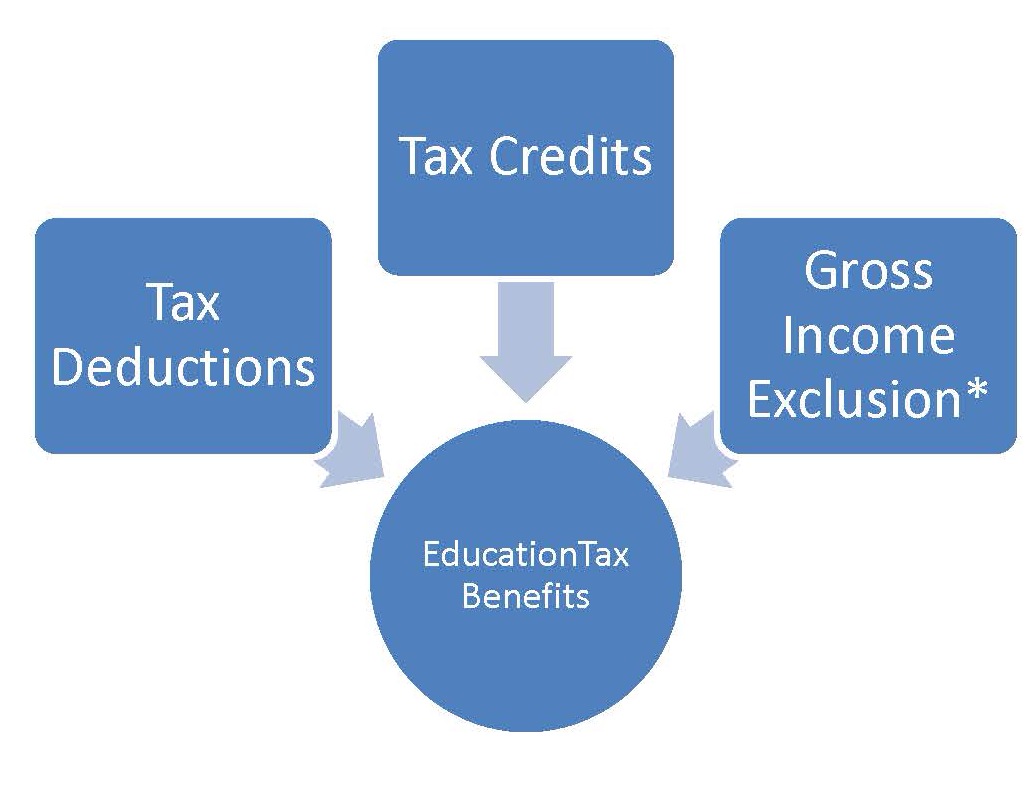
*To be discussed in a separate lesson.
Tax credits, deductions and savings plans can help taxpayers with their expenses for higher education. The calculus is to choose the one that will yield the best result – the lowest overall tax. That’s it! When coupled with the education savings plans that we discussed earlier this week, parents can use these additional incentives to help curb the cost of a child’s education.
Education:
There are three types of education tax benefits. In today’s lesson, we will help you understand the different benefits that are available to you and how they can be used to save you MONEY!
Tax Benefit |
What is does |
Preference |
Tax Deduction |
Reduces the amount of income tax that you pay dollar-for-dollar. |
Least preferred |
Tax Credit |
Reduces the amount of your income that is subject to tax. |
Preferred |
Gross Income Exclusion |
No income tax is paid on this benefit, but you may be prevented from using additional tax-free benefits (deductions and credits). |
Most preferred |
EDUCATION TAX CREDITS
The diagram below depicts the education-related tax credits that may be available for parents.

It is important that you understand the difference between the education tax credits available to you. To make it easier to compare the two most predominate tax credits currently available, please refer to the comparison chart below.
|
American Opportunity Tax Credit |
Lifetime Learning Credit |
|
| Maximum credit | Maximum credit up to $2,500 credit per eligible student. | Up to $2,000 ($4,000 if a student in a Midwestern disaster area) credit per return . |
| Limit on modified adjusted gross income (MAGI) | $180,000 if married filling jointly adjusted gross $90,000 if single, head of household, or qualifying widow(er). | $120,000 if married filling jointly; $60,000 if single, head of household, or qualifying widow(er). |
| Refundable or nonrefundable | 40% of credit may be refundable; the rest is nonrefundable. | |
| Number of years of postsecondary education | Available only for the first 4 years of postsecondary education. | Available for all years of postsecondary and for courses to acquire or improve job skills. |
| Number of tax years credit available | Available only for 4 tax years per (including any year(s) Hope Scholarship Credit was claimed.) | Available for an unlimited number of years. |
| Type of degree required | Student must be pursuing an undergraduate degree or other recognized education credential. | Student does not need to be pursuing a degree or other recognized education credentials. |
| Number of courses | Student must be enrolled at least half time for at least one academic period beginning during the year. | Available for one or more courses. |
| Felony drug conviction | No felony drug convictions on student’s records. | Felony drug convictions are permitted. |
| Qualified expenses | Tuition and required enrollment fees. Course-related books, supplies and equipment do not need to be purchased from the institution to qualify. | |
| Payments for academic periods | Payments made in 2010 for academic periods beginning in 2011 and in the first 3 months of 2011. | Payments made in 2009 for academic periods beginning in 2009 and in the first 3 months of 2010. |
Example – Tax Credit
A married couple has a total TAXABLE income is $15,000, which results in a tax bill of $1,500 (10% tax bracket). One spouse took a few courses during the year, for a total tuition and fees of $3,000. The couple is ineligible for the American Opportunity Tax Credit because both spouses have undergraduate degrees. The couple is able to claim the lifetime learning credit.
Total Tax $1, 500
Less: Lifetime Learning Credit <1,500>
Tax After Credits $ 0 <<< Yippie 🙂
EDUCATION TAX DEDUCTIONS
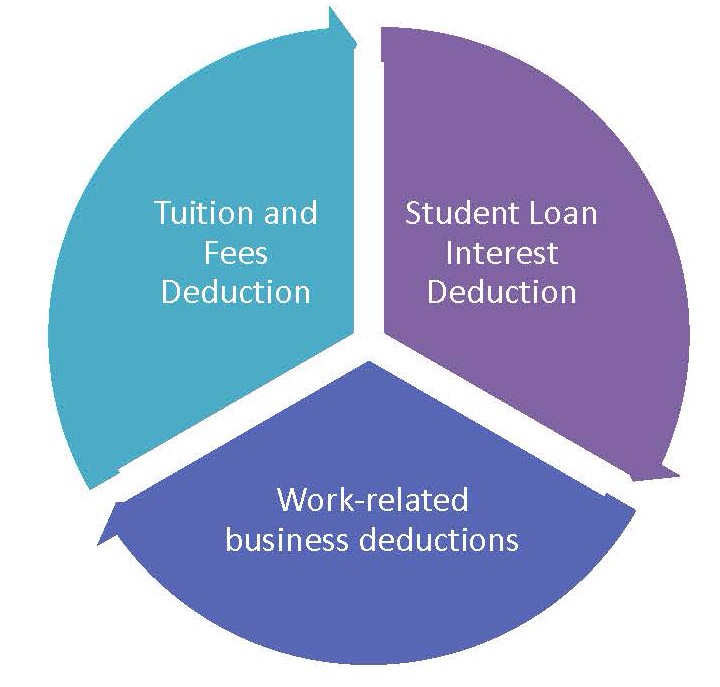
The diagram below depicts the education-related tax deductions that may be available for parents. The work-related business deductions are beyond the scope of today’s lesson and will be discussed in the near future.
Tuition and Fees Deduction
|
Pros |
Cons |
| Deduct qualified education expenses paid during the year for yourself, your spouse or your dependent. | You cannot claim this deduction if your filing status is married filing separately or if another person can claim an exemption for you as a dependent on his or her tax return. |
| Can reduce the amount of your income subject to tax by up to $4,000. | The qualified expenses must be for higher education. |
| You can claim this deduction even if you do not itemize deductions. | Deduction is phased out if your modified adjusted gross income (MAGI) is more than $80,000 ($160,000 if filing a joint return). |
| Student-activity fees and expenses for course-related books, supplies and equipment are included in qualified education expenses only if the fees and expenses must be paid to the institution as a condition of enrollment or attendance. | Cannot be claimed if you were a nonresident alien for any part of the year and did not elect to be treated as a resident alien for tax purposes. |
Student Loan Interest Deduction
|
Pros |
Cons |
| Can reduce the amount of your income subject to tax by up to $2,500. | Deduction is phased out if your modified adjusted gross income (MAGI) is less than $75,000 ($150,000 if filing a joint return), |
| You can claim this deduction even if you do not itemize deductions. | Must be a qualified student loan. |
Example – Tax Deduction
A married couple has a total TAXABLE income is $15,000, which results in a tax bill of $1,500 (10% tax bracket). One spouse took a few courses during the year, for a total tuition and fees of $3,000. The couple is ineligible for the American Opportunity Tax Credit because both spouses have undergraduate degrees. The couple is able to claim the lifetime learning credit.
Total Taxable Income $15,000
Less: Tuition and Fees Deduction <3,000>
Taxable Income after Deduction $12,000
Total tax $12,000 x 10% $1,200 <<< tax bill 😦
Resources:
FinAid – (http://www.finaid.org/otheraid/tax.phtml) – The smart student guide to financial aid.
Important terms from this lesson:
|
Term |
Definition |
| Tax Credit | Reduces the amount of income tax you may have to pay dollar-for-dollar. |
| Tax Deduction | A deduction reduces the amount of your income that is subject to tax, thus generally reducing the amount of tax you may have to pay. |
| Gross Income Exclusion | No tax is paid on the benefit. |
| Qualified Student Loan | loan you took out solely to pay qualified education expenses |
Action Step: Find out if you are eligible to claim an Education Credit
Use the IRS Interactive Tax Assistant to see if you are eligible to claim an education credit.
This application will help you determine if you are eligible for certain educational credits or deductions including the American Opportunity Credit, the Lifetime Learning Credit and the Tuition and Fees Deduction.
 Education and Action