Today is the deadline to enroll in the Affordable Care Act and get covered for 2014. This is the most important lesson for you and your family today, especially if you are NOT covered. You have until MIDNIGHT to get covered.
Each Saturday, I will find ways to encourage you to reach your goals. Whether it’s a video, an inspirational message, a poem, or whatever…I want to keep you focused on achieving your goals. Remember that you are the sun and you will provide the light for the people around you to believe. By embarking on this journey, you have already proven that you are a standout in the crowd, a leader. You have shown the desire and willingness to improve your life by implementing new strategies and lessons. I strongly believe that you will be the catalyst for a seismic shift in your family.
Today, our encouragement comes from Amar’e Stoudemire who wants to inspire a new generation to read, namely middle school boys. You may know him as the superstar power forward for the New York Knicks, but he is much more than a basketball player. I am always looking for encouragement from wherever I can find it. Earlier today, I saw a broadcast which featured Amar’e and his book series called Stat. I was especially intrigued because African American men are often portrayed as pariahs, which ignores all of the wonderful contributions that they make to our society. Those generalizations enrage me because there are men like Amar’e who are doing remarkable things and leading by example. When so much negativity is highlighted in the media and our culture, I wanted to shed light on a gentleman who has defied all odds to become a great role model for men and boys.
Order these books for the boys in your life. STAT: STANDING TALL AND TALENTED BOOK #1: HOME COURT
By Amar’e Stoudemire
Scholastic Paperbacks
Publication Date: August 1, 2012 STAT: STANDING TALL AND TALENTED BOOK #2: DOUBLE TEAM
By Amar’e Stoudemire
Scholastic Paperbacks
Publication Date: October 2012
STAT: STANDING TALL AND TALENTED BOOK #3: SLAM DUNK
By Amar’e Stoudemire
Scholastic Paperbacks
Publication Date: January 2013
To order books, visit your favorite book retailer.
Have a beautiful Saturday!
Action Step: Be encouraged and do not forget to Feed The Pig!
Watch out parents – your kid is watching you! With that piece of information, you should realize that kids mimic the behavior of their parents. Frugal parents raise frugal children. Extravagant parents raise extravagant children. Pensive parents raise pensive children. I think you get the picture. What that teaches is that kids will learn to save or spend based on the example that you provide for them. Today’s lesson is to give you a fun tool to help teach your child about smart spending habits.
Action Step: Print and complete the Spending Smarts Word Search with your child. Split up the words between you and your child. Once completed, ask your child to explain their understanding of the words that they were given.
“What’s in a name? that which we call a rose
By any other name would smell as sweet.” – William Shakespeare
Why would you NOT incorporate?
Yesterday, I asked you why you would incorporate. Today, we will examine why some businesses opt to form a partnership or LLC in lieu of a corporation. What’s in a name? Well, if there are two or more people involved in this entity, the question will likely be – nothing! But beware of the default button! Who’s on first – partners or members?
Education:
Partnerships
A partnership is the relationship existing between two or more persons who join to carry on a trade or business. Each person contributes money, property, labor or skill, and expects to share in the profits and losses of the business.
Types of Partnerships
1. General Partnership (GP) – Beyond the scope of this lesson
2. Limited Partnership (LP) – Beyond the scope of this lesson
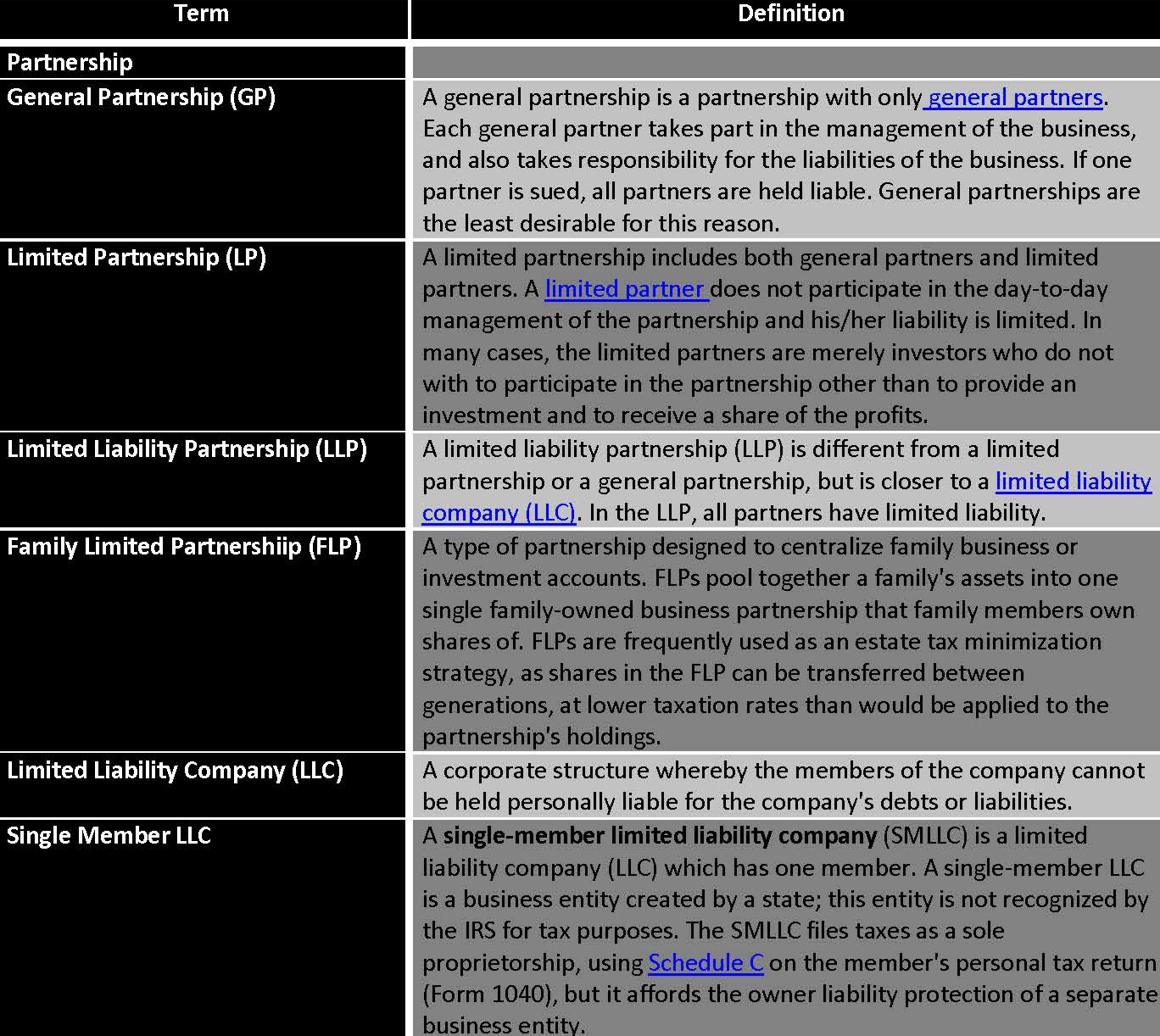
3. Limited Liability Partnership (LLP) – See comparison chart below
4. Family Limited Partnership (FLP) – To be discussed in a future lesson
Limited Liability Company
A Limited Liability Company or LLC is a figment of your imagination. Well, sort of! Let me explain. Did you know that the Internal Revenue Service (IRS) does not recognize the LLC as an entity form? That’s a great bit of trivia to try out at the next cocktail party. No, the LLC is a function of state law, which simply means that it was created and envisioned by the state. As a result, you must apply to be an LLC with the Department of State in your jurisdiction. Formally, an LLC is a hybrid business organization that mixes the best of corporations, partnerships, and sole proprietorships. This legal structure offers the greatest level of flexibility and is a preferred structure for certain industries.
Types of Limited Liability Companies
1. Single Member LLC
2. Multi-Member LLC (partnership by default, and S or C Corporation (by election)
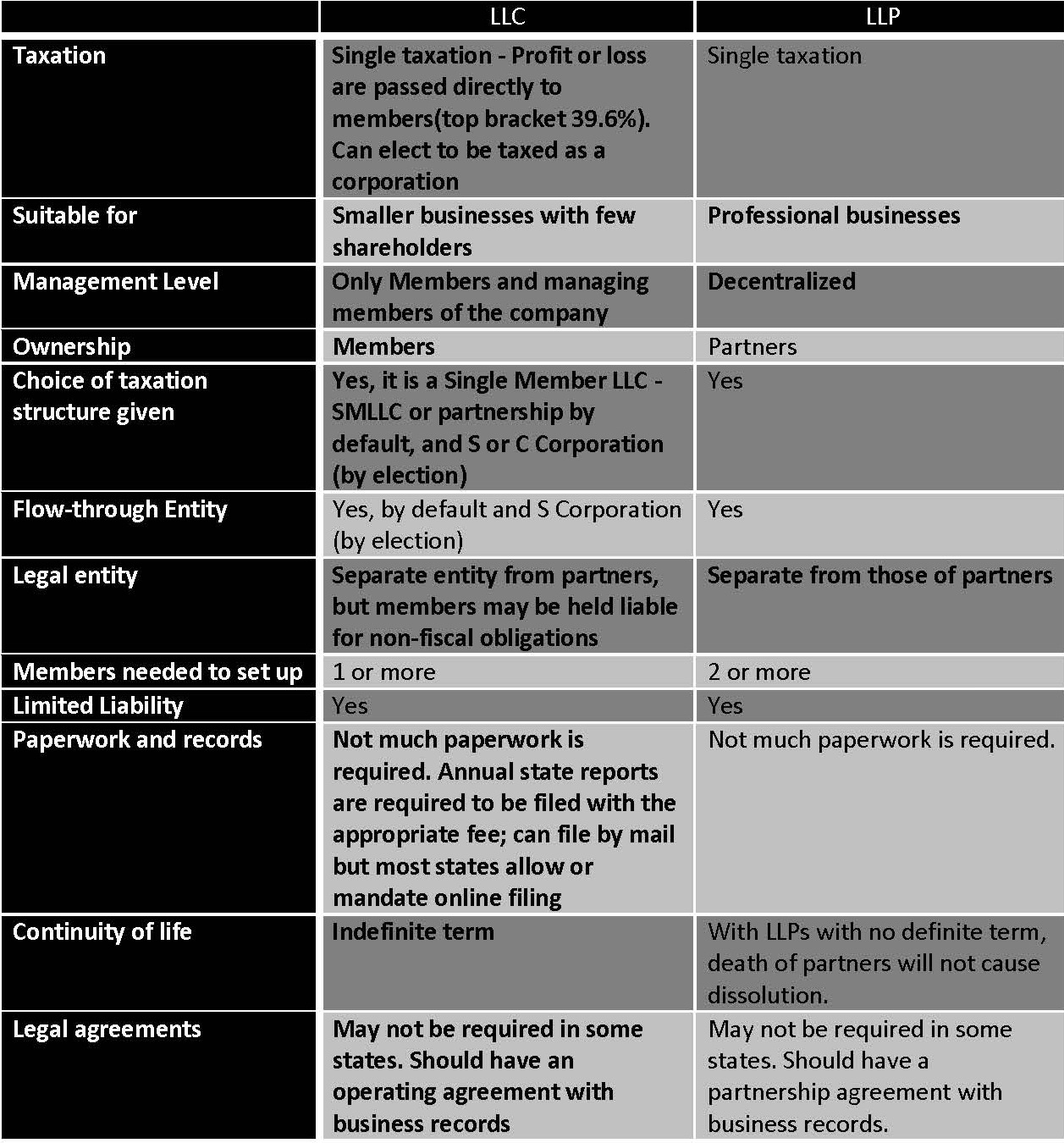
LLC vs LLP Comparison Chart
We just scratched the surface of this fairly complicated area of tax law. There are many more characteristics that differentiate the LLC from the partnership, including the preferred structure based on your industry. However, discussion that is beyond the scope of this lesson.
For more information or a free consultation of Entity Choice, visit me at http://www.kmsykescpa.com.
Resources:
• Legalzoom.com – Find resources and information to set up your partnership or LLC.
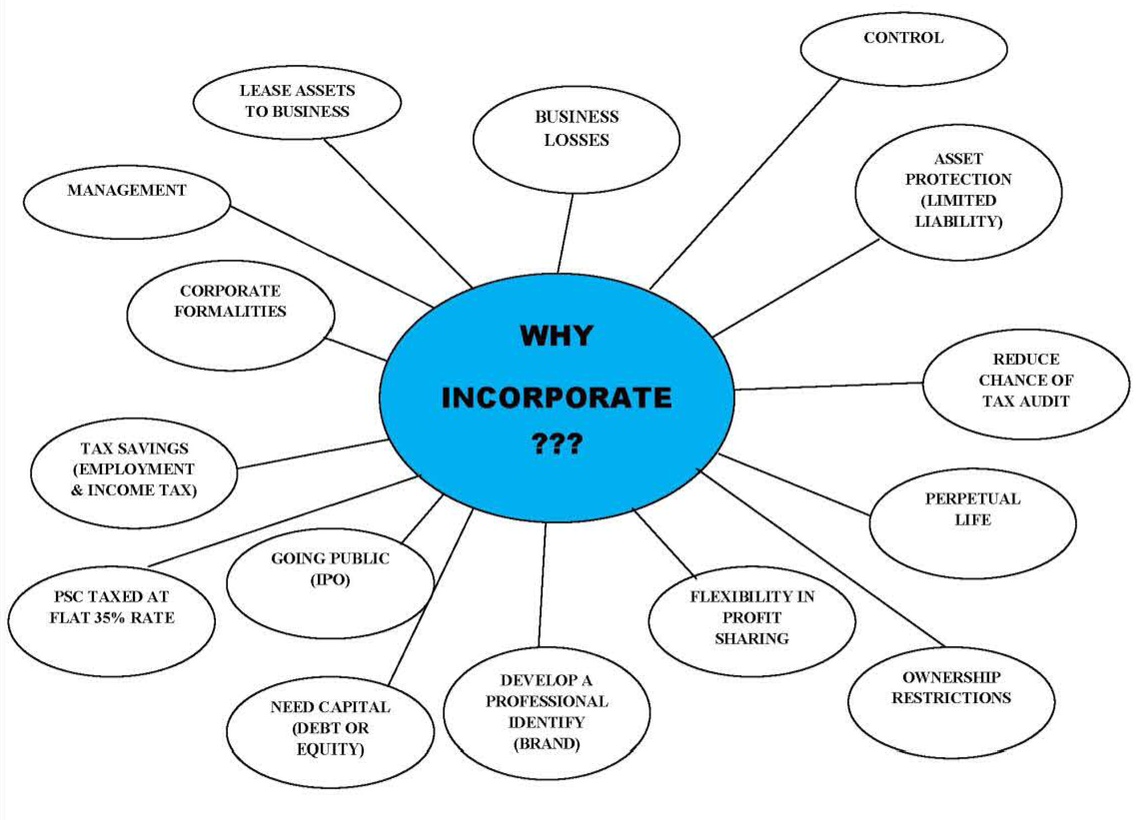
The answer to this question is usually – “because someone told me to”. Choosing the right legal structure for your business is the most important question that a new business owner must answer. This is an area where many costly mistakes are made by business owners and some overzealous tax preparers, who are not well versed in this area. When determining which legal structure makes the most sense for you, it is important to understand the tax and nontax factors to consider when making your decision. About four years ago, I created this diagram as a discussion piece for a lecture to a class of aspiring entrepreneurs. Of course, this chart was like hieroglyphics to them because they had no idea that there were so many factors to consider when starting a business. Today, we will discuss the merits of operating your business as a corporation.
Education:
A Corporation is a legal entity that is separate and distinct from its owners. Corporations enjoy most of the rights and responsibilities that an individual possesses; that is, a corporation has the right to enter into contracts, loan and borrow money, sue and be sued, hire employees, own assets and pay taxes. The most important aspect of a corporation is limited liability. That is, shareholders have the right to participate in the profits, through dividends and/or the appreciation of stock, but are not held personally liable for the company’s debts.
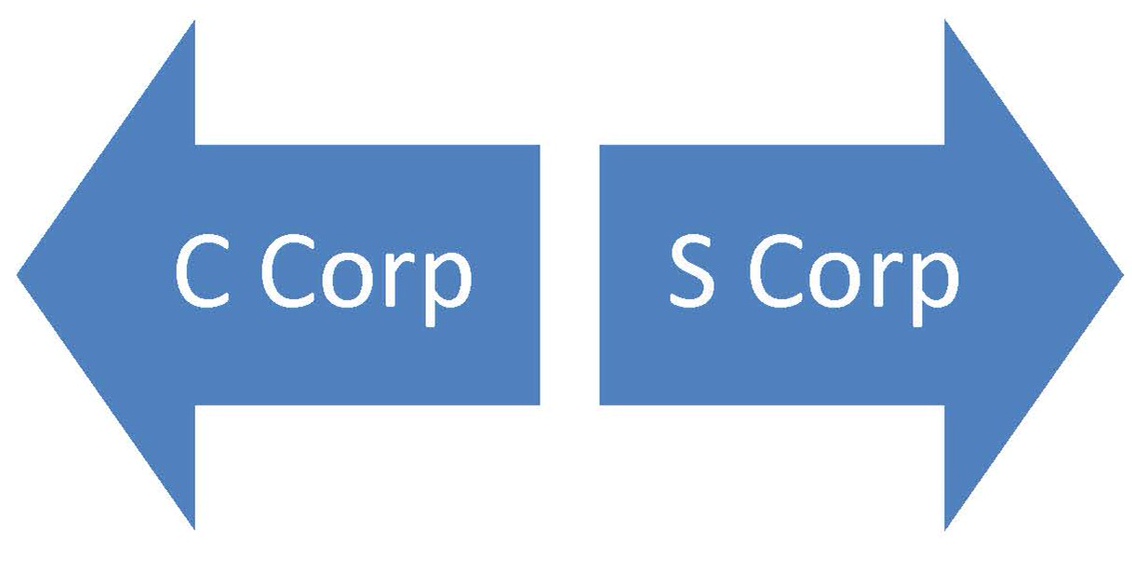
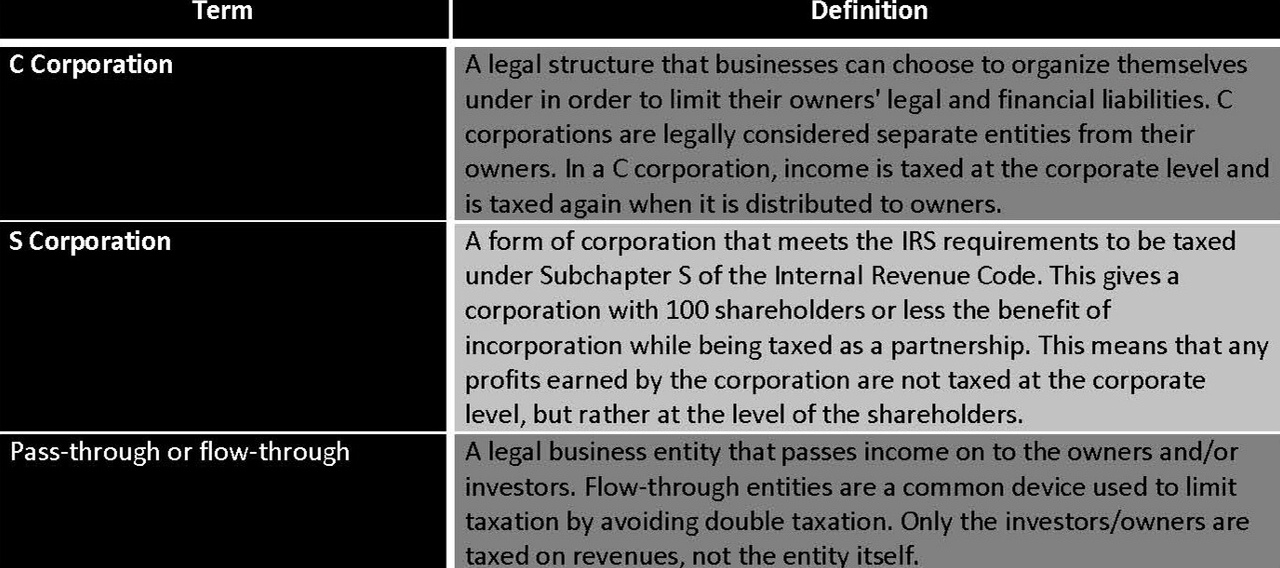
There are two types of corporations: “C Corporations” and “S Corporations”. The moniker comes from the section of the Internal Revenue Code which governs the legal business entity – Subchapter C or Subchapter S of the 1986 Code.
C or S Corporation choice is critical for small business. This choice is of C vs. S status is all about taxes. By default, when a business formally incorporates, it becomes a C Corporation. The S Status is a special category reserved for eligible businesses where they can elect to be taxed the same as an LLC or partnership. In other words, the S status gives a corporation the opportunity to be taxed as a “pass-through or flow-through” entity is a legal business entity that passes income on to the owners and/or investors. Flow-through entities are a common device used to limit taxation by avoiding double taxation. Only the investors/owners are taxed on revenues, not the entity itself. The chart below shows some of the differences between the two types of corporations.
There are additional nuances to the C vs. S Conuudrum that are beyond the scope of this lesson. In the next lesson, we will discuss the LLC vs. the Partnership as the final legal business structure options available to business owners.
Resources:
• The Company Corporation (www.incorporate.com) – Find resources and information to incorporate your business.
Choosing the right legal structure for your business is the most important question that a new business owner must answer. This is an area where many costly mistakes are made by business owners and some overzealous tax preparers, who are not well versed in this area. As far as the tax landscape goes, a business may as well be in another universe when it comes to taxes. But taxes are not the only factor to consider when choosing a structure for your business. Over the next few lessons, we will delve into this topic to give you the information needed to make the right decision.
Education:
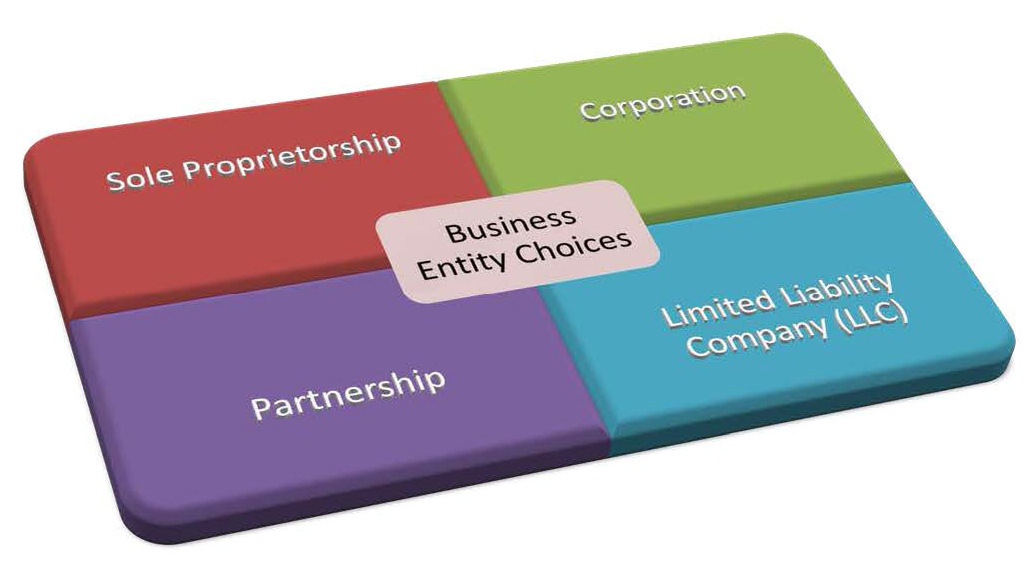
There are four primary entity choices that you can use to operate your business.
1. Sole Proprietorship
2. Corporation (C Corp or S Corp)
3. Limited Liability Company (LLC)
4. Partnership
Within the LLC and Partnership are some additional options, but that is beyond the scope of this lesson. For now, we will focus on these four entity choices. In today’s lesson, we will begin with entity choice #1 – Sole Proprietor.
Sole Proprietorship
A sole proprietorship is the simplest and most common structure chosen to start a business. It is an unincorporated business owned and run by one individual with no distinction between the business and you, the owner. You are entitled to all profits and are responsible for all your business’s debts, losses and liabilities.
Forming a Sole Proprietorship
You do not have to take any formal action to form a sole proprietorship. As long as you are the only owner, this status automatically comes from your business activities. In fact, you may already own one without knowing it. If you are a freelance writer, for example, you are a sole proprietor.
If you choose to operate under a name different than your own, you will most likely have to file a ficticious name (also known as an assumed name, trade name, or DBA name, short for “doing business as”). You must choose an original name; it cannot already be claimed by another business.
Sole Proprietor Taxes
Because you and your business are one and the same, the business itself is not taxed separately-the sole proprietorship income is your income. You report income and/or losses and expenses with a Schedule C and the standard Form 1040. The “bottom-line amount” from Schedule C transfers to your personal tax return. It’s your responsibility to withhold and pay all income taxes, including self-employment and estimated taxes.
Advantages of a Sole Proprietorship
• Owners can establish a sole proprietorship instantly, easily and inexpensively.
• Sole proprietorships carry little, if any, ongoing formalities.
• A sole proprietor need not pay unemployment tax on himself or herself (although he or she must pay unemployment tax on employees).
• Owners may freely mix business or personal assets.
Disadvantages of a Sole Proprietorship
• Owners are subject to unlimited personal liability for the debts, losses and liabilities of the business.
• Owners cannot raise capital by selling an interest in the business.
• Sole proprietorships rarely survive the death or incapacity of their owners and so do not retain value.
In the next lesson, we will discuss entity choice #2 – Corporation.
Resources:
• IRS.gov (Small Business and Self Employed) – Find resources and information about legal business structures.
Important terms from this lesson:
Term
Definition
Sole Proprietorship
A sole proprietorship is the simplest and most common structure chosen to start a business.
Do you have the capital to start your business? For most aspiring business owners, the answer to this questions is usually no. Sure, there are some who will pursue entrepreneurship after a successful career in another area where they were able to build a war chest to use to fund their new dream. But, for most aspiring business owners, there is no war chest available. So what now? Well, since you don’t own a money tree, you need to learn about the options available to you.
Education:
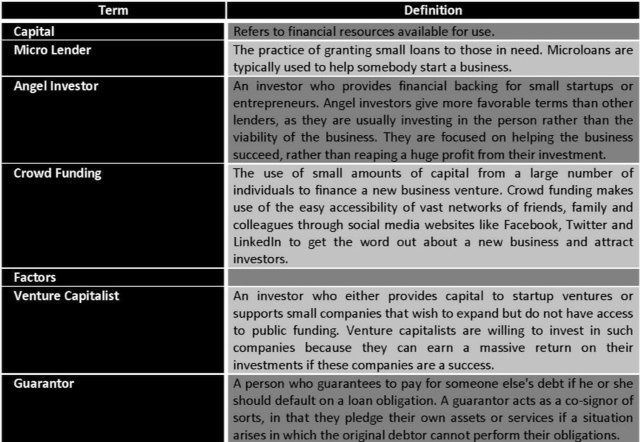
One of the most critical factors to the success of any business is access to capital. Capital refers to financial resources available for use. Capital is different from money. Money is used simply to purchase goods and services for consumption. Capital is more durable and is used to generate wealth through investment. In this case, the investment is a business.
In today’s lesson, we will continue discussing the merits of business owners as a path to wealth. In Lesson #59, I introduced the business plan. One of the purposes of a business plan is to provide a document of your capital needs. Once you have an idea of the amount of capital that you will need to get started, the next step is to – find the money.
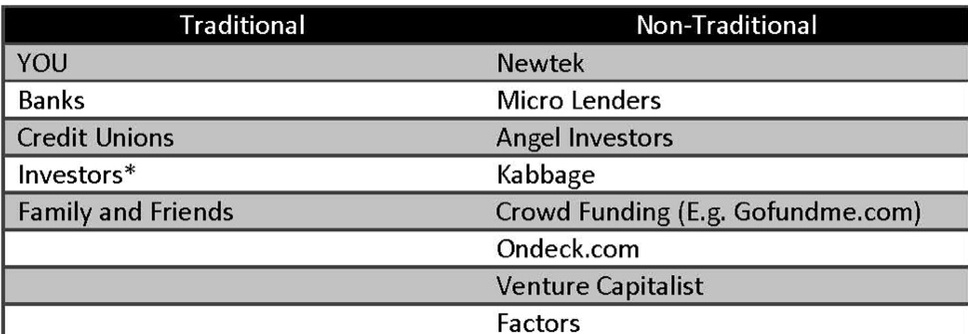
There are many ways to raise capital – traditional sources and non-traditional sources. The chart below lists the sources that are currently available to aspiring and established business owners.
*Beware – Investors are not free!
Common Misconception about SBA Loans
One common misconception is the you can get a loan from the Small Business Administration (SBA). Let’s be clear, the SBA is not a lender and does not lend money. The SBA is a guarantor, which means that they guarantee loans (up to a limit) made by other approved lenders. Access to capital is the bedrock of business growth and viability. From the ability to satisfy working capital needs, to expansion, to exploring new business opportunities, to hiring employees, the availability of capital is the predictor of the business’ ability to thrive. Use the chart to learn about the different financing options available to you.
Resources: Newtek (thesba.com) – The Small Business Authority offers SB loans from $50,000 to $10 million.
Kabbage.com – Kabbage provides working capital to small businesses. From online sellers to brick and mortar stores, Kabbage services every type of small business. Banks take weeks to decide on an advance and merchant cash advance companies take days. Kabbage delivers funds in 7 minutes. Ondeck.com– Ondeck delivers small business loans using the OnDeck Score™ technology,
which focuses on the health of your business – not your personal credit score.
Important terms from this lesson:
Action Step: Go through the chart of Traditional vs. Non-traditional sources and find out which option works best for you. Refer to the Resources and Important Terms sections for assistance.
Each Saturday, I will find ways to encourage you to reach your goals. Whether it’s a video, an inspirational message, a poem, or whatever…I want to keep you focused on achieving your goals. Remember that you are the sun and you will provide the light for the people around you to believe. By embarking on this journey, you have already proven that you are a standout in the crowd, a leader. You have shown the desire and willingness to improve your life by implementing new strategies and lessons. I strongly believe that you will be the catalyst for a seismic shift in your family.
Today, our encouragement comes from Bishop TD Jakes and his life changing series, Living on Purpose. I recall the first time that I heard the original sermon. I was simply blown away. I ordered the series on CD and I listened to it over and over; picking up a new piece of information to apply to my life. This man is simply remarkable, a godsend, and each morning I rise and begin my day with him and The Potters Touch. Please be inspired to Live on Purpose.
Have a beautiful Saturday!
Action Step: Be encouraged and do not forget to Feed The Pig!
Sometimes, the things you want cost more money than you have. What do you do? You can either save up by not spending on other items, or you can try to earn some extra money.
With a little work, a little creativity and an okay from your parents, you can start adding to your piggy bank.. Here are a few ideas to get you started:
Help out more at home.
Ask your parents if you can help with any big projects around the house: cleaning or organizing the garage, basement, or attic. Or you can help tidy closets, straighten up the laundry area. You can think of more.
Help people take care of their yards.
Tell your neighbors that you would like to be their helping hand. Offer to help with grass-cutting, snow shoveling or leaf-raking. You can pull weeds, water lawns, or pick up branches during spring clean-up. Make flyers and drop them off at houses in your neighborhood.
Wash cars.
Turn your driveway into a neighborhood car wash.
Babysit little kids.
Once you’re legally old enough, take a babysitting class. Local hospitals usually offer these classes. Parents are always looking for a good sitter.
Start a dog-walking service.
Feed, watch or walk dogs. If you’re really responsible, you might offer to care for other people’s pets — like lizards and birds —while they’re busy or away from home.
Sell unwanted items.
Set up a “rummage sale.” Some parks and schools hold big rummage sales. You could be a part of them. Some stores sell “used” toys and clothes. Ask your parents about this idea. They can help you find a store in your neighborhood.
Sell candy or bakery.
Bake some cookies and brownies and sell them at events.
(Source: Themint.org)
Resources:
Themint.org – the site provides tools to help parents as well as educators teach children to manage money wisely and develop good financial habits: the building blocks for a secure future.
Important term!s from this lesson:
Term
Definition
FUN
No definition needed!
Action Step: Help your child earn some extra cash for spring break!
Take the Be Your Boss Challenge (from TheMint.com) – click below to begin:














 Education and Action