Do you have junk in your money trunk?
As we continue our discussion on bonds, it must be noted that not all bonds are created equal. Like people and everything else in life, there are good bonds (investment grade) and there a bad bonds (junk). In this lesson, we will introduce two features that will help you pick the right bond for your portfolio.
Education:
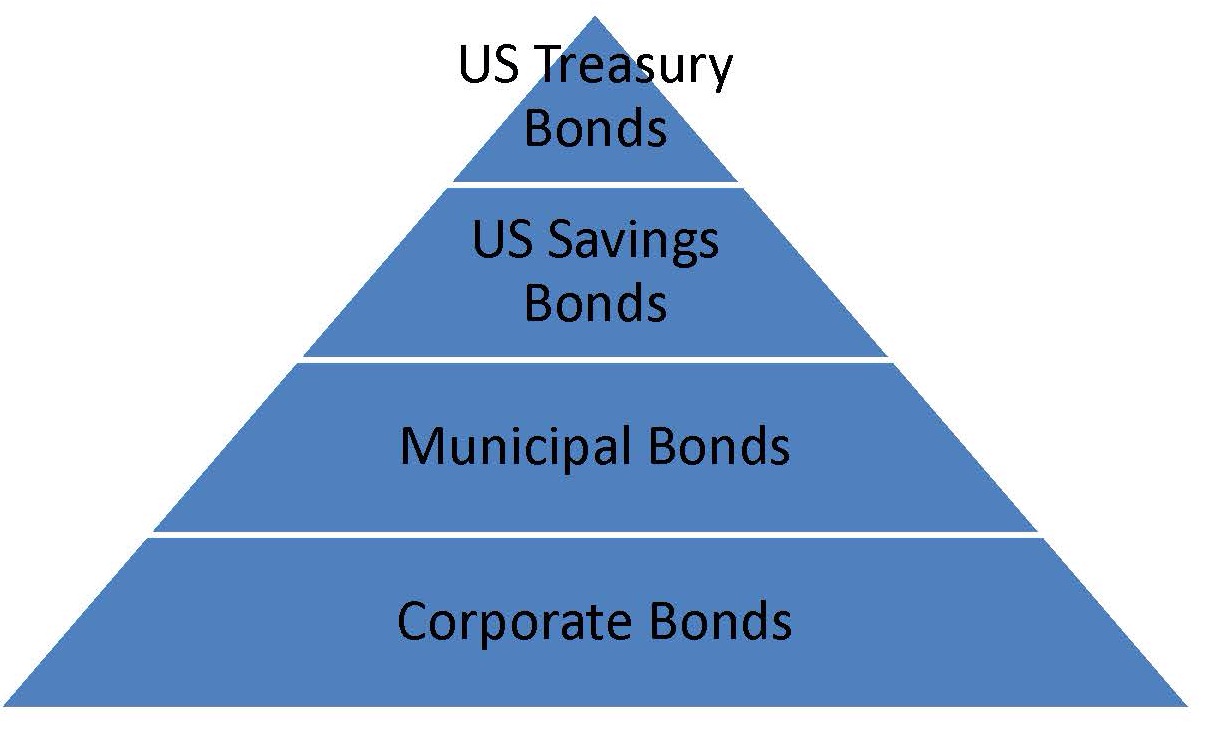
A bond is best known for its two features – quality and duration. The quality of the bond speaks to its safety or the risk of default. Yesterday, I told you that the safest bond was the US Treasury Bond. Because the US Government can print money, there is no possible risk of default. The more susceptible a bond is to default, the lesser the quality. This quality is expressed in a term called, bond or credit rating.
Think of a bond or credit rating like school grades. If you are an A student, that typcially means that you are an excellent student and a college would be wise to offer you a full scholarship. On the other hand, if you are an F student, that means that you may not be a great student and a college would take a large risk to offer you a scholarship when there are other A students available. I know that’s a pretty tough analogy, but you get the picture.
To illustrate the bond ratings and their meaning, we’ll use the Standard & Poor’s format:
Investment Grade
AAA and AA: High credit-quality investment grade
AA and BBB: Medium credit-quality investment grade
Junk Bonds
BB, B, CCC, CC, C: Low credit-quality (non-investment grade), or “junk bonds”
D: Bonds in default for non-payment of principal and/or interest
Naturally, AAA bonds would be considered the highest quality. That’s pretty easy to follow, so let’s move on to the second feature.

The second feature of the bond is its duration, the period expressed from the date of purchase to the date of maturity.
Duration = Purchase Date – Maturity Date
Example: Hint – It’s not rocket science!
A 90-day bond would mature in…you guessed it…90 days. That means that if you purchased the bond for $100 (its face value or par value), in exactly 90 days, the bond would mature and you would receive the face value or par value of the bond, $100 plus whatever interest was earned during that period.
A 1-year bond would mature in…you guessed it…1 year. That means that if you purchased the bond for $100 (its face value or par value), in exactly 1-year, the bond would mature and you would receive the face value or par value of the bond, $100 plus whatever interest was earned during that period.
Of course, the longer the duration, the higher the coupon (interest) rate that you would have to be offered to tie up your money. Let’s test your understanding of duration and quality using three scenarios.
Scenario #1 – Enron is issuing a 5-year bond with a D rating with a coupon rate of 8.0%.
Scenario #2 – US Government is issuing a 5-year bond with an AAA rating with a coupon rate of 1.48%.
Scenario #3 – The City of Detroit is issuing a 5-year bond with a BB rating with a coupon rate of 2.5%
Which bond would you choose based on quality and duration?
It makes sense for Enron to offer the highest coupon rate because it has the lowest quality. The company would have to offer a fairly high rate to entice you to invest your hard-earned money into something so risky. However, Enron is offering the best return on your money. So what do you do?
The first thing that you need to do is to figure out what type of investor you are. Are you a RISK SEEKER or are you RISK ADVERSE (See Lesson #14)?
Second, do your research! There is no shortage of information available to help you research bond options. A great place to start is by reviewing the bond or credit ratings. This is easy because there are companies that do the research for you. Companies like Standard & Poor’s, Moody’s and Fitch are great places to begin. These agencies provide a credit rating, or an opinion on the general creditworthiness of an issuer, or the creditworthiness of an issuer with respect to a particular debt security or other financial obligation. In other words, they vouch for quality of bonds.
Tomorrow, we will begin exploring the different types of bonds beginning with US Treasury Bonds.
Resources:
Standard & Poor’s (http://www.standardandpoors.com/ratings/en/us/): Publishes financial research and analysis on stocks and bonds.
Moody’s (https://www.moodys.com/researchandratings) – Publishes financial research and analysis on stocks and bonds.
Important terms from this lesson:
|
Term |
Definition |
| Bond or Credit Rating | A grade given to bonds that indicates their credit quality. |
| Bond Rating Agency | The agencies that provide the grades given to bonds. |
| Investment Grade | A rating that indicates that a municipal or corporate bond has a relatively low risk of default. |
| Junk Bond | Junk bonds are risky investments, but have speculative appeal because they offer much higher yields than safer bonds. |
| Face Value or Par Value |
In bond investing, face value, or par value, is commonly referred to the amount paid to a bondholder at the maturity date, given the issuer doesn’t default |
Action Step: Watch the video, An Introduction to Bonds, presented by Khan Academy.
 Education and Action